
MiniMax H3 or Seedance 2.5: Which Shots Go to Which Model
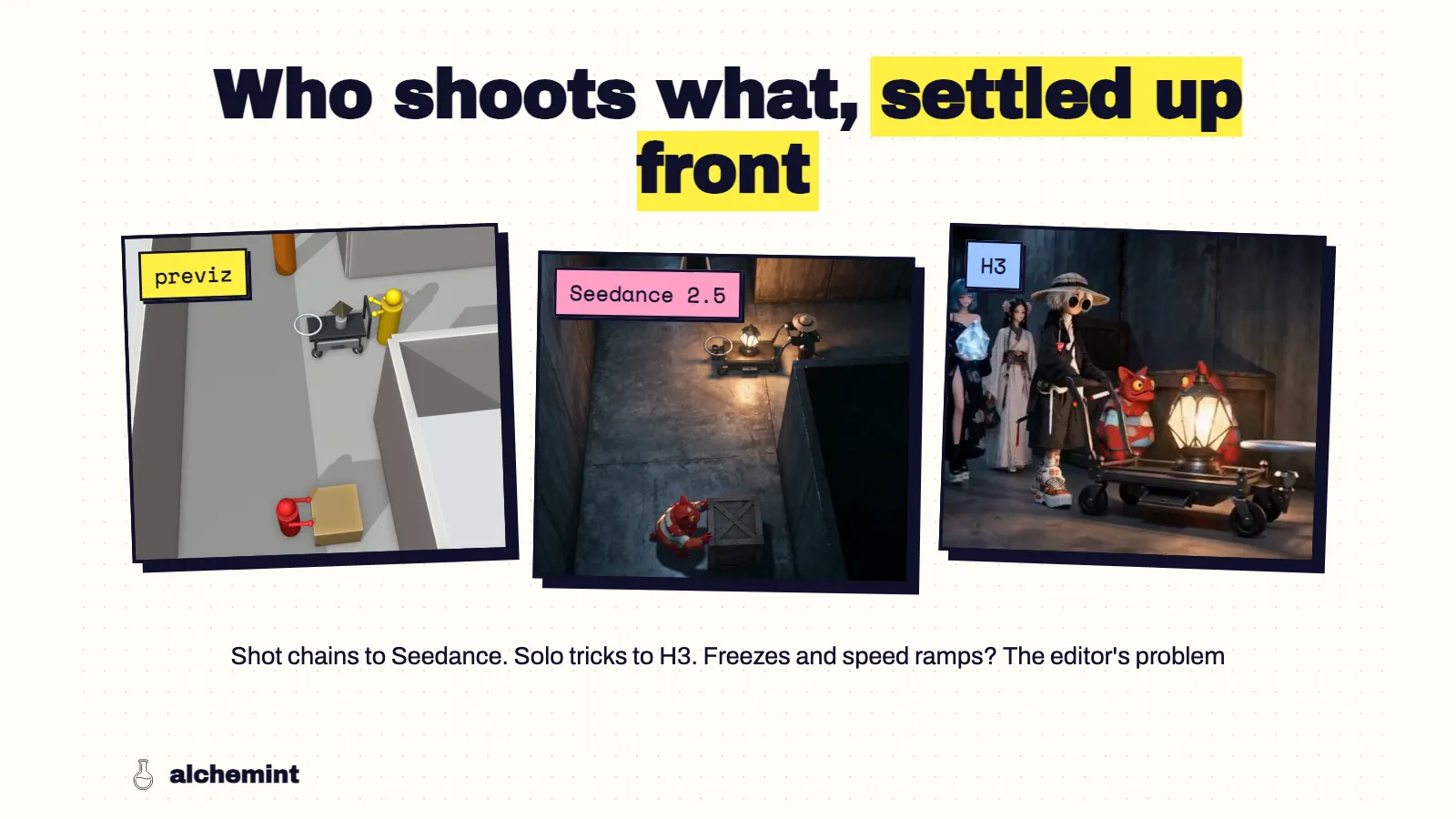
One previz batch, two models: Seedance 2.5 for sequences whose edit and environments come from the previz, H3 for single-shot techniques and inserts, the edit for what neither can do.
We ran the same Blender previz through two models: three open-source builds of MiniMax H3 on our own RTX 5090, and Seedance 2.5 as a paid service. After measuring both, I no longer pick one model per project. I split the previz by shot type.
Here's the split I use now.
| Shot type | Model | Why |
|---|---|---|
| Multi-shot sequence where the previz is already the edit | Seedance 2.5 | Hit 31 of 35 previz cuts to the frame and kept the previz's motion timing |
| Untextured previz whose environment must come out finished | Seedance 2.5 | Previz leaked into 2 of 32 units, against up to 13 of 39 for H3 |
| Single-shot camera technique: crane, pan, tilt, split screen, crash zoom | H3 | Kept in all six H3 conditions; quick and cheap to iterate locally |
| Insert of a prop with its own reference image | H3 | The box came back right in all six conditions, engraved text included |
| A cut you'll want to retime several times | H3 | Cuts follow the timestamps in the text, so a retime is a one-number edit |
| Freeze frame, dolly zoom, speed ramp | Neither | Failed or only partly worked in every H3 condition; do it in the edit |
The numbers behind each row are in the cut-timing article, the previz-leak article and the prompt article.
Why sequences go to Seedance
The clearest example is a T-junction. The previz opens on a top-down view of two groups converging, then cuts to a high oblique angle that keeps the cart, the stacked crates and the path between them in one frame. That second angle is how the audience learns which way is blocked.
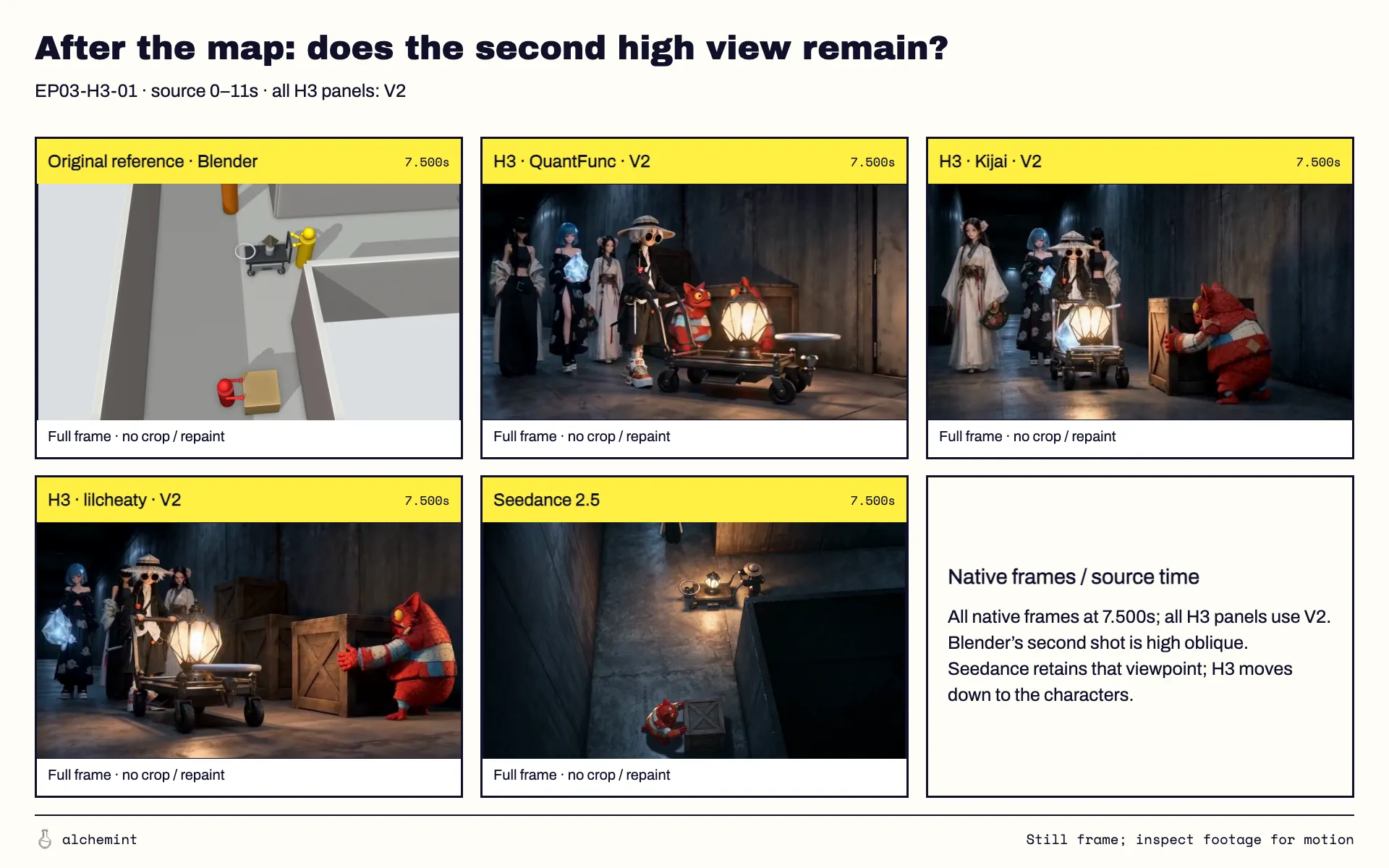
Seedance held both angles. All six H3 conditions got the top-down opening and then dropped to ground level for the second shot, framing the characters instead of the route. Each frame looks fine. As a sequence, it loses the information the previz was built to deliver.
That matches the measurements. Seedance keeps the previz's cuts and its motion timing; H3 keeps the events but re-stages them. For one shot that's often fine. For a chain of shots that depend on each other, it compounds.
Why single shots go to H3
H3 is strong inside one shot. Crane reveals, pans across a group, split screens, crash zooms and dissolves landed in every condition we ran. The fast QuantFunc build turns those around about 2.2 times faster than the 20-step builds, on hardware we already own. That's the loop I want for trying a technique three ways before committing. (If the names are fuzzy, the camera move guide defines each one.)
H3 also renders referenced props accurately, which makes it a good insert generator. The other reason to use it is editorial: because H3 cuts where the text says, I can try a cut at 4.0 seconds and 4.5 seconds by changing one number. Doing the same with Seedance means re-rendering the previz.
Seedance still needs supervision
Two Seedance takes changed something I'd asked it to keep.
- It added a camera angle. A cart chase was staged as one continuous same-side tracking shot that only changes speed. Seedance cut to a front view backing away, then to a side view. The handoff in the middle read cleanly. The geography was gone.
- It swapped characters in a long montage. A ten-character, three-location montage put the wrong character next to Pi on the roof, then put a cat-eared woman with teal eyes where Biwa should have been. Run through H3 as four-second excerpts, the same shots kept those identities.
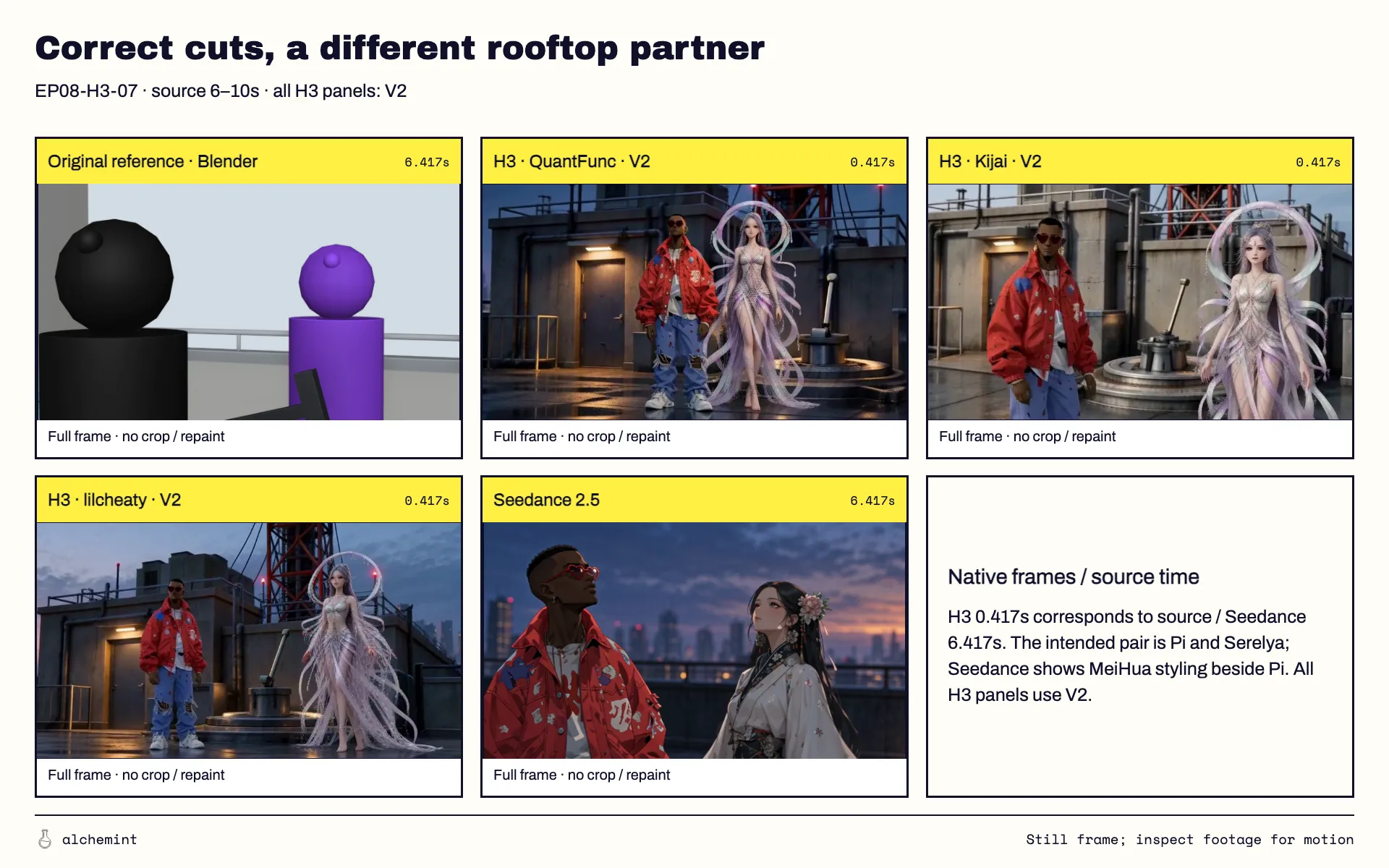
So I'd still split long multi-character montages into shorter generations, whichever model gets them, and state any camera condition Seedance must not change ("keep the same side of the cart for the whole shot").
Three checks before accepting any take
These caught more broken takes than any quality metric, on both models. Setting characters up so they pass is covered in the character-consistency guide.
- Who is in the shot. One H3 output cut from three characters to three characters, except one of them was now someone else. Counting heads didn't catch it.
- Who holds the prop. Another kept the box in the scene but gave it to the wrong character, so the next shot, where the right one lifts it, no longer connects.
- Whose accessory is whose. In one market close-up, five of the six H3 conditions put Shami's choker and pendant on Kai, although the prompt defined them separately.
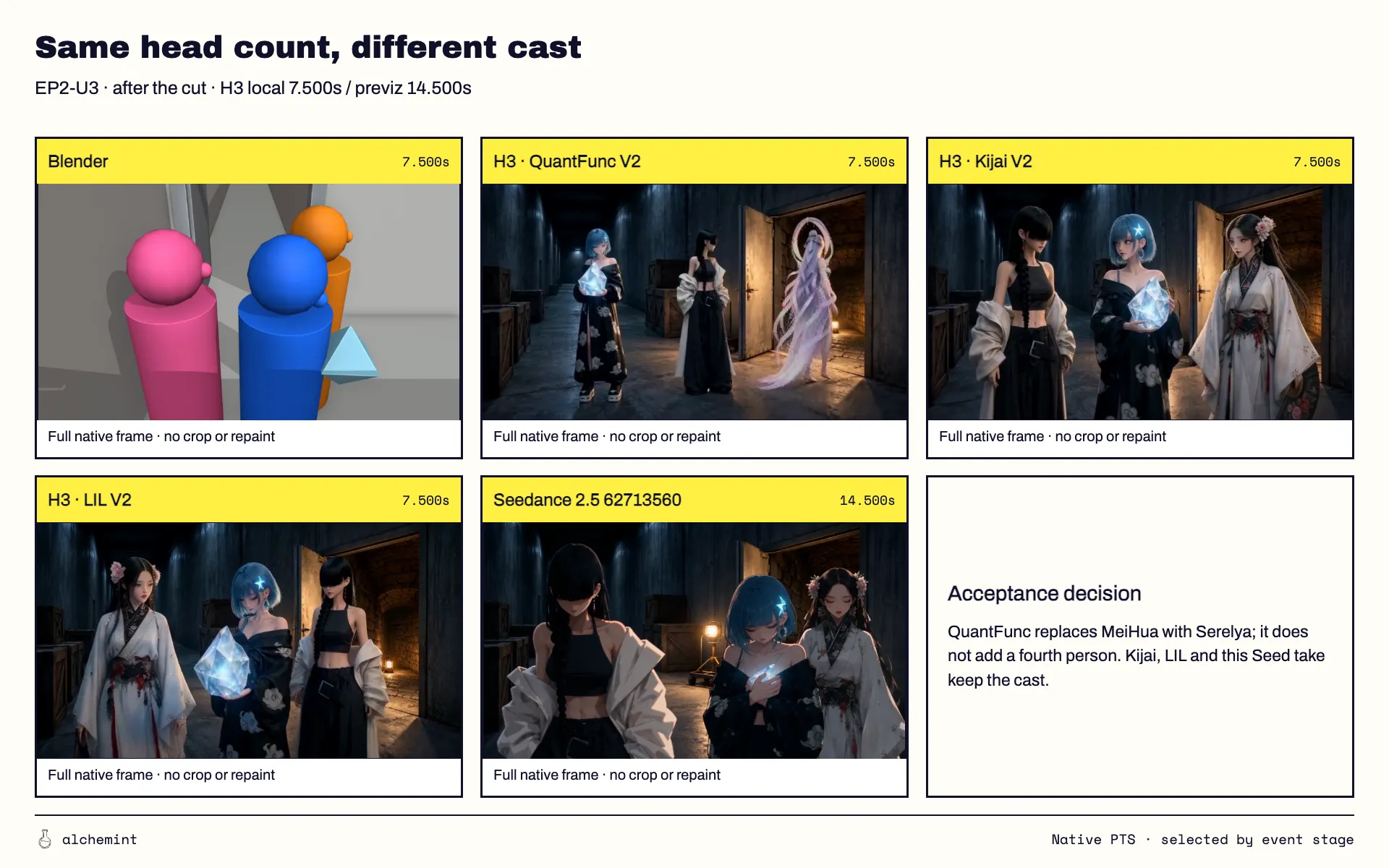
If the prop holder is cropped out of the frame, I count the take as unverified, not as passing.
If I could only pick one
For an untextured previz that's already cut the way I want, I'd give the whole sequence to Seedance and use H3 for inserts and technique tests. I'd reverse that only if the previz were rough staging I still wanted to edit heavily in text, or if the budget had to stay on local hardware. On this batch neither was true.
Conditions
The full setup is in the series opener. Technique results here come from 438 manual judgments; cut, motion and previz-leak numbers come from frame-by-frame measurement.