
AI Video Character Consistency Starts with a Character Sheet
Use Biwa, Suseka and MeiHua’s actual character sheets and footage to define recognisable traits, assign references and catch identity drift across shots.
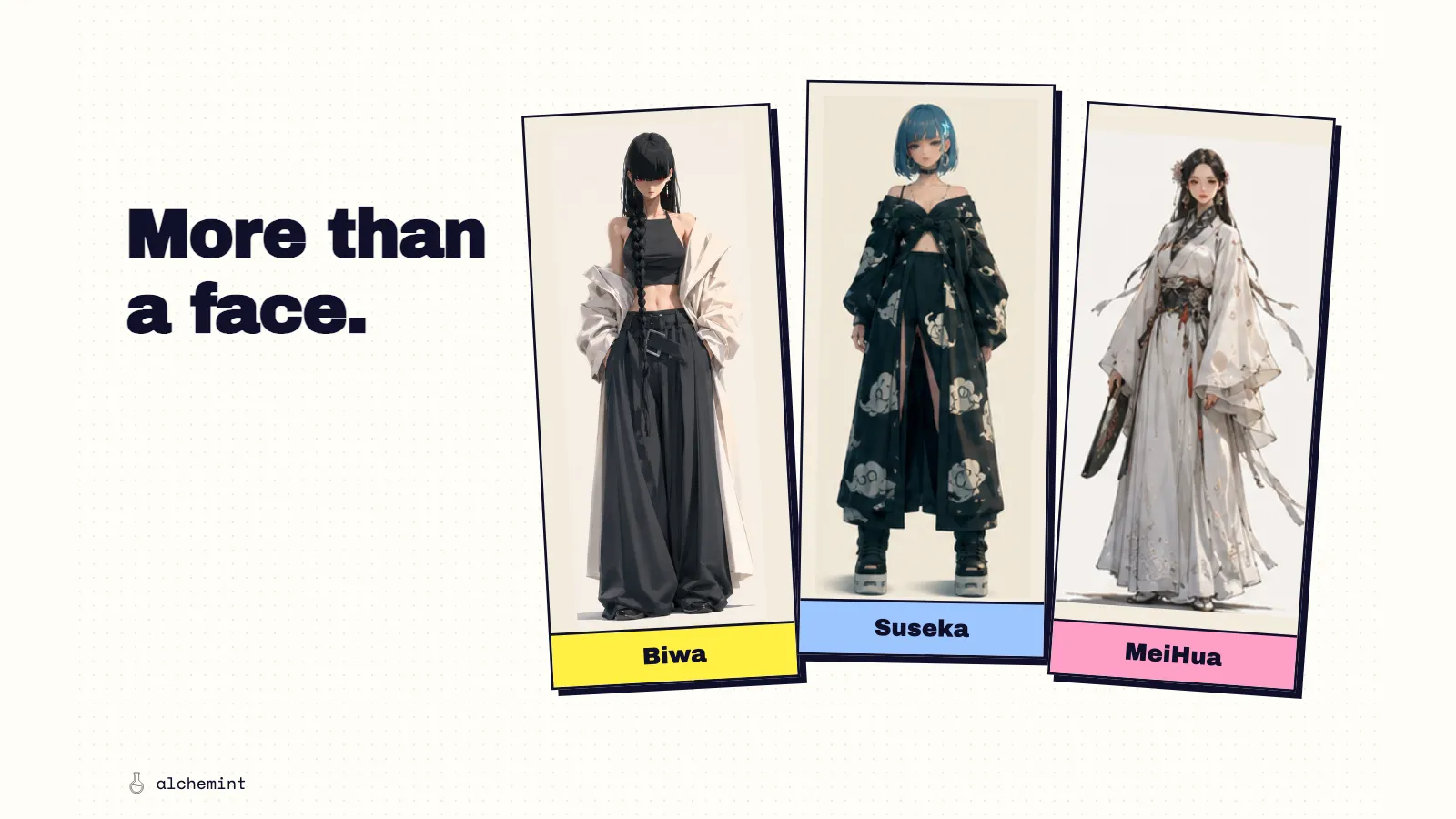
Biwa, Suseka and MeiHua move from a cold metal corridor into an archive, then through a tunnel to a lantern-lit market in our heist animation. Seedance 2.5 generates them again for each scene. The audience still has to recognise who carried the folder and who is now walking out with the box.
I start by establishing each character’s appearance in a character sheet, then reuse that reference across shots. Character consistency needs a visible standard that I can check. “The same woman” or “keep the character consistent” doesn’t decide which features must survive.
The three sheets below are the references used in production. We’ve rearranged crops from the original artwork to show the identifying features and different views, then compared them with generated footage. They gave us a cast we could reuse. They also let us name what went wrong.
Recognising Biwa when her fringe hides her eyes
Biwa has a heavy black fringe over her eyes and a thick braid down her front. A black halter crop top, wide pleated trousers and an off-white coat below her shoulders create a distinctive silhouette. Those features give us something to recognise even when her face occupies little of the frame.
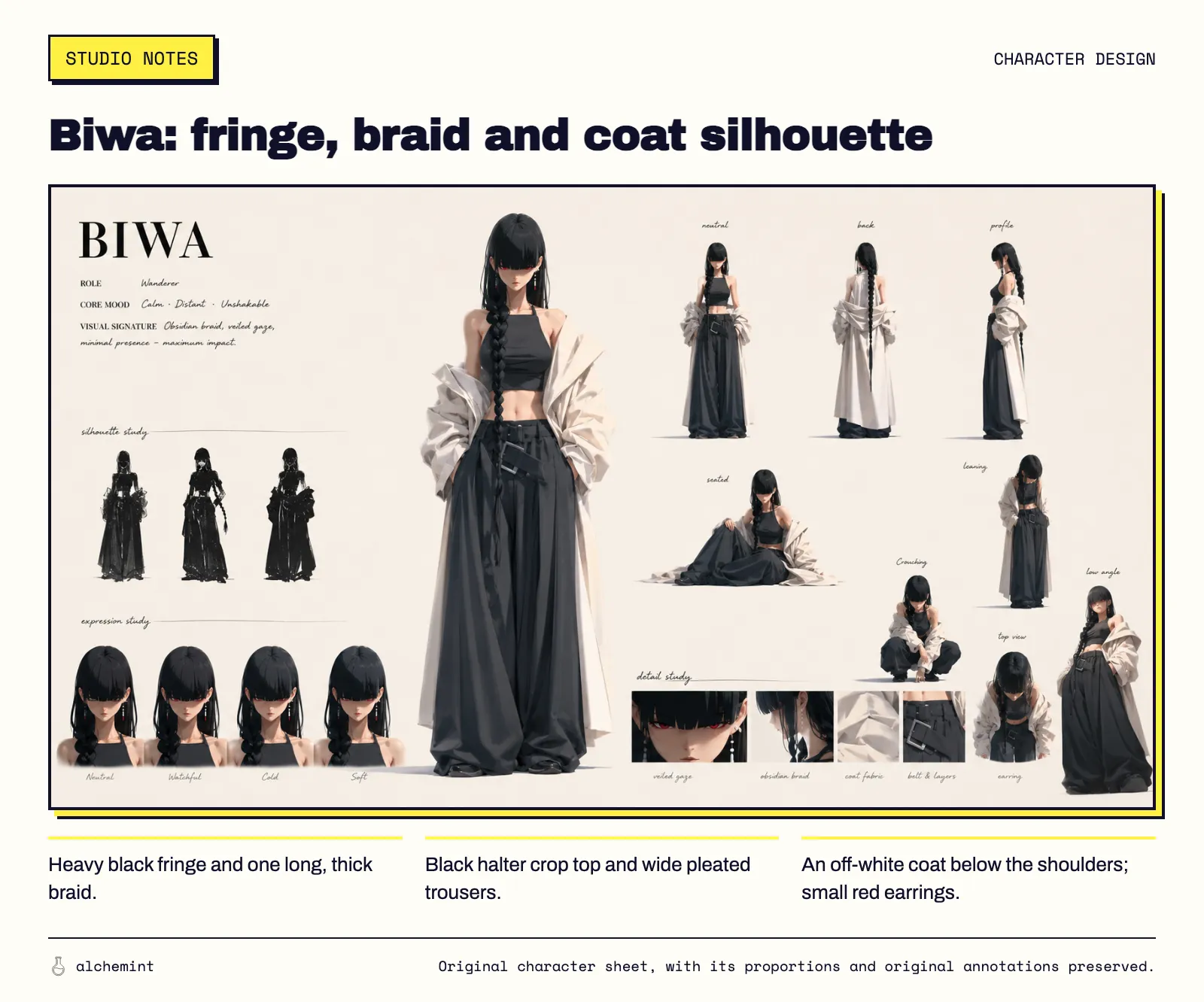
Biwa’s full-body, face and rear views come from one original character sheet. All of them define the same person.
The design also affects performance. Before asking her to communicate through her eyes, I need to know whether the shot can show them. The actual prompt for the keycard scene describes a sly smile beneath her fringe. The design stays in place; the expression uses a part of her face the audience can see.
I’d choose the recognition cues for a medium shot, a rear view and a close-up before generating those shots. A beautiful front-facing portrait leaves the turn away from camera undecided.
Suseka’s rear view exposes a gap in the written description
Suseka is immediately distinguishable by her blue bob, luminous star clip and large hoop earrings. Her black off-shoulder robe carries white cloud motifs. Look at the back view, though: she also has a long braid.
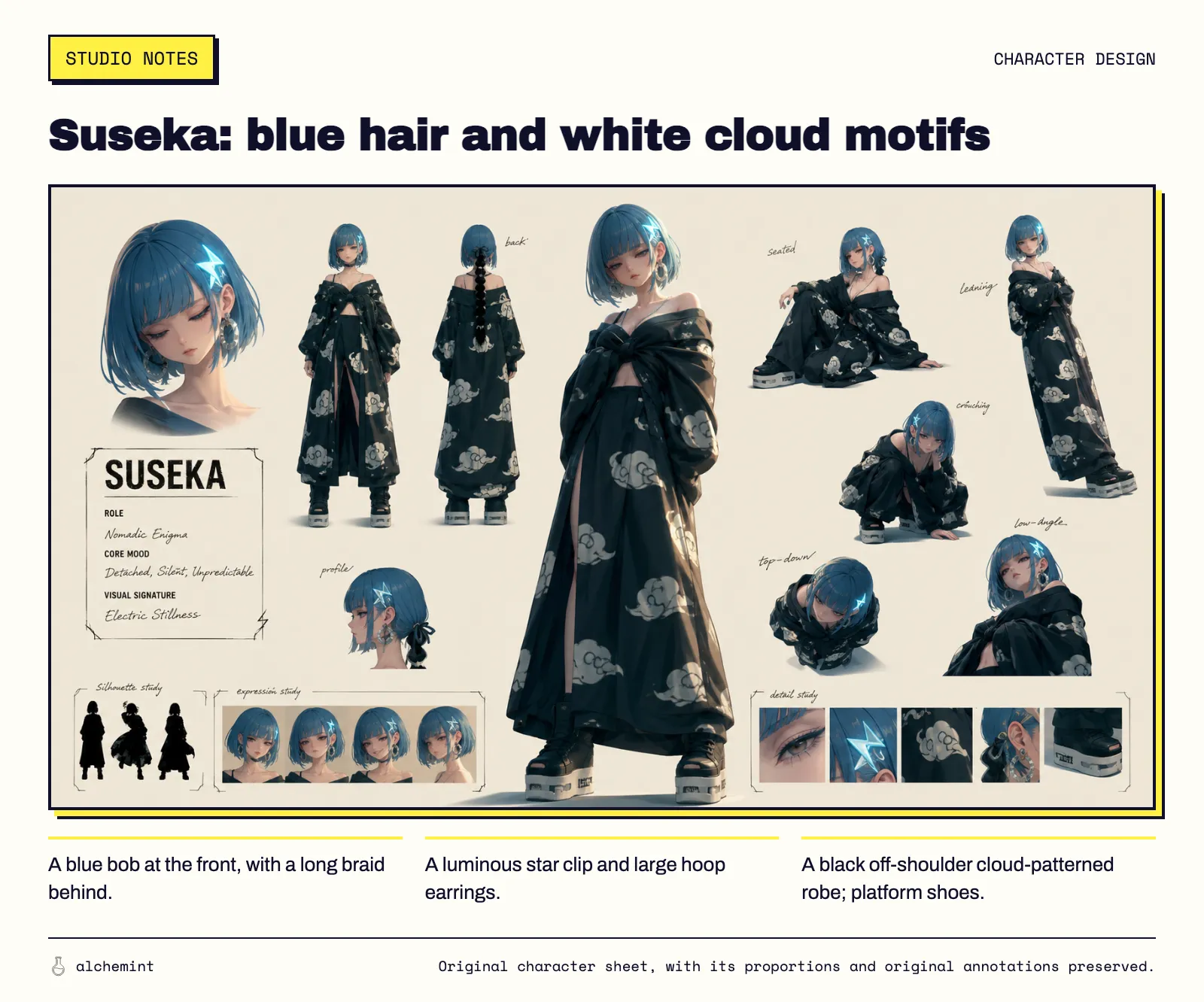
Describing Suseka only as having a blue bob leaves out the braid in the rear view. Check turns against the original sheet.
Our production prompt identified her with a short blue bob and supplied the complete sheet. That description distinguishes her quickly, but doesn’t describe all her hair. The braid remains visible in the generated archive scene. Judging the output from the written shorthand alone could mean mistaking the original design for an error.
I use the image and text together. The text assigns the image to a person and calls attention to features; the picture preserves proportions, garment construction and rear details that prose can omit. If they contradict each other, settle the reference before asking the model to interpret it.
MeiHua’s fan has to follow the scene
MeiHua’s long black hair, pink floral ornaments, wide white sleeves and dark embroidered collar distinguish her from the other two. Her sheet also shows a black floral folding fan, both open and closed.
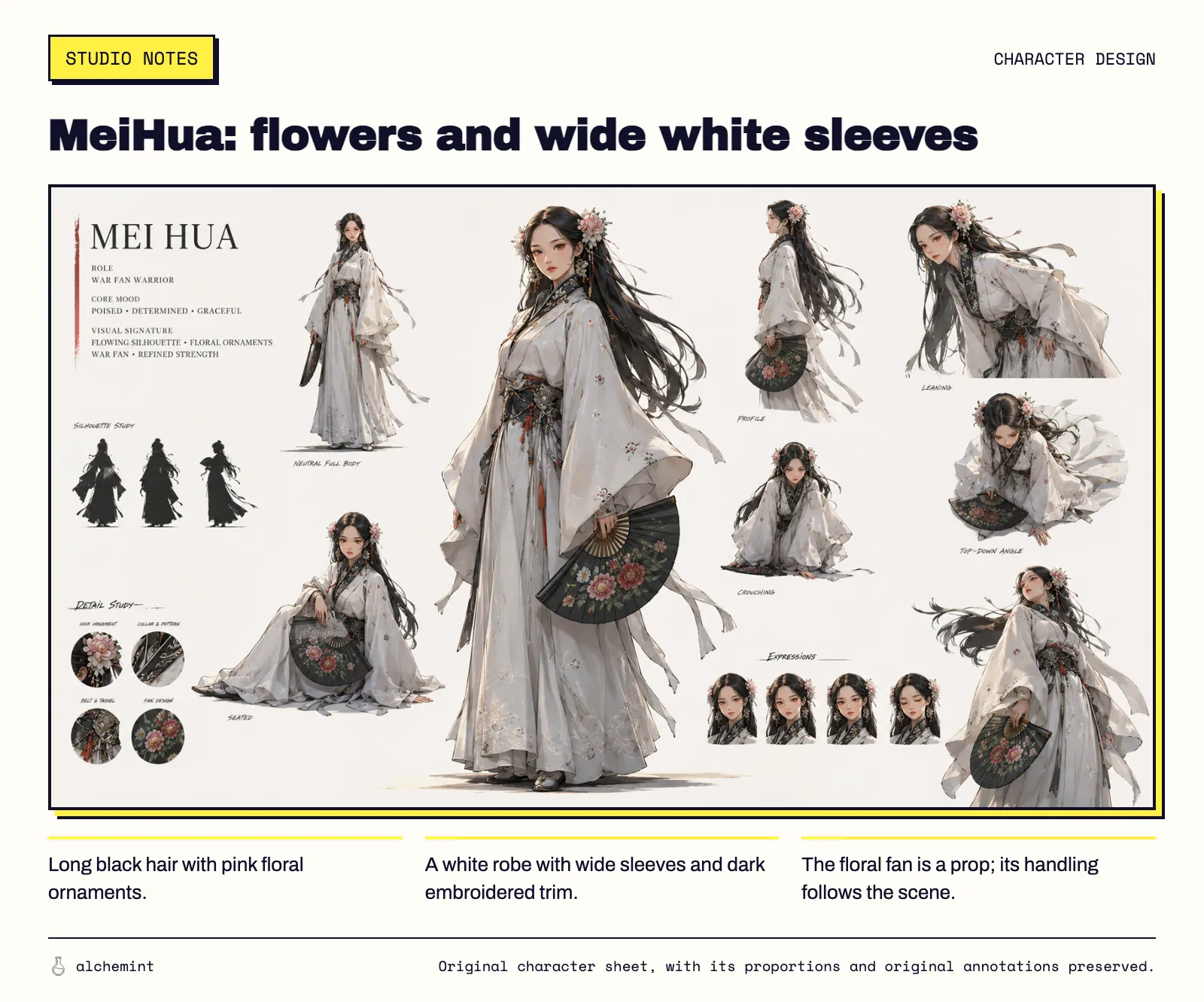
The fan has a defined appearance. How MeiHua holds it depends on the action; the reference pose need not repeat in every shot.
She needs her hands to take a keycard or push a door. The submitted prompt places the fan at her waist, then describes her receiving and using the card separately.
That requires distinguishing appearance from the current state. Her ornaments, collar and clothing silhouette should identify the same person. Whether she holds a fan, a card or nothing depends on the scene. Freezing the reference pose would get in the way of her performance.
Assign each sheet to one named character
For shots with several people, we assigned Biwa, Suseka and MeiHua their own references. We also specified that the heads and poses on each sheet depict one person. The white background, labels and page layout don’t belong in the film.
Seedance 2.5’s official sd25-pe skill gives the same kind of mapping instruction: bind each character to a reference individually. If several images define one person, say which view or attribute each supplies, rather than treating them as separate people. Official skill: Assign Asset Roles and Subject Mappings
Here is an adapted identity section from our keycard instructions. It is a teaching example, not the complete submitted prompt; the action, setting and sound would be supplied separately.
Biwa uses @Biwa.png. Preserve her heavy fringe, thick black braid,
black halter crop top, wide pleated trousers and off-white coat
worn below the shoulders.

Suseka uses @Suseka.png. Preserve her blue hair, star clip,
hoop earrings and black robe with white cloud motifs.
Use the sheet for her hair from every angle.

MeiHua uses @MeiHua.png. Preserve her long black hair, pink
floral ornaments, wide white sleeves, dark embroidered collar
and belt. Her fan is at her waist for this scene; her hands
perform the keycard actions.

All poses and heads on each sheet depict the same person.
Do not exchange the three characters’ features or reproduce
the sheets’ backgrounds, labels or page layouts.
Attach the actual images and use the asset labels provided by the tool. @Biwa.png is the example’s name; typing a filename doesn’t upload a reference. The Seedance 2.5 prompt skill guide explains how to ask an agent to organise a complete scene.
We also used Blender previz: orange represented Biwa, blue represented Suseka and pink represented MeiHua. Those colours identified the figures. Their clothing still came from the character sheets. Otherwise, the pink placeholder could compete with MeiHua’s white robe as an appearance instruction.
Check what survives the change of light
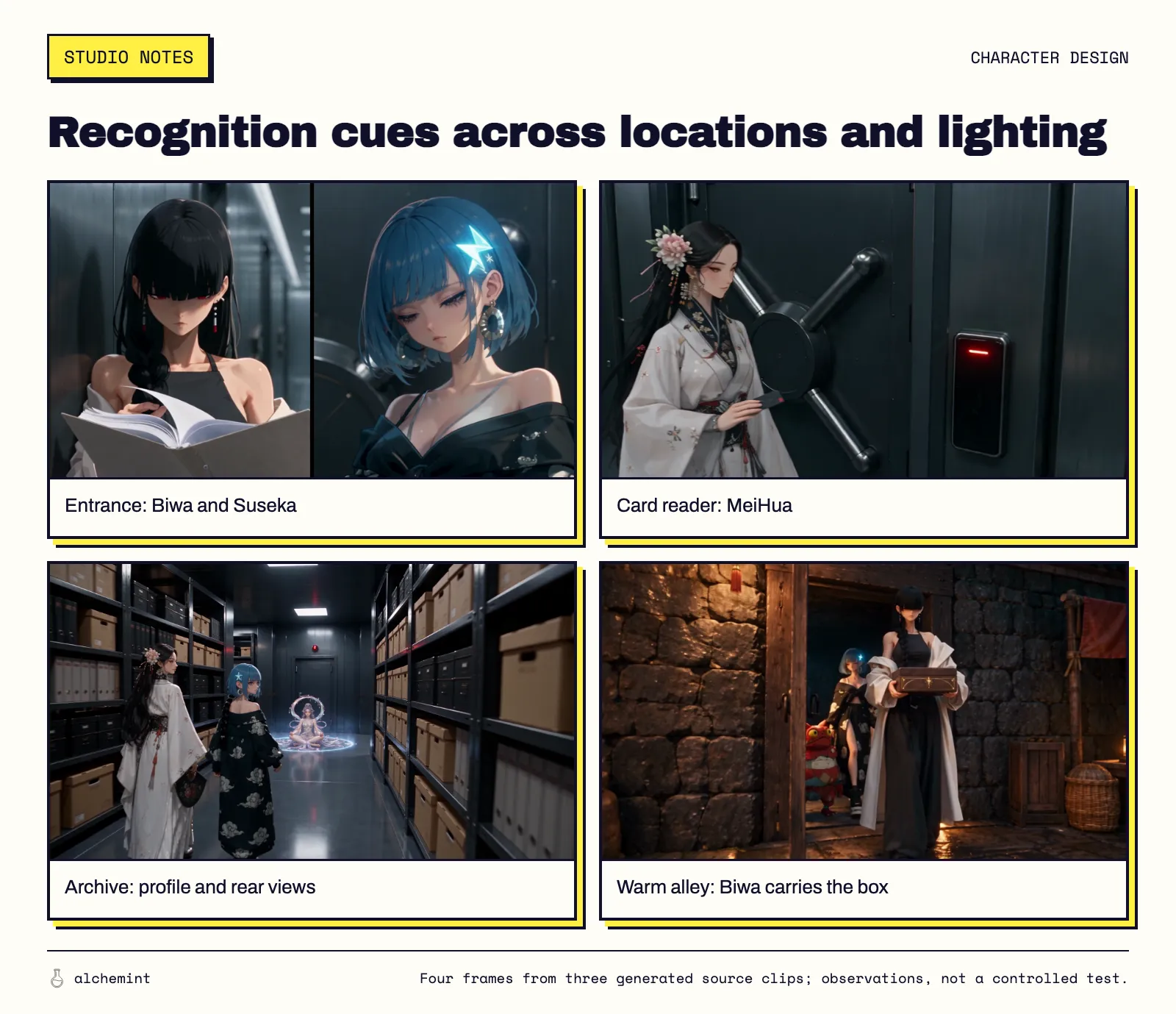
Actual outputs from different scenes. They support visual comparison, not a test in which only one input changed.
Cold corridor light and warm lantern light render skin and fabric differently. I check the silhouette, hair and garment structure before deciding whether a colour change is an identity error. An off-white coat looking yellow under a lantern is a different problem from a coat acquiring a different cut.
In these frames, Biwa’s dark outfit and pale coat, Suseka’s blue hair and cloud motifs, and MeiHua’s flowers and white robe still help identify them. Small accessories, embroidery and facial details need closer inspection than this grid can provide.
Biwa still acquired cat ears
About two seconds into an ending source clip, a black-haired character with cat ears appears where Biwa was meant to stand beside Suseka and MeiHua. The clothing still resembles Biwa’s. The head has departed from her design.
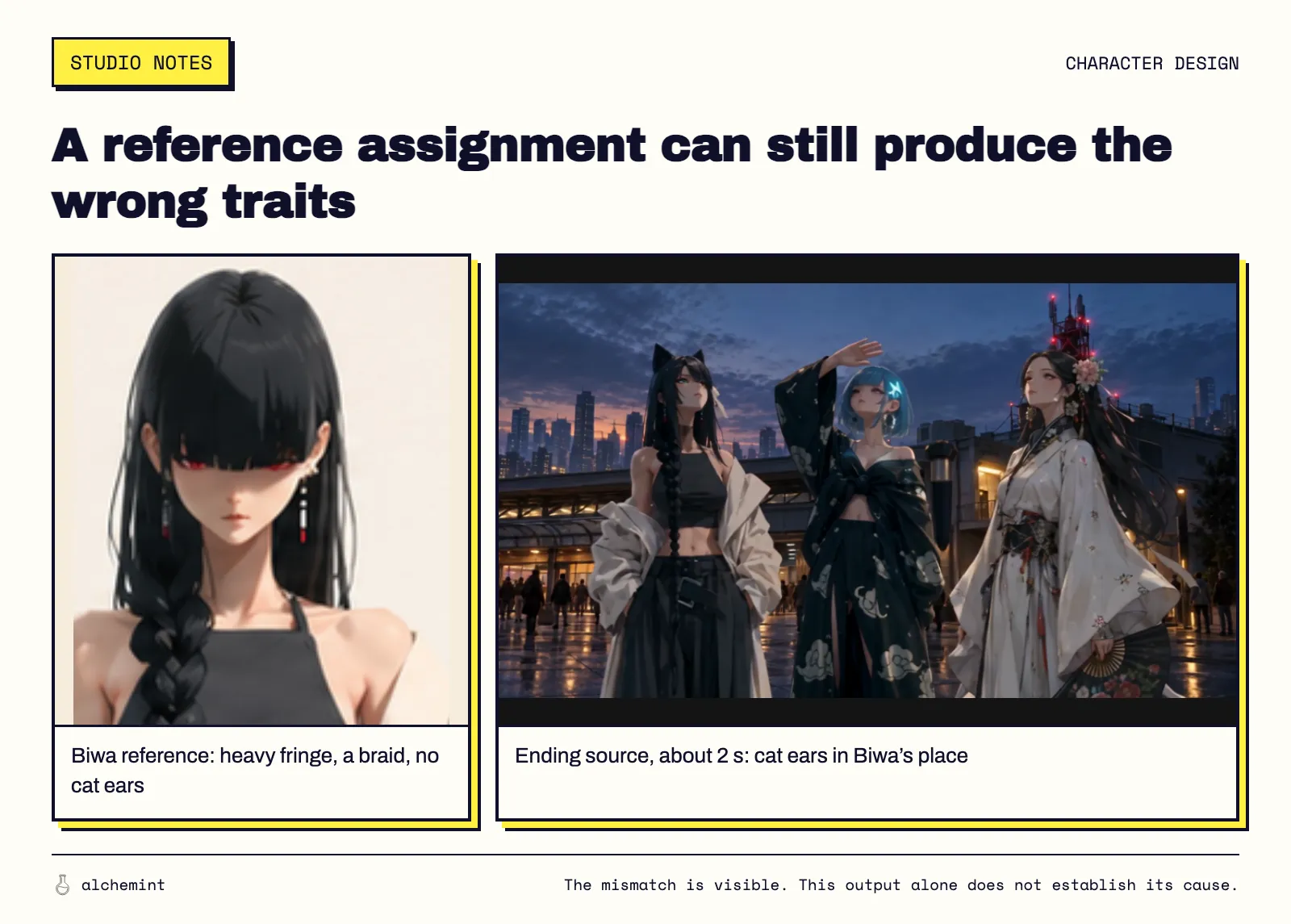
The reference has no cat ears. Checking only the black top and off-white coat would miss the identity error.
That submission already assigned each character a reference and instructed the model not to exchange identities. The same task also included Shami, a different character who does have cat ears. The output shows signs of mixed appearance, but this one clip doesn’t establish which image or instruction caused it. It does show why a clear assignment still needs an output check.
The original character sheets stay on the left while the entrance, card reader, warm alley and ending play on the right at original speed. The last passage switches to Biwa’s face reference beside the cat-ear error. Each excerpt keeps its source audio.
I play the shots that will sit together, then return to the sheets for the features most likely to cause trouble: Biwa’s fringe and braid, Suseka’s hair as she turns, MeiHua’s ornaments and the state of her fan. First check whether the audience can recognise the person, then inspect the details needed by this scene.
If I remade this ending, I’d isolate the trio’s shot, supply only the characters and setting it needs, and check the heads again. That is a proposed next step, not a retry completed in this production. Who holds the box and which doorway they use belong in the storyboard and continuity check.
The sheet gives that decision a basis. If the shot needs Biwa, I have to compare it with Biwa’s design. A pleasing image isn’t enough reason to accept somebody else.
- 01Create Video with AI: your prompt is your video
- 02Create Video with AI: start with text, an image or a script?
- 03Create Video with AI: use a simple storyboard to connect every shot
- 04AI Video Character Consistency Starts with a Character SheetYou are here