
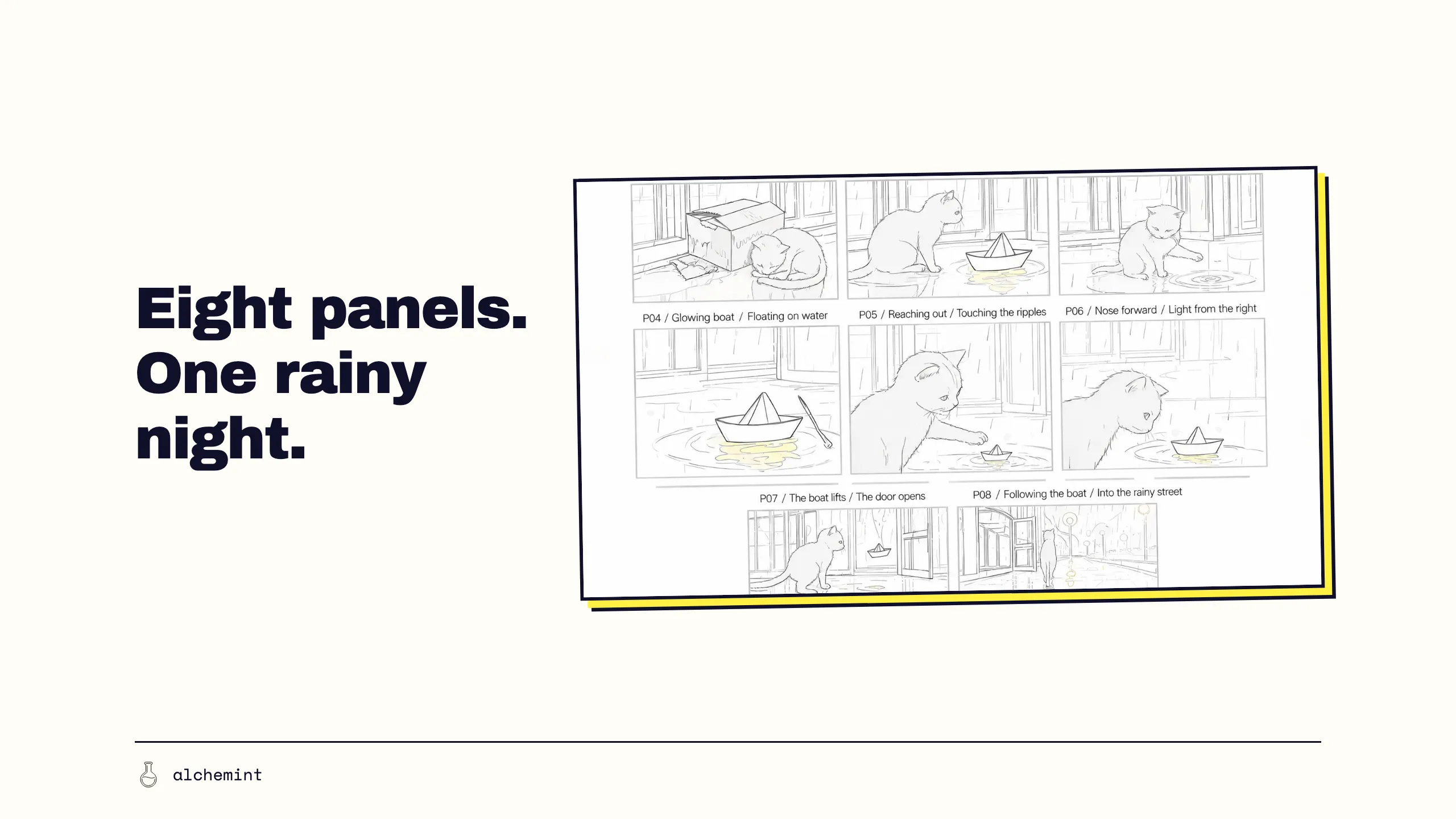
Does Seedance 2.5 Read Storyboards? We Found All 8 Panels
We matched two multi-panel storyboards against the 60fps final films. All eight panels made it; the P02/P03 blur and Desktop Act 3 jump cut exposed our undercooked camera directions.
Short version: both films followed our storyboards, and ByteDance's engineers absolutely cooked.
The generated shots carried details from the boards that our first comparison table missed.
Every panel from P01 through P08 appears in both finished films. Portrait P01 returns at the three-second mark. P02 survives into the opening of P03. The portrait P07 match also sits 0.1 seconds earlier than we first labelled it. We found those details during an editorial review, reopened FFmpeg, and moved through the films in half-second steps.
For another production like this, we would prepare a storyboard before generating the video.
Does an AI Video Storyboard Work? All Eight Panels Made the Film
We made six generation submissions: Acts 1, 2 and 3 in Desktop, plus the same three Acts in Mobile. Each Act received its own section of the storyboard. Act 3 also received the matching Act 2 tail frame as its opening-frame reference.
| Act | Storyboard panels | Event |
|---|---|---|
| Act 1 | P01–P03 | Cat curls up, raises its head and tests the water |
| Act 2 | P04–P06 | Boat glows; cat steps in the water and brings its nose close |
| Act 3 | P07–P08 | Boat rises; cat follows it into the street |
We picked eight representative frames from each film. The timestamps below make them easy to find and compare.
| Panel | Act | 16:9 representative frame | 9:16 representative frame |
|---|---|---|---|
| P01 | Act 1 | 1.500s, f90 | 3.000s, f180 (P01→P02 boundary) |
| P02 | Act 1 | 7.500s, f450 | 8.000s, f480 |
| P03 | Act 1 | 9.167s, f550 | 9.167s, f550 |
| P04 | Act 2 | 12.033s, f722 | 12.033s, f722 |
| P05 | Act 2 | 17.800s, f1068 | 19.000s, f1140 |
| P06 | Act 2 | 22.500s, f1350 | 22.500s, f1350 |
| P07 | Act 3 | 31.500s, f1890 | 34.200s, f2052 |
| P08 | Act 3 | 36.000s, f2160 | 41.000s, f2460 |
The complete story and six-submission workflow are covered in Making an AI Video: A Paper Boat Came Back for a Stray Cat. This article stays on the storyboard, the prompt and what the frames actually show.
What BytePlus Means by “Multi-panel Storyboard Reference”
The Seedance 2.5 Prompt Guide calls this feature Multi-panel storyboard reference. Its example uses a nine-panel storyboard to establish the overall shot structure, shot sizes and camera-movement rhythm. The same guide leaves the generated video room to move; it recommends multiple keyframe references when tighter alignment matters. Read the BytePlus documentation.
We cared most about whether the story flowed: the cat and boat stayed in readable positions as they approached, tested the water and left. A door closing later or a boat drifting farther left did not send us straight back to generation.
Before Generation, Eight Panels Put the 45-Second Film on the Wall
Before the first render, P01–P08 gave everyone a shared index. “Act 2 starts at P04” is a useful production sentence. Repeating the entire rainy-night plot every time is a tax nobody needs.
The 16:9 multi-panel storyboard submitted for Desktop
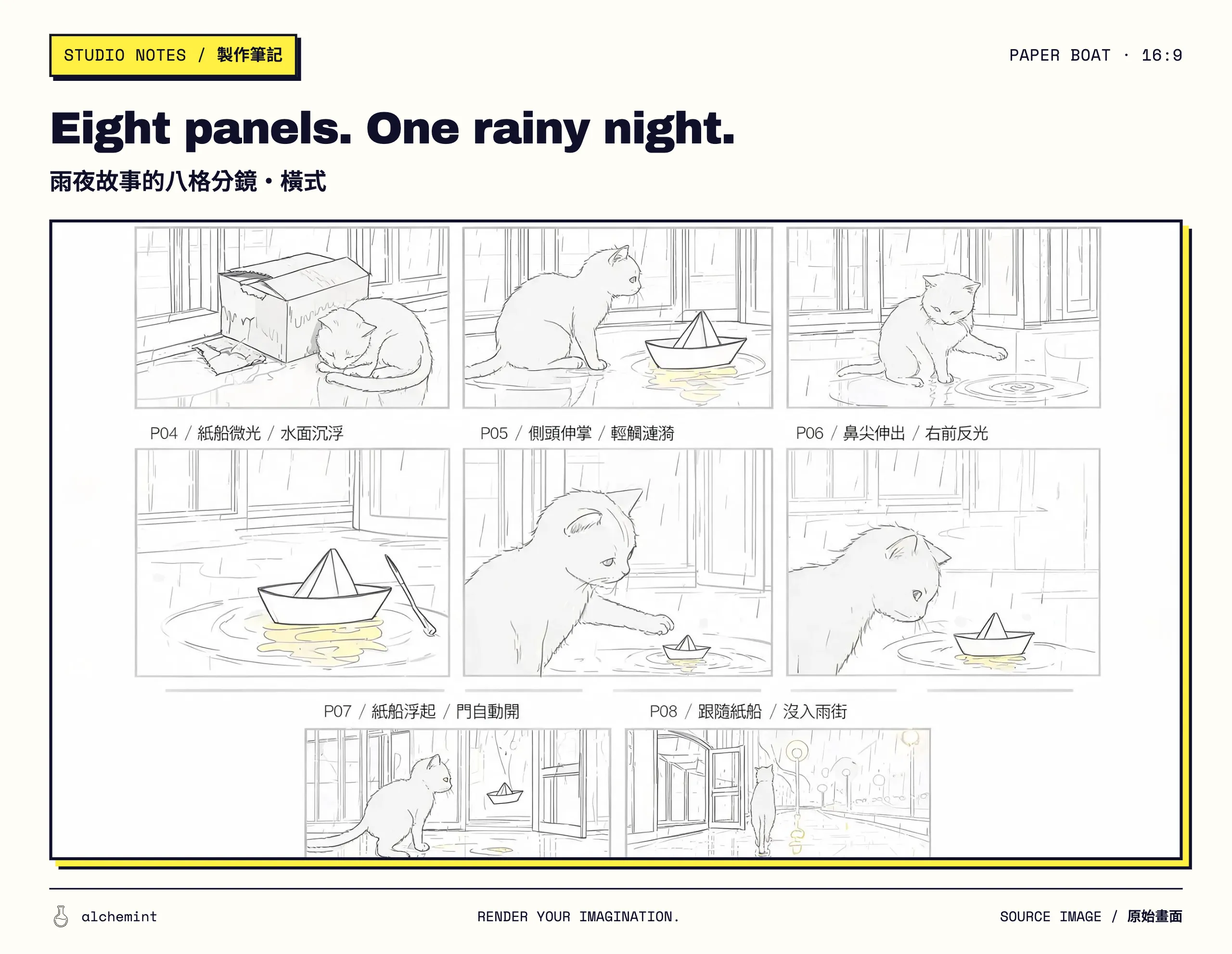
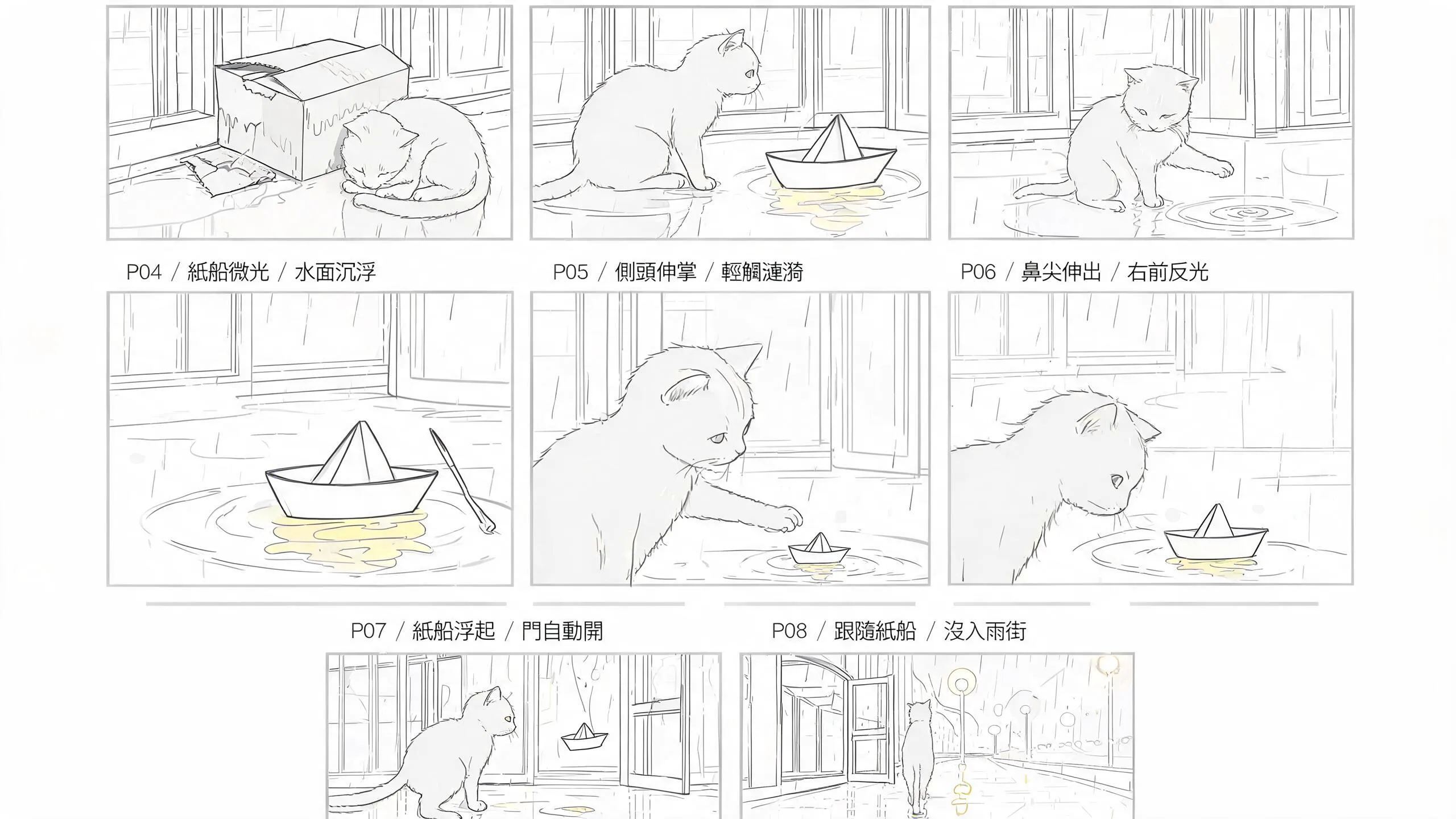
16:9 multi-panel storyboard. Seedream 5.0 Lite casually cropped away the P01–P03 titles while generating it.
The 9:16 multi-panel storyboard submitted for Mobile
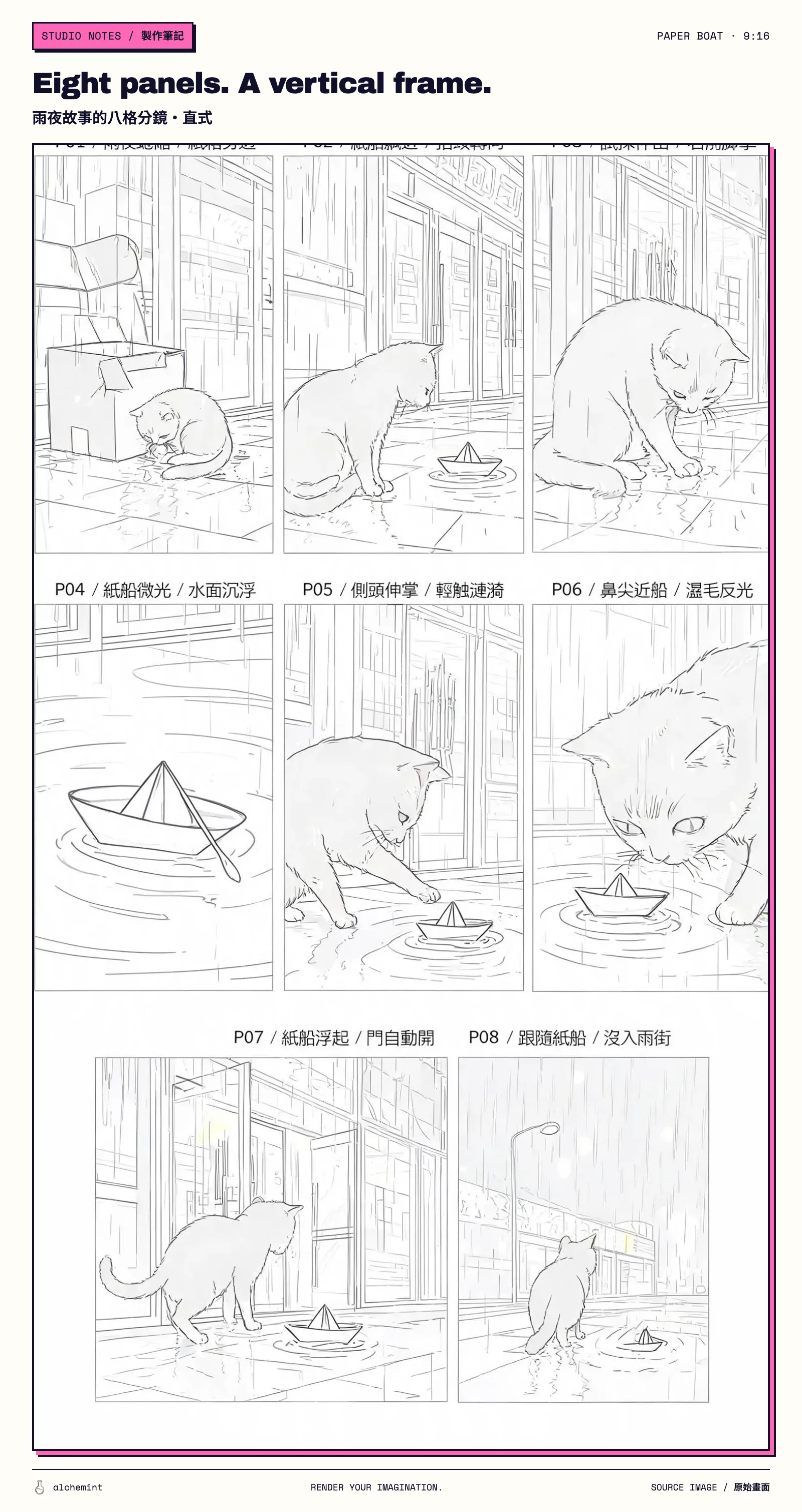
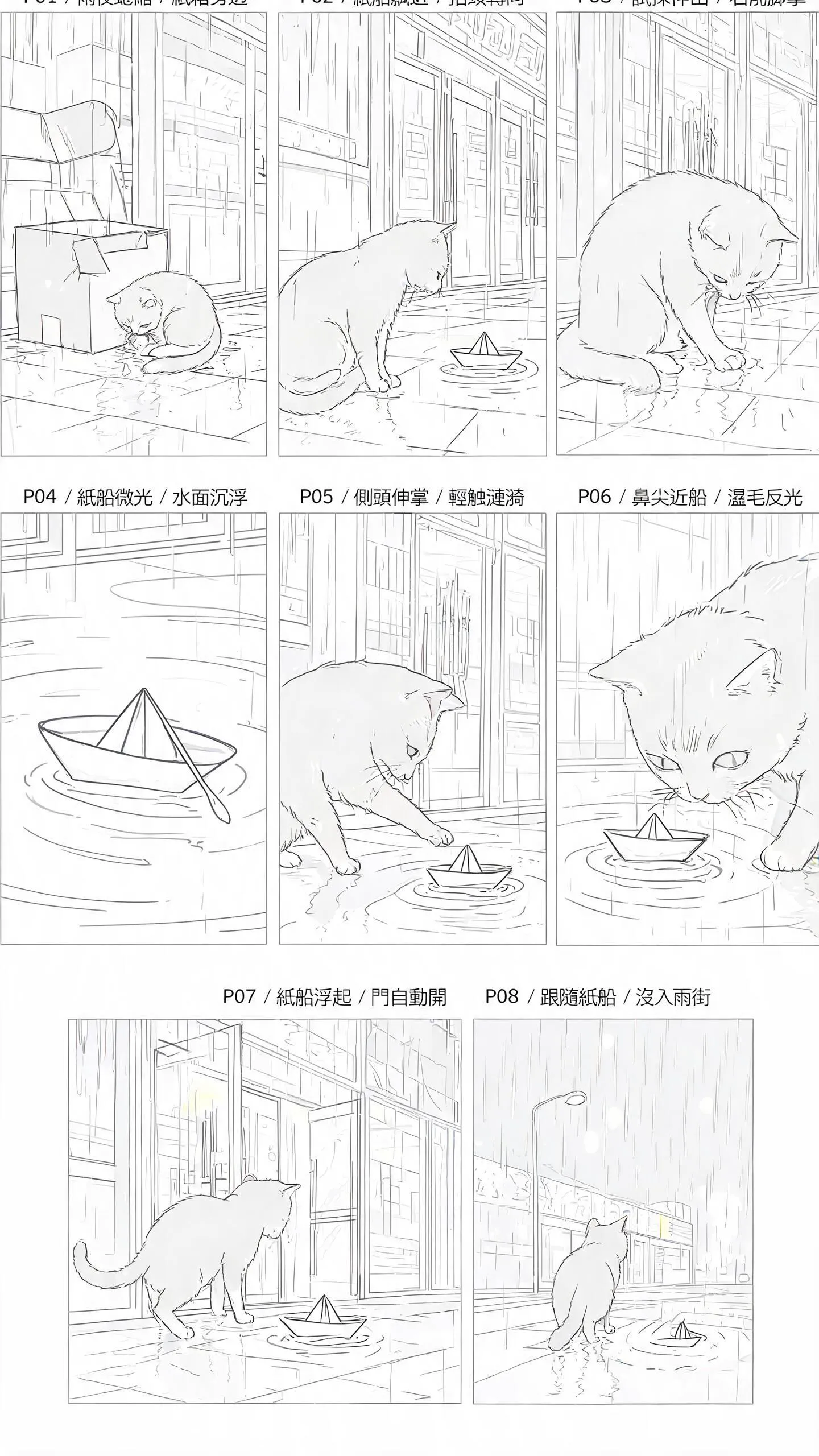
9:16 multi-panel storyboard. Seedream 5.0 Lite was feeling generous this time and left us half of the top margin.
Both final films run at 60fps. We matched panels using shot size, subject positions, eyeline, paw direction, storefront geometry, puddles and departure direction. Landscape images stay landscape below; portrait images stay portrait. Readability won the argument over matching boxes.
We submitted the prompts in Chinese. The English excerpts below are translations of those prompts.
Act 1: P01 Returns at Three Seconds, Then P02 and P03 Blur Together
P01: one frame carries the end of one panel and the start of the next
The landscape match at 1.500 seconds already confirms P01. The portrait frame at 3.000 seconds tells us more: the cat still curls beside the box while the paper boat has entered the foreground. P01 holds the cat; P02 sends in the boat.
16:9
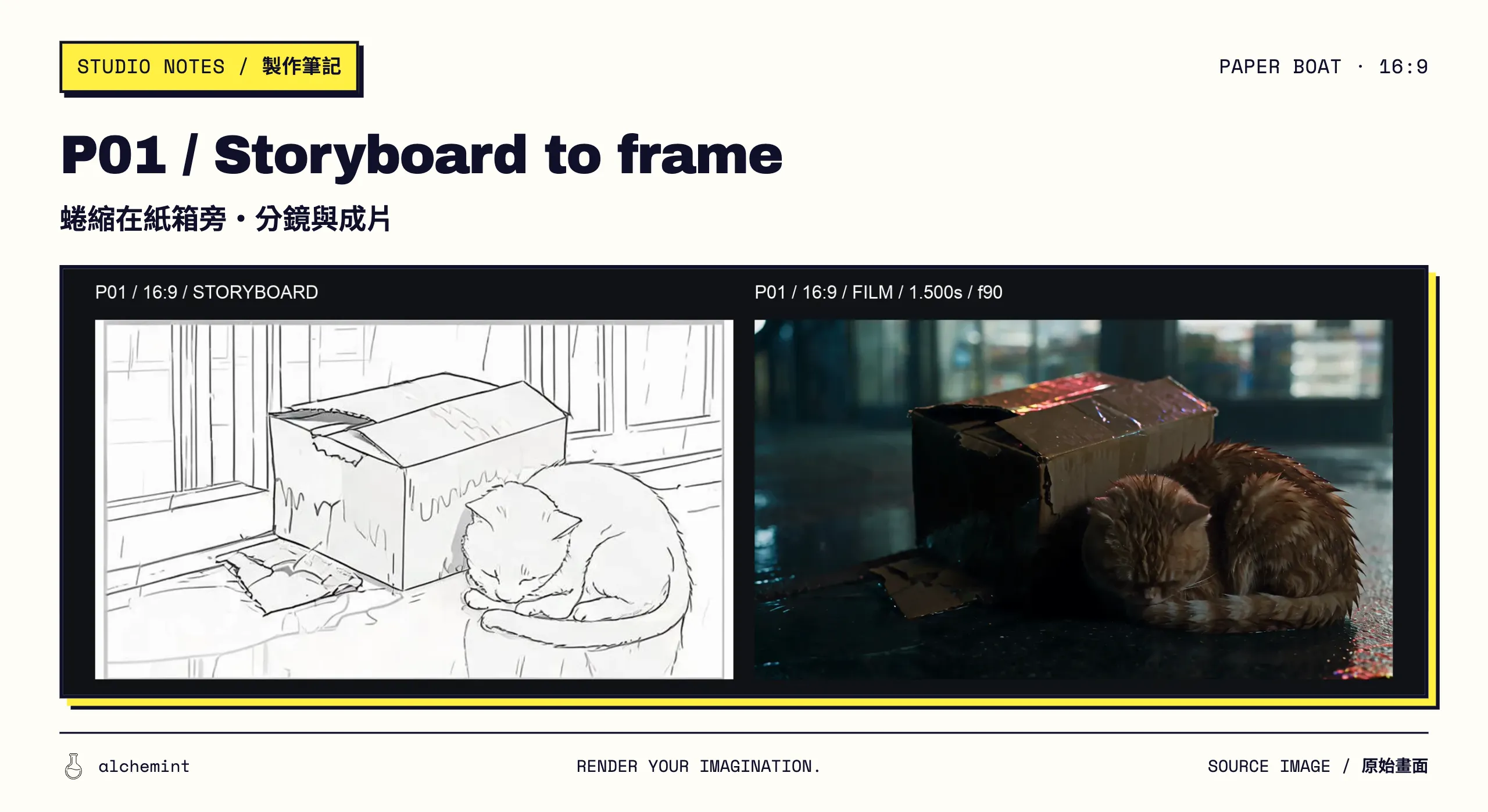
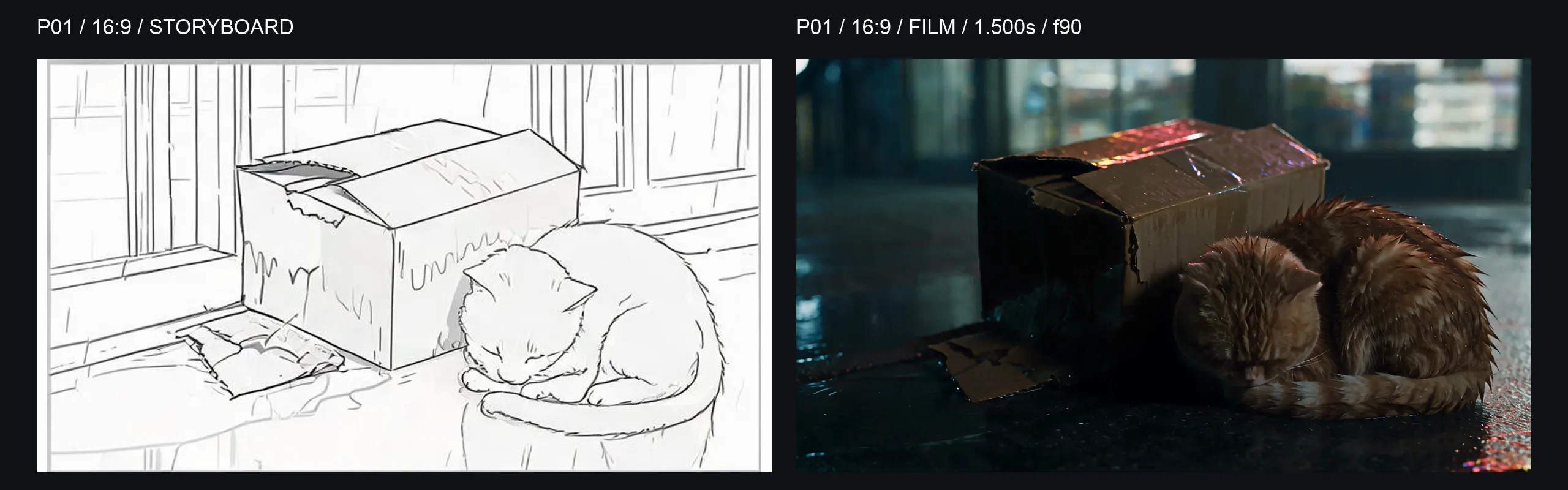
P01, 16:9. Representative frame: 1.500s, f90.
9:16
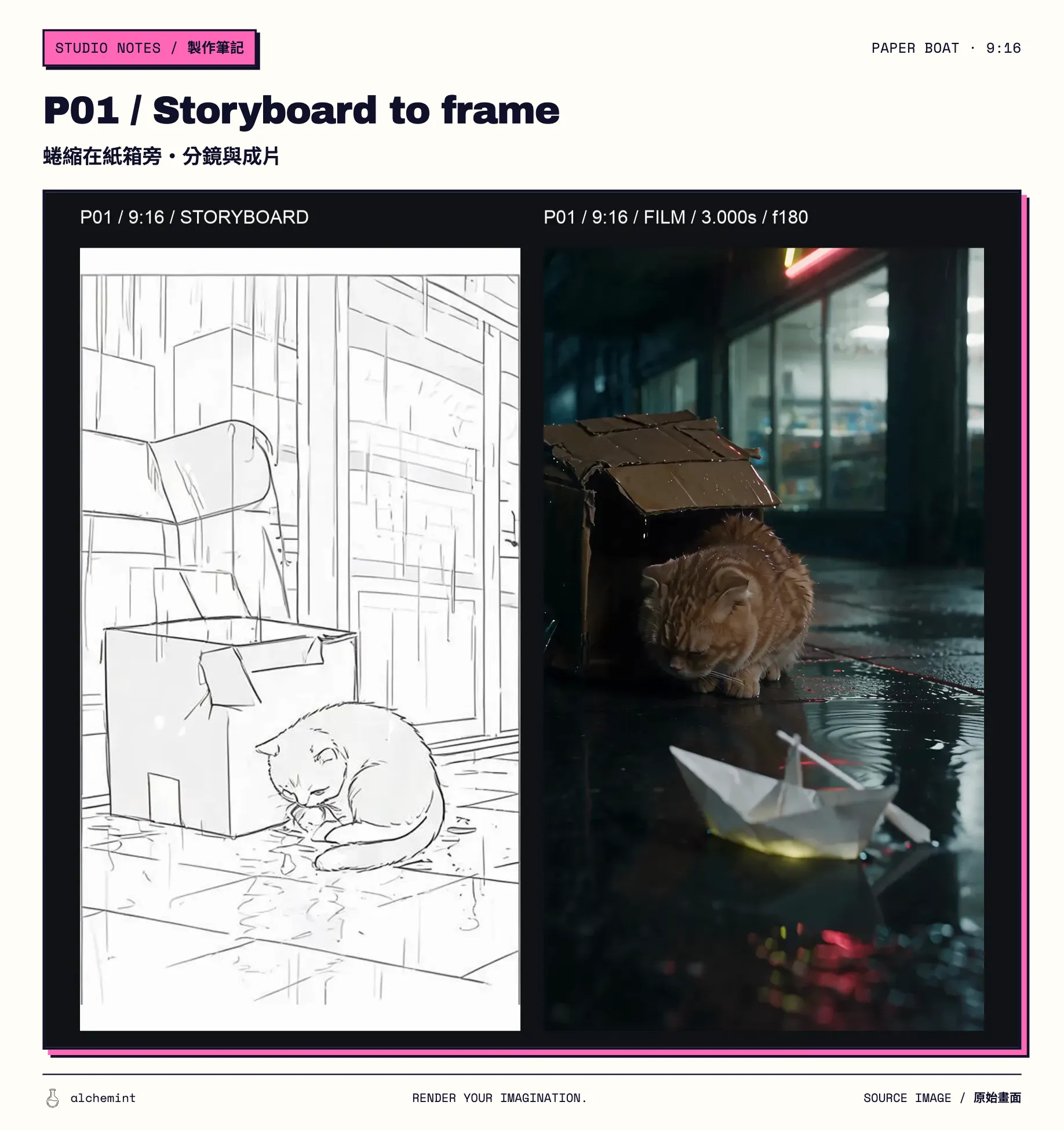
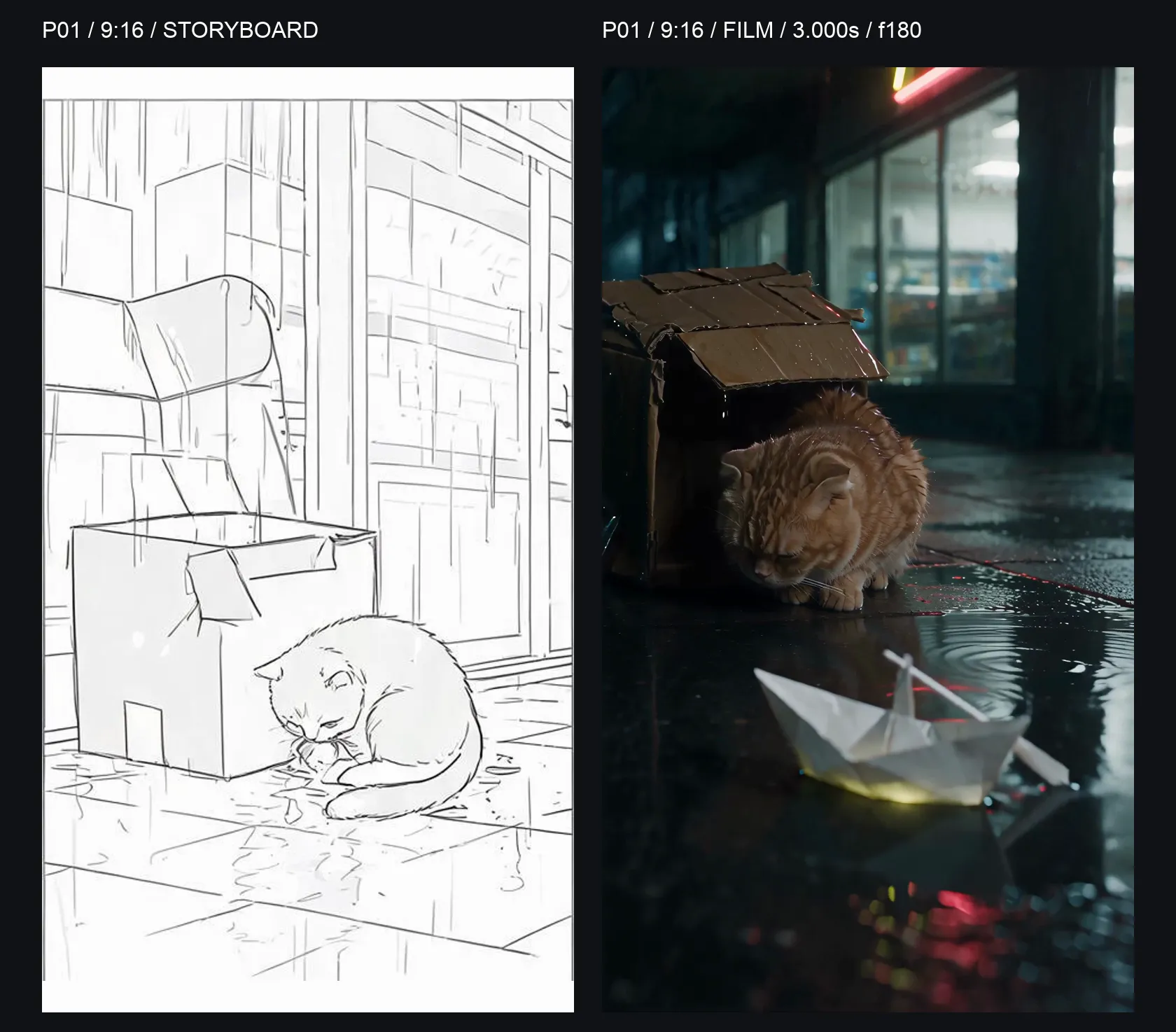
P01→P02 boundary, 9:16. Film frame: 3.000s, f180.
The submitted P01 ends with a line that carries real weight. Here is our English translation of the Chinese prompt:
P01, 0–3 seconds: medium close-up, locked camera. The cat curls beside the wet cardboard box, body tucked into a ball, head lowered between its forelegs, tail wrapped around its body. Rain falls on the cat and the puddle ahead, which reflects coloured neon. At the end, the cat remains curled and still.
FFmpeg detects the first clear portrait cut at 2.950 seconds. After that cut, the cat still holds P01's instructed ending pose, and P02's boat has entered the frame.
At three seconds, P01's ending overlaps with P02's opening. The cat has not moved yet, but the boat has arrived. The two panels flow into each other.
If your standards for camera movement are that high, our recommendation is to ask the boss to top up the credits first.
P02: it was there, just later than our first label
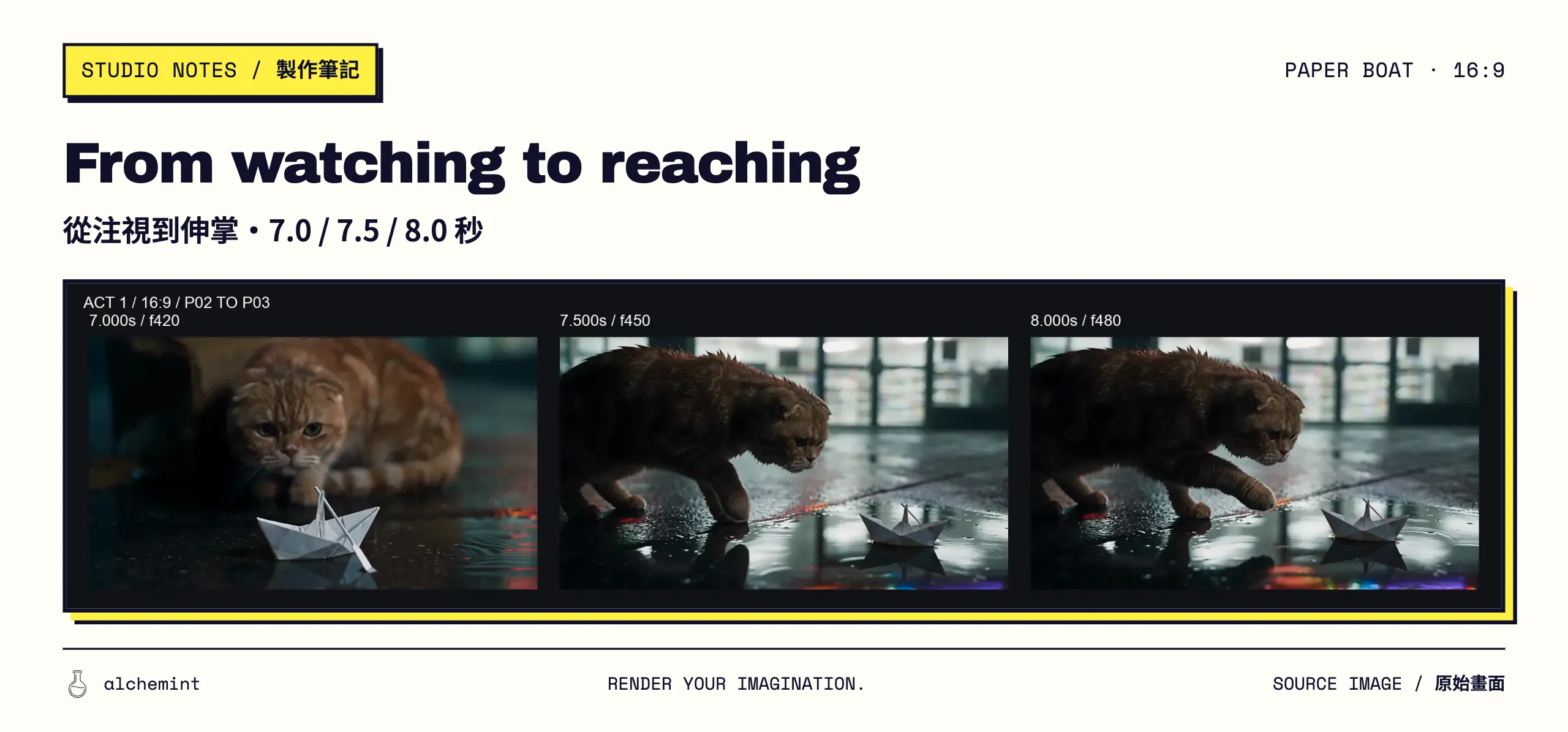
P02’s visual relationship is simple: cat on one side, boat on the other, with the cat looking toward it. The cleanest landscape match lands at 7.500 seconds. Portrait lands at 8.000 seconds. P03’s reaching motion has already started to leak into both frames. This is one of those moments when the hype is earned: the prompt got Seedance 2.5 to generate—shoot—a continuous performance.
If we had issued a call sheet for a live cat to perform this 45-second short, we would need at least ten glowing paper boats on standby. The cat could still reject every one of them.
16:9 | formal storyboard on the left; final film on the right
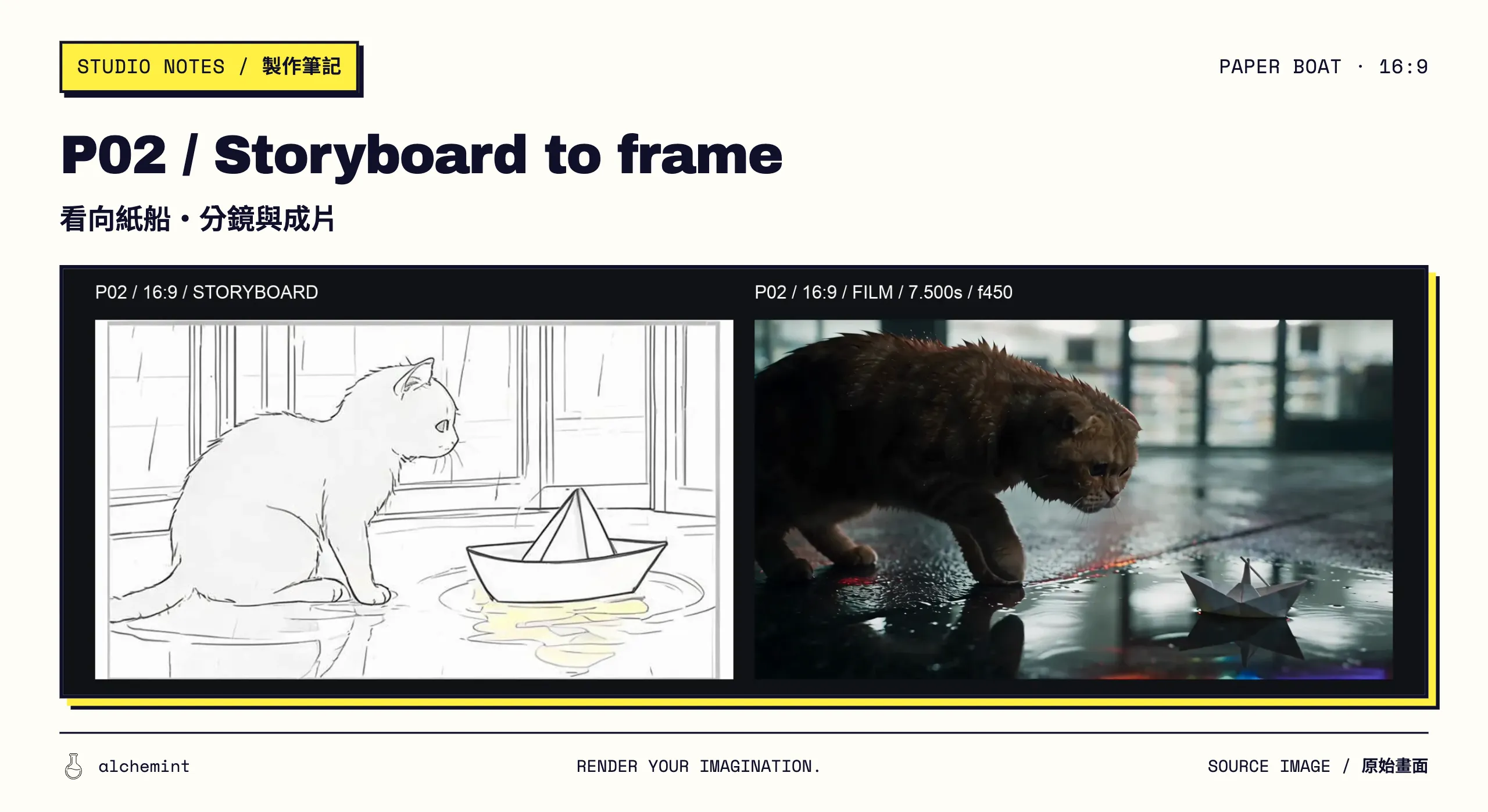
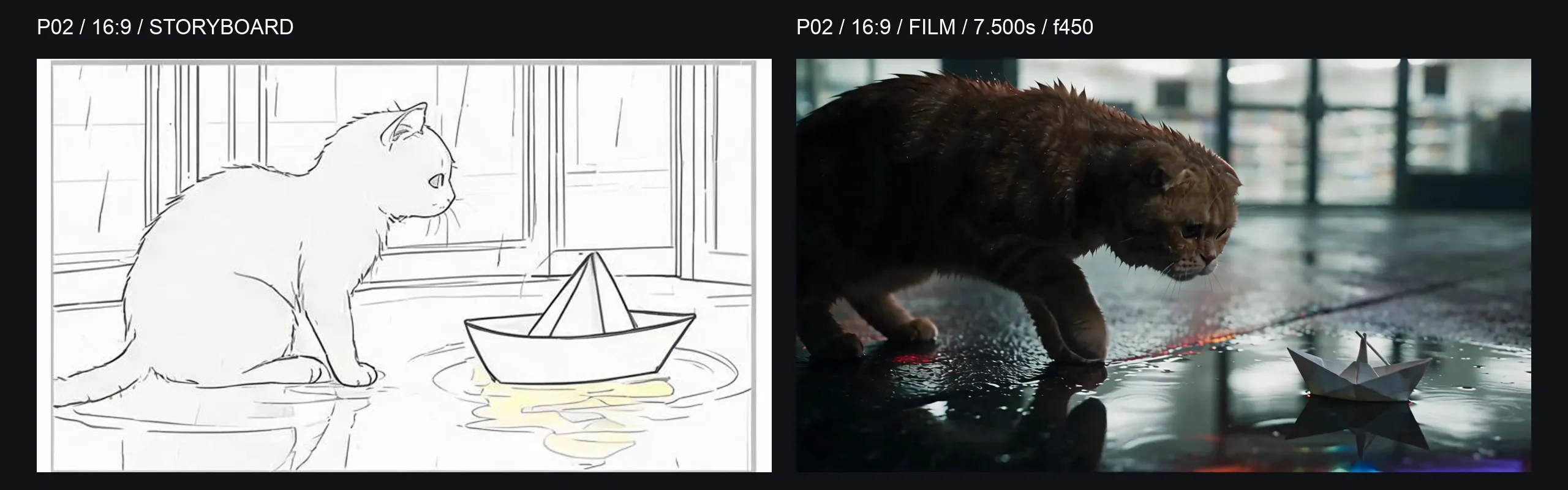
P02, 16:9. Representative frame: 7.500s, f450. The P03 action has begun.
9:16 | formal storyboard on the left; final film on the right
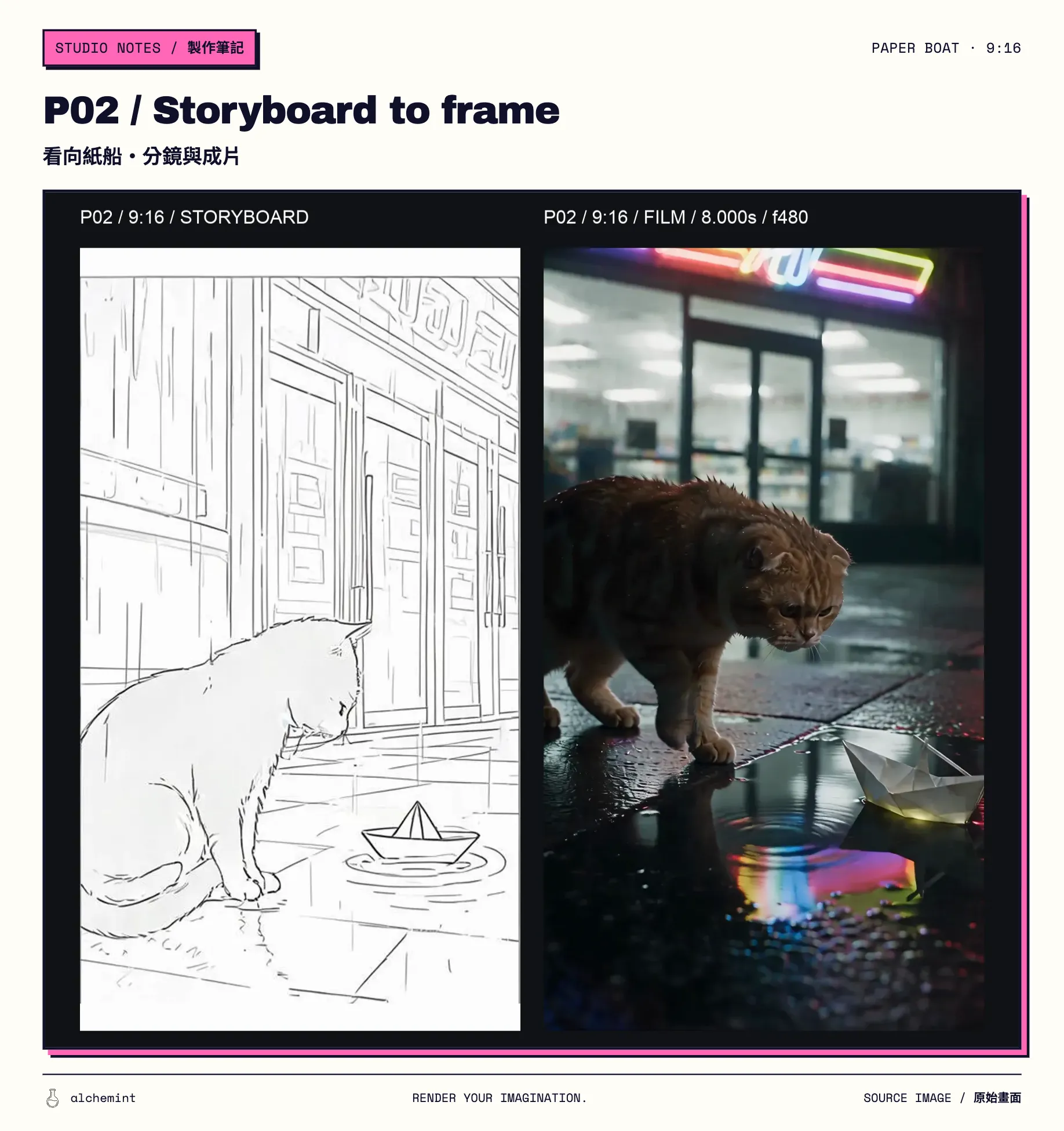
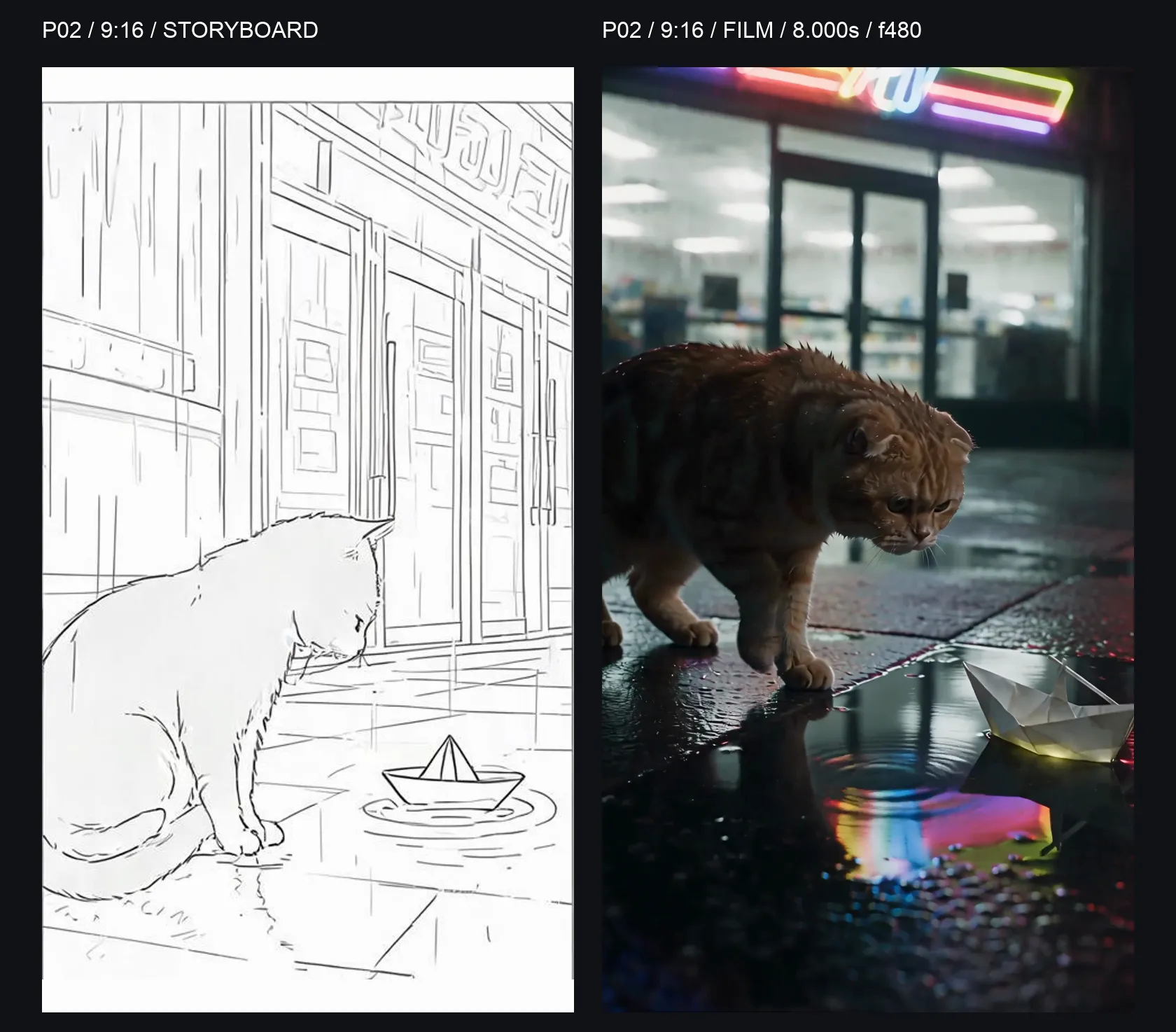
P02, 9:16. Representative frame: 8.000s, f480. P02’s composition continues into P03.
P03: Seedance made the cut; we made the two shots look alike
The full reaching pose is clear at 9.167 seconds in both films. P03 made the film, and the cat did not lose a leg. Good, because the director did not need another reminder of his two cats.
16:9
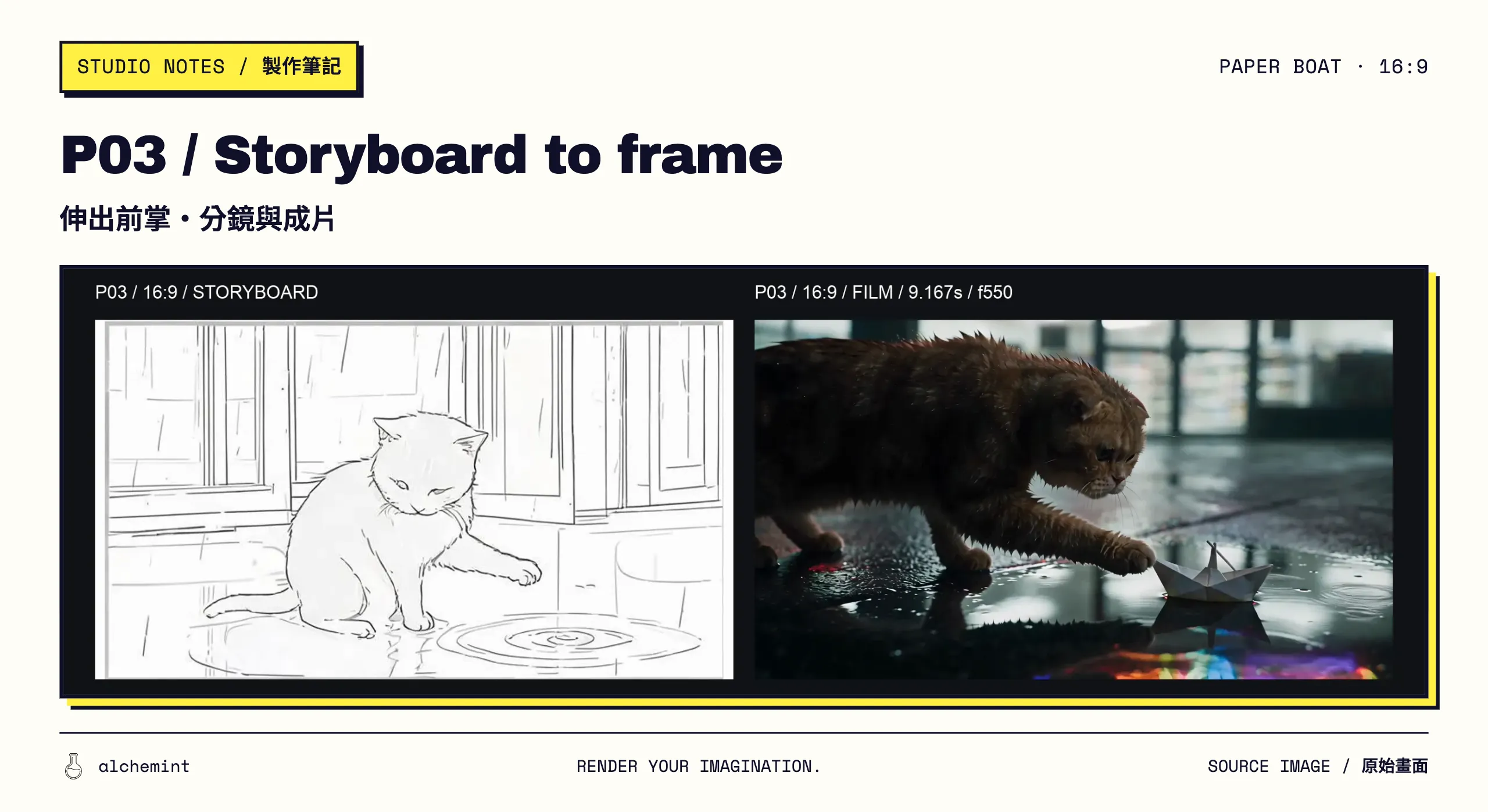
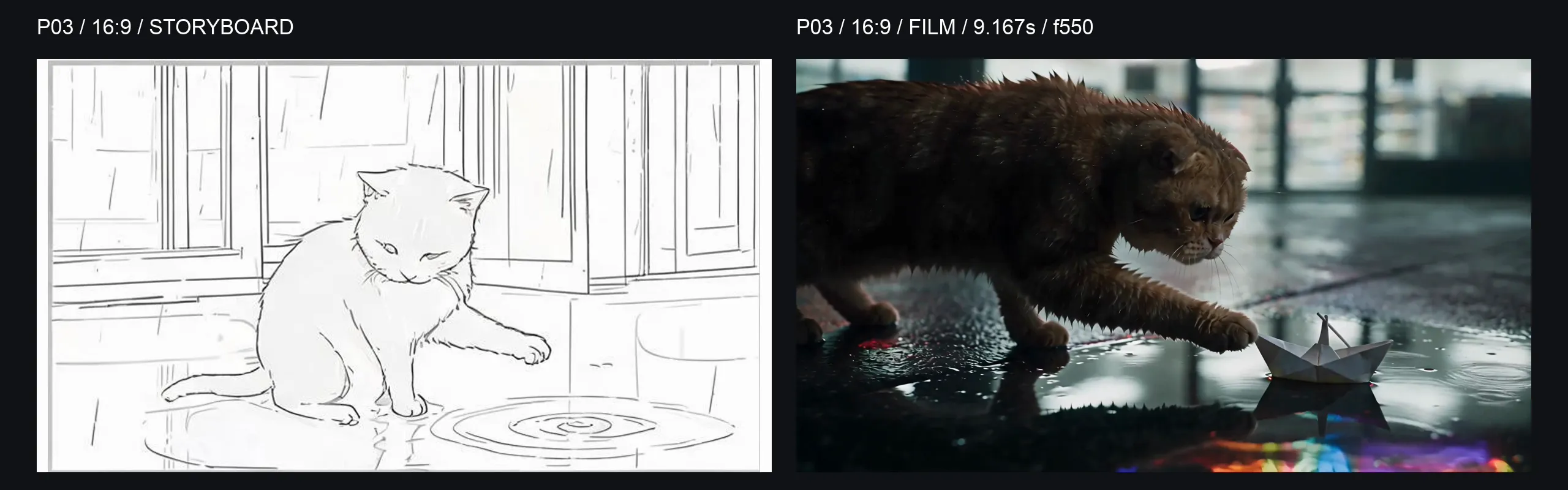
P03, 16:9. Representative frame: 9.167s, f550.
9:16
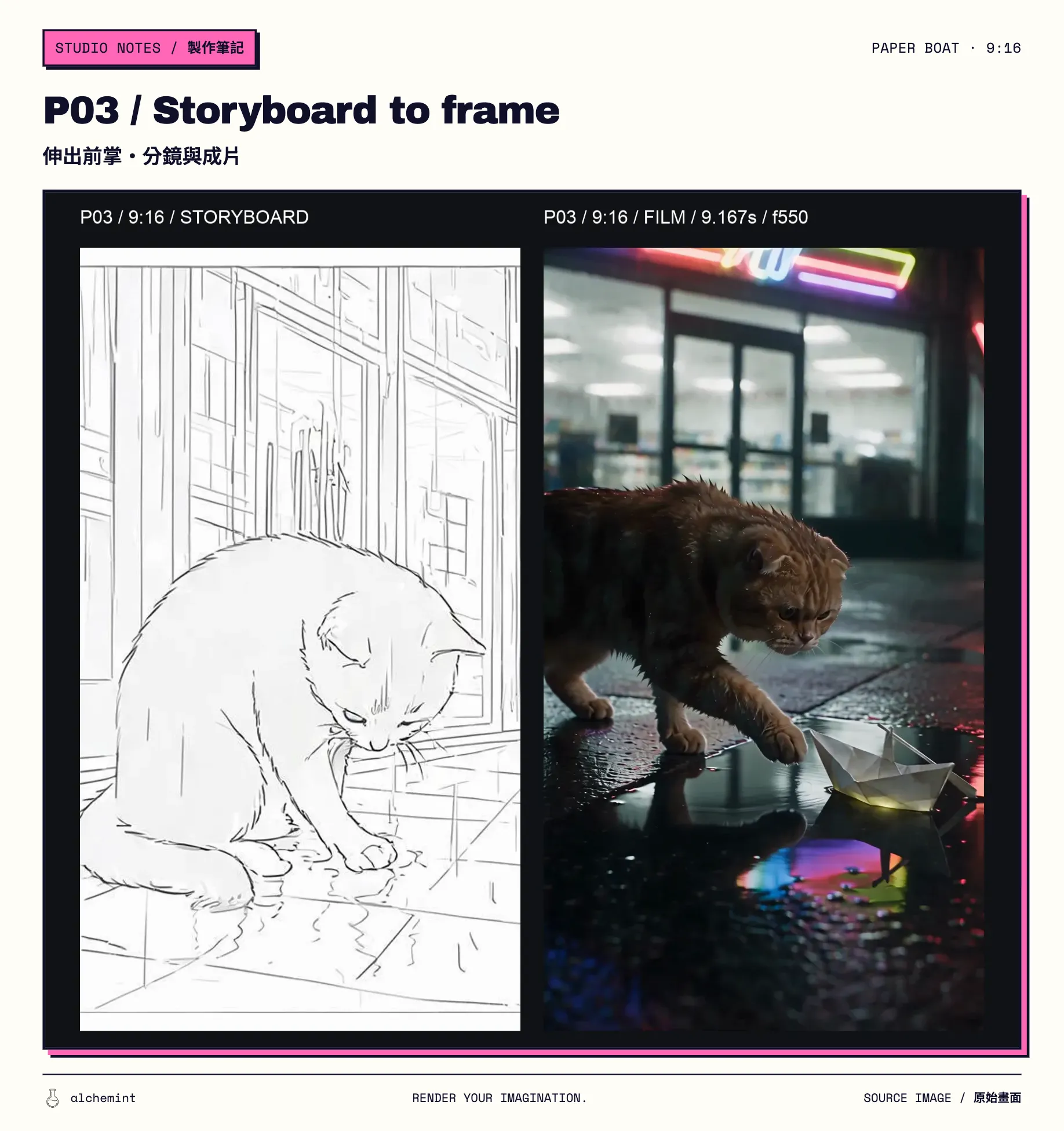
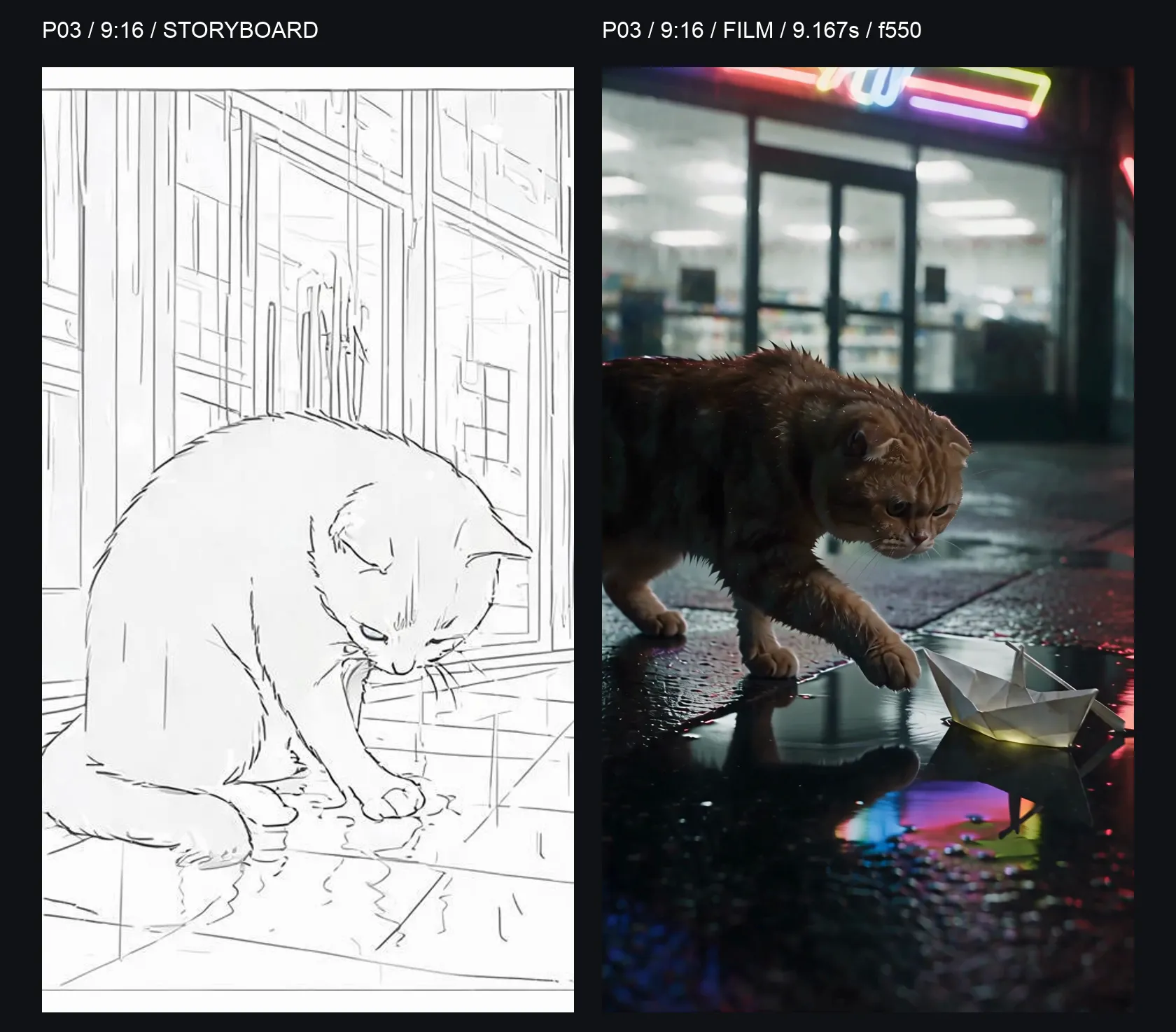
P03, 9:16. Representative frame: 9.167s, f550.
The 7.000, 7.500 and 8.000-second strips make the transition easy to read. Desktop cuts near 7.133 seconds; Mobile cuts near 7.217 seconds. Both films make a cut. The new shot keeps almost the same spatial relationship, so P03 plays like an extension of P02.
16:9 | P02→P03 in half-second steps
9:16 | P02→P03 in half-second steps
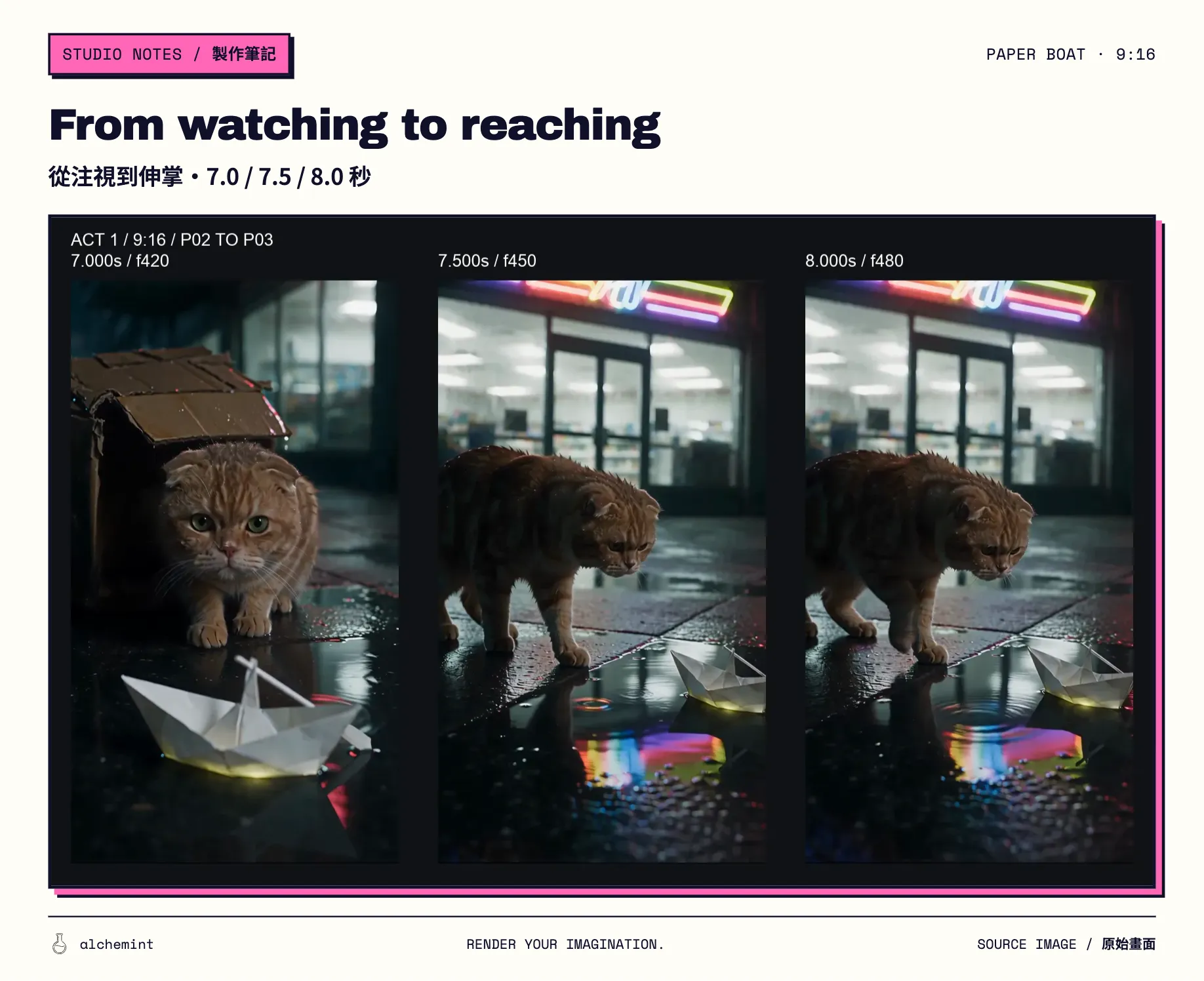
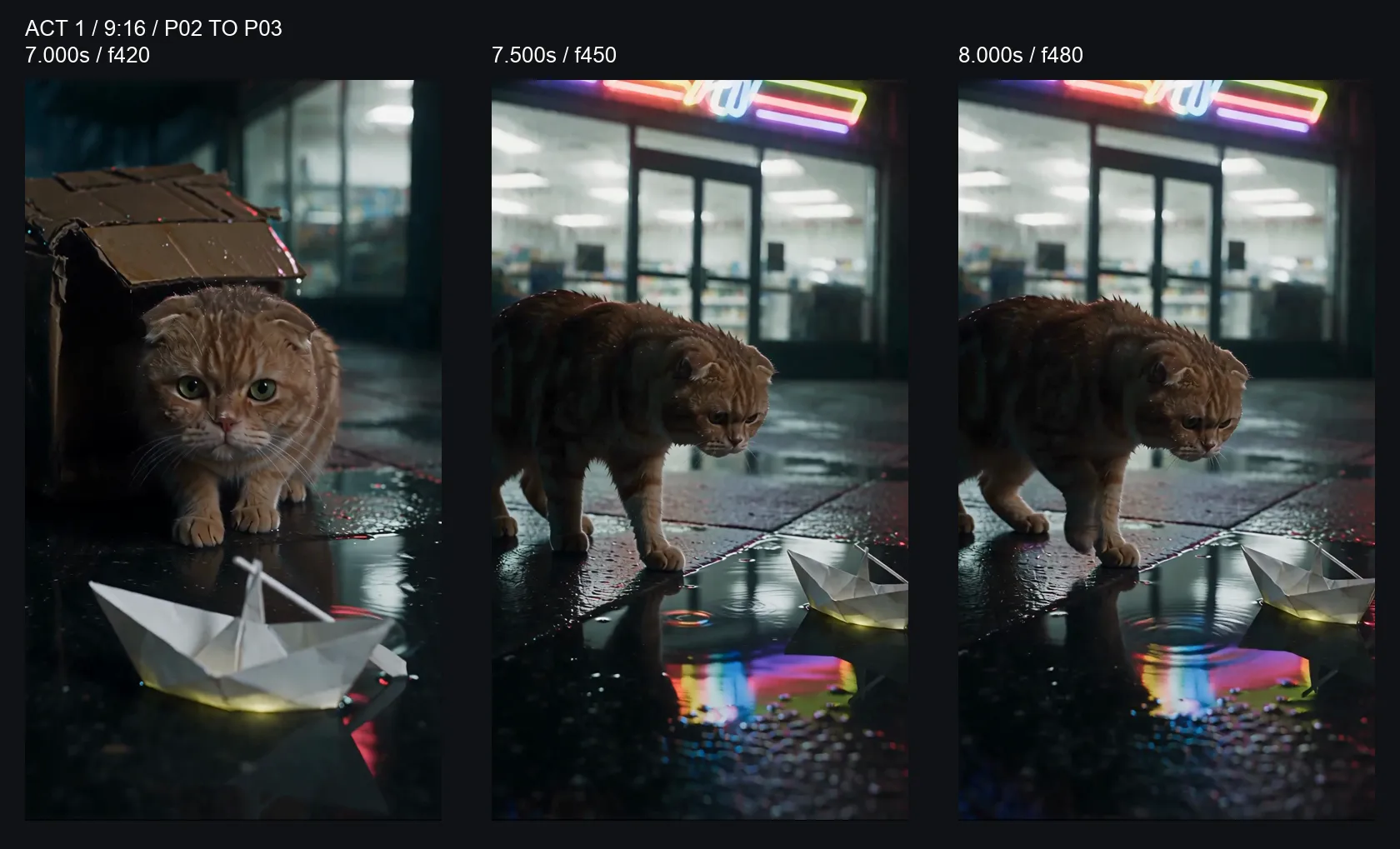
Here is the English translation of the camera direction we actually submitted:
P02, 3–7 seconds: medium close-up, tracking. … The camera follows the cat’s eyeline toward the paper boat.
P03, 7–12 seconds: medium shot, following. … The cat rises and turns sideways toward the puddle, extending its right forepaw.
“Tracking” and “following” do not establish a meaningful camera-position change. We also skipped the axis, left-right layout and opening composition after the cut. Seedance delivered three shots; the last two share a stage. That one is on us.
A tighter version would specify the composition on each side of the cut. This proposed rewrite has not been tested; its English translation reads:
Hold P02 in a frontal medium close-up until the end, with the cat behind and the boat in front. At 7 seconds, hard cut to a side-on medium shot for P03 while holding the 180-degree axis. Place the cat on frame left and the boat in the right foreground. The cat rises and reaches only after the cut.
Act 2: P04–P06 Follow the Board Almost Beat for Beat
Act 2 gained extra generated time. The landscape segment runs 15.033 seconds; portrait runs 17.020 seconds. Their pauses differ, while P04, P05 and P06 remain in order.
P04: the boat takes centre frame and the light arrives through the water
16:9 | formal storyboard on the left; final film on the right
We love this treatment. Who says no to a cat paw?
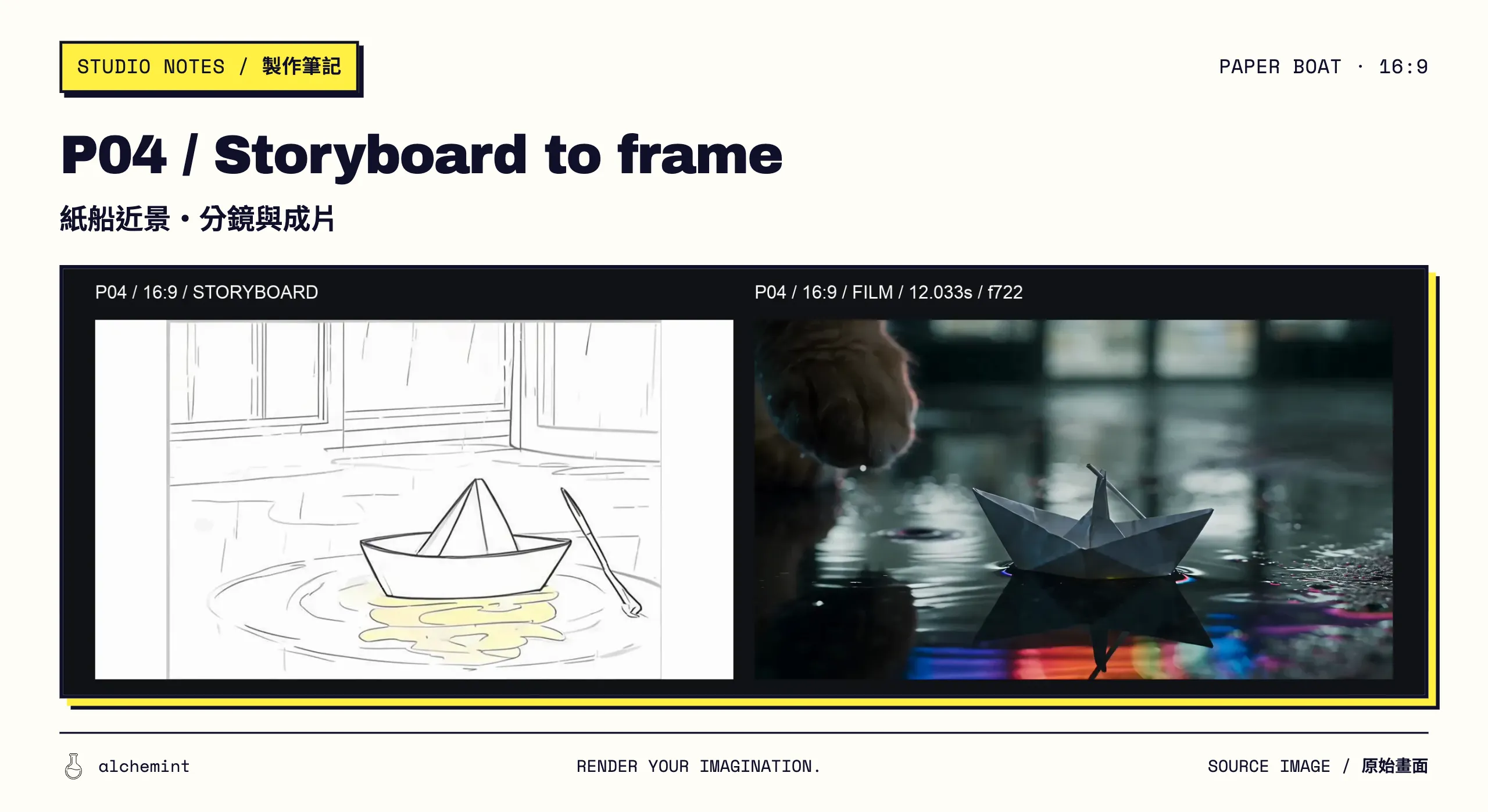
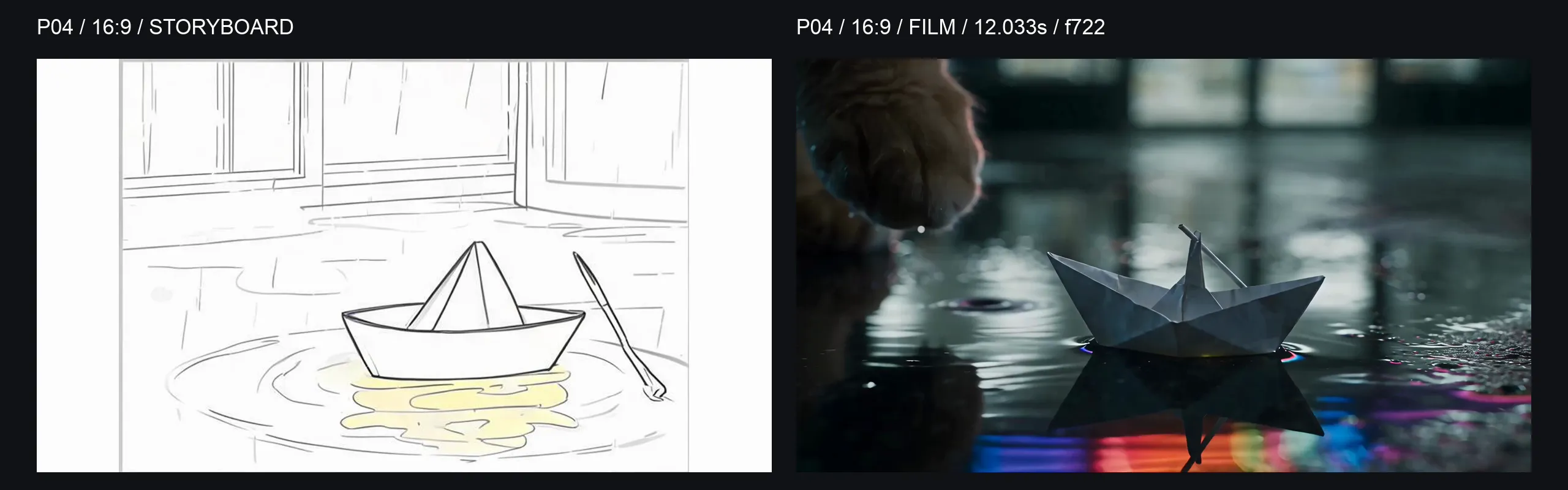
P04, 16:9. Representative frame: 12.033s, f722.
9:16 | formal storyboard on the left; final film on the right
We did not demand frame-perfect art from the Seedream 5.0 Lite storyboard. “Roughly the same shot” did the job. ByteDance still has not gone public, and buying token after token is starting to make us feel for the boss.
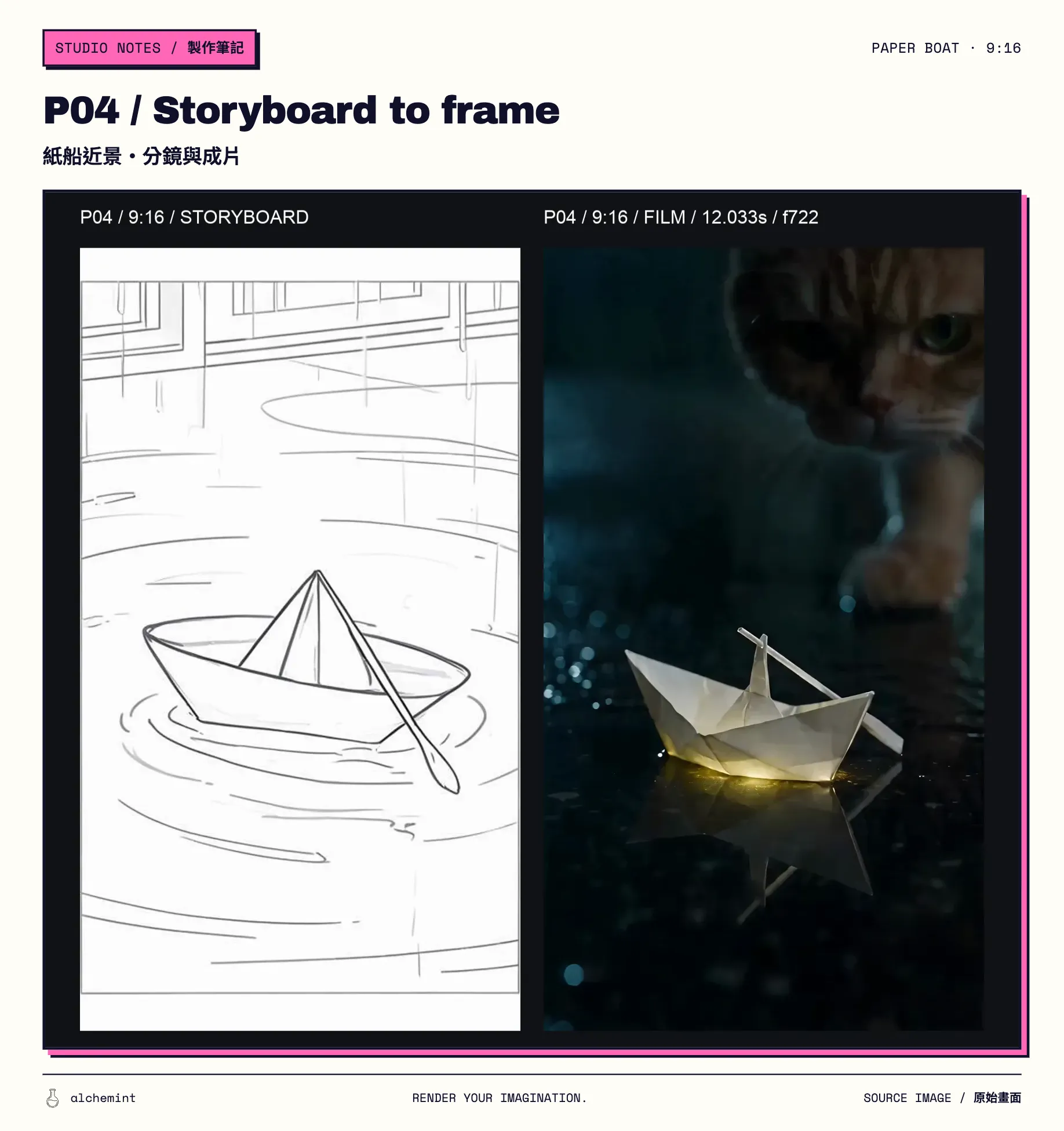
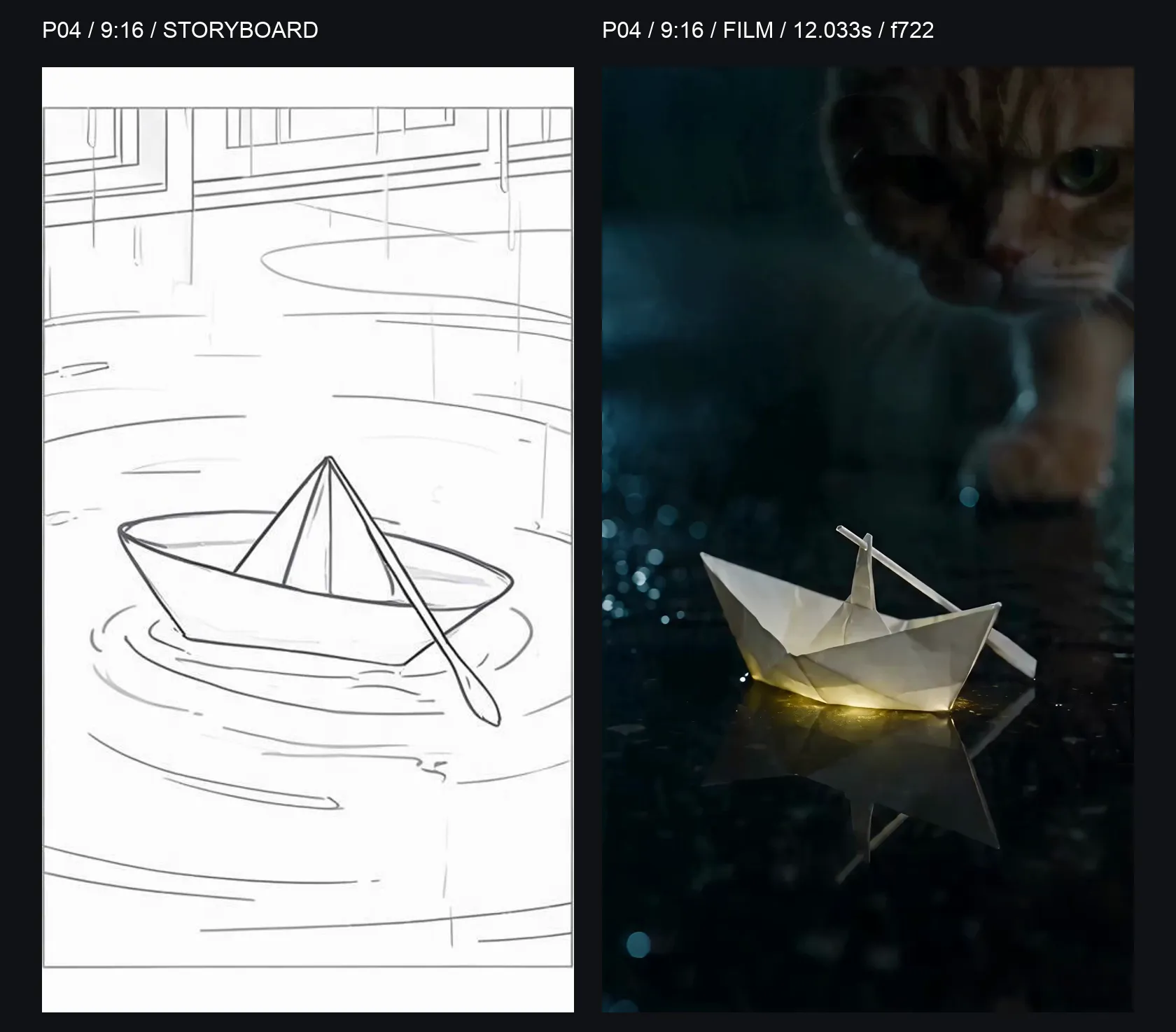
P04, 9:16. Representative frame: 12.033s, f722.
P05: face, paw and boat line up
16:9 | formal storyboard on the left; final film on the right
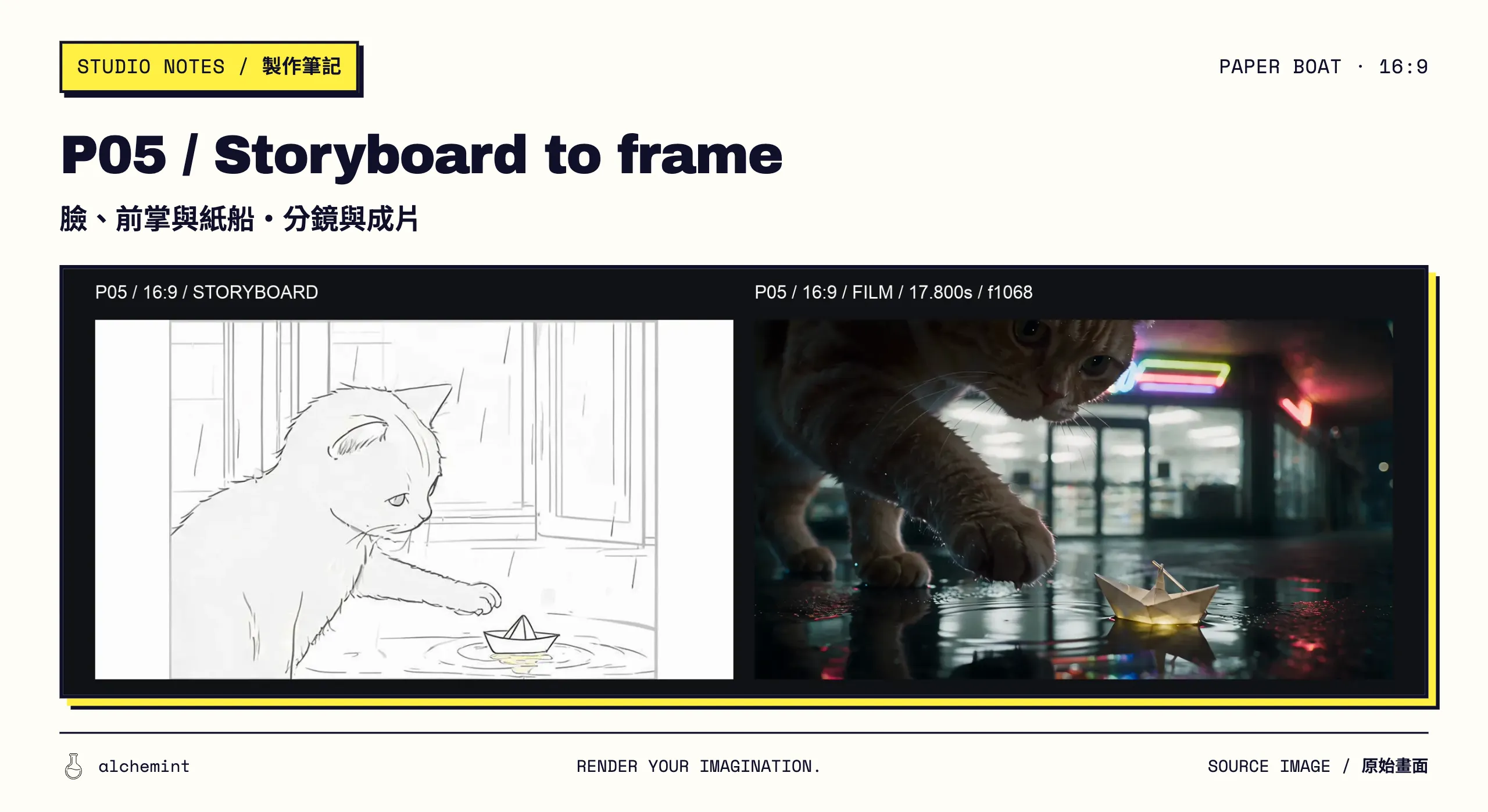
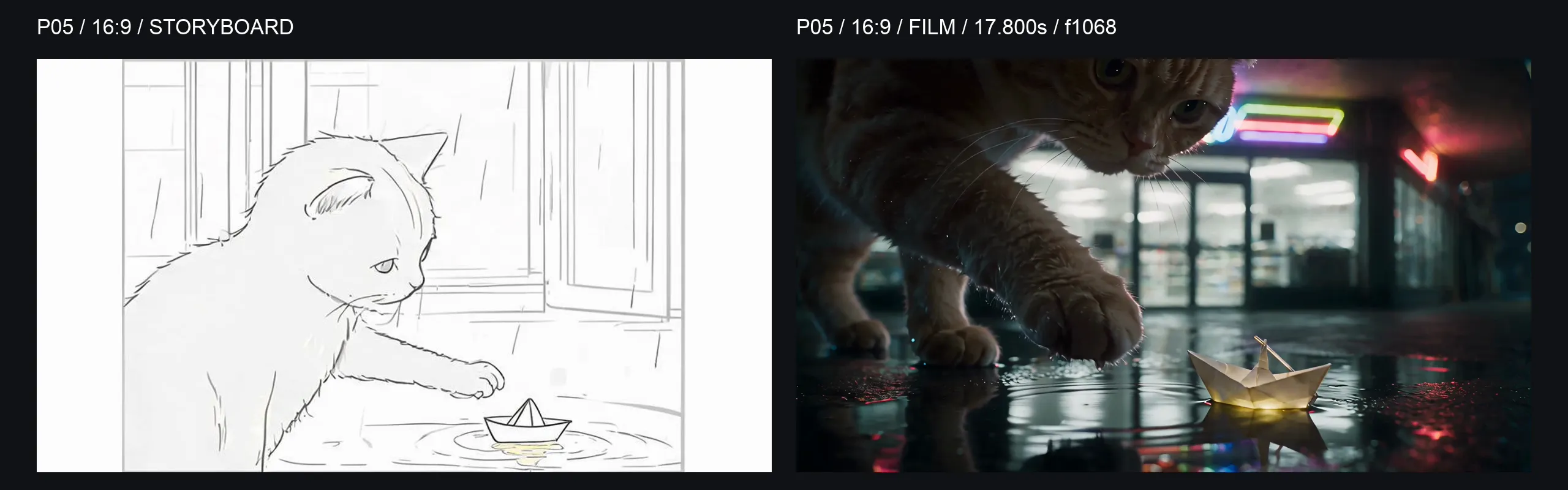
P05, 16:9. Representative frame: 17.800s, f1068.
9:16 | formal storyboard on the left; final film on the right
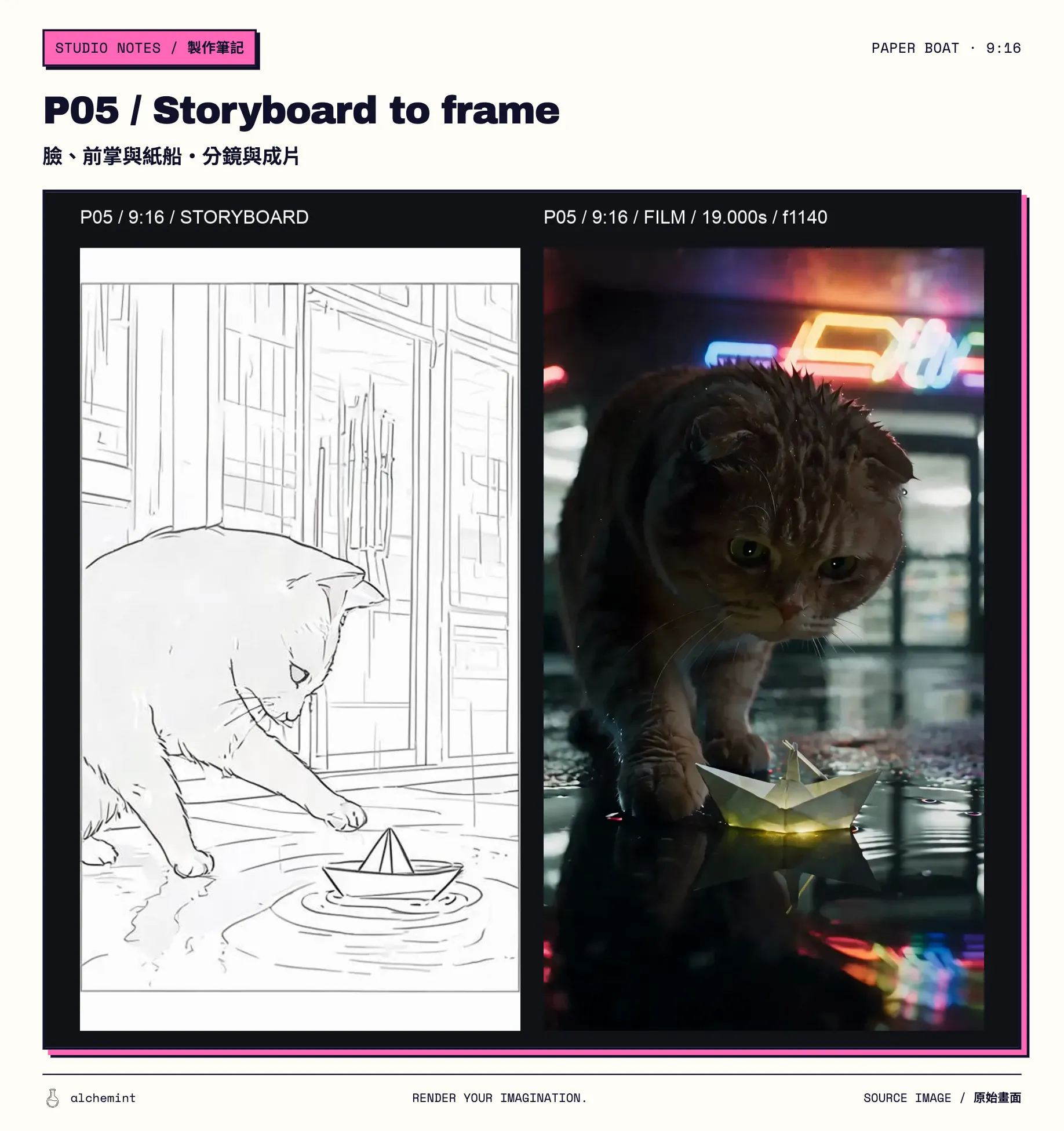
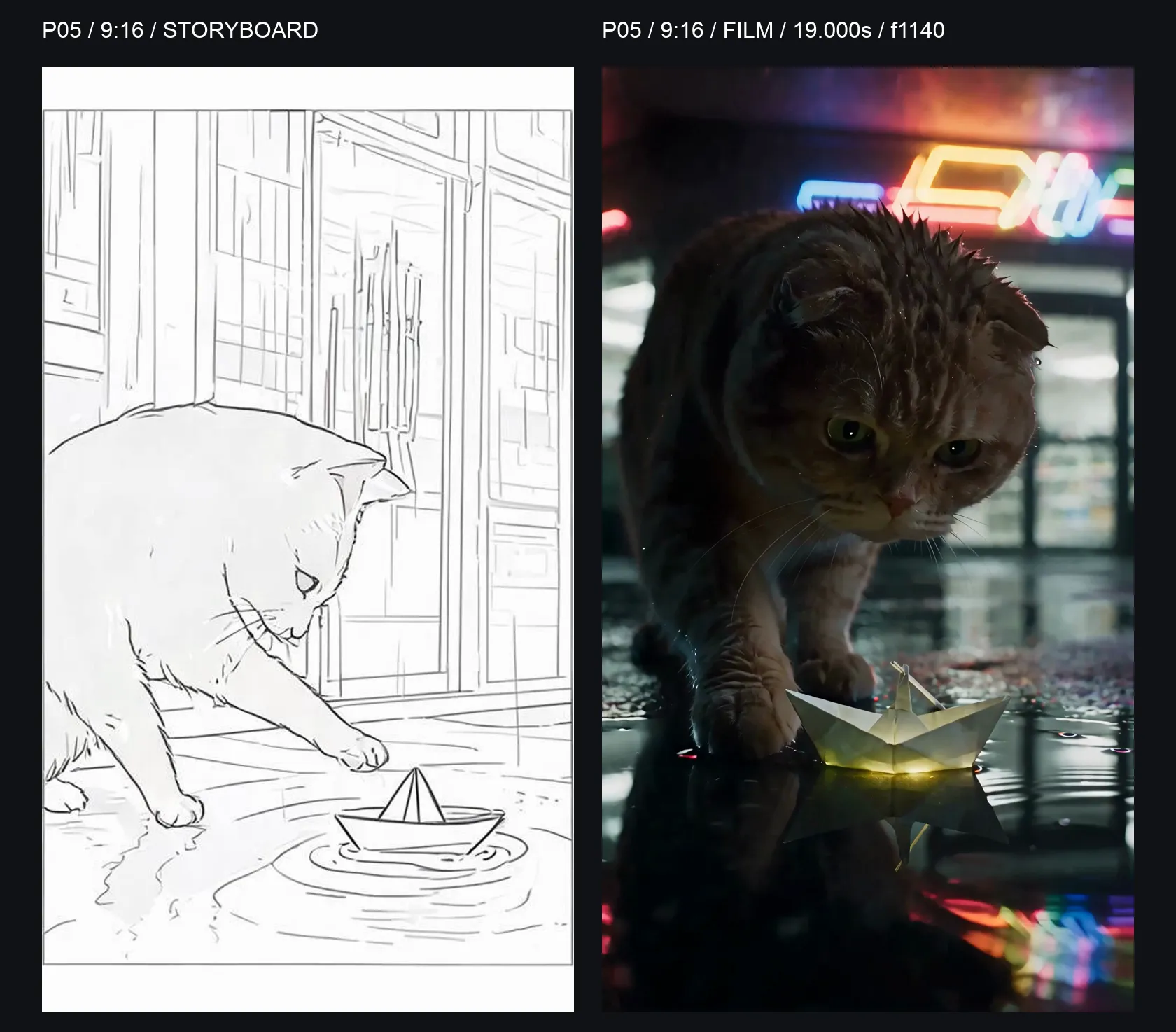
P05, 9:16. Representative frame: 19.000s, f1140.
P06: nose meets the glowing boat
P06 is one of the film’s most obedient frames. The cat’s face presses in from above, the boat stays under its nose, and the puddle catches the reflection.
16:9 | formal storyboard on the left; final film on the right
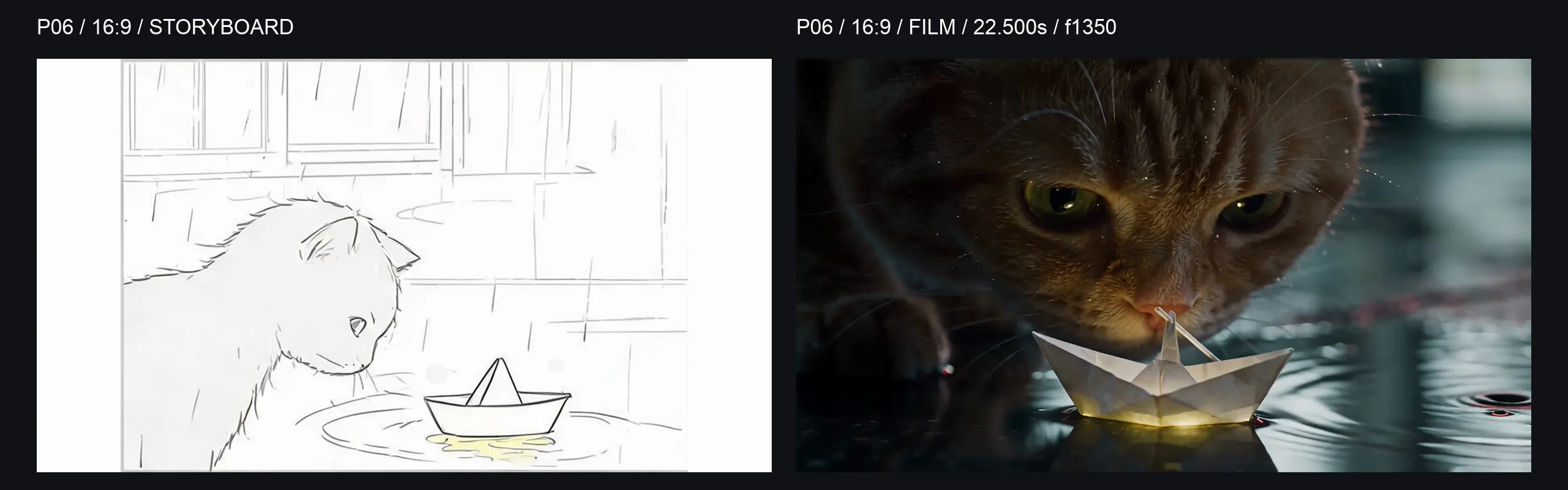
P06, 16:9. Representative frame: 22.500s, f1350.
9:16 | formal storyboard on the left; final film on the right
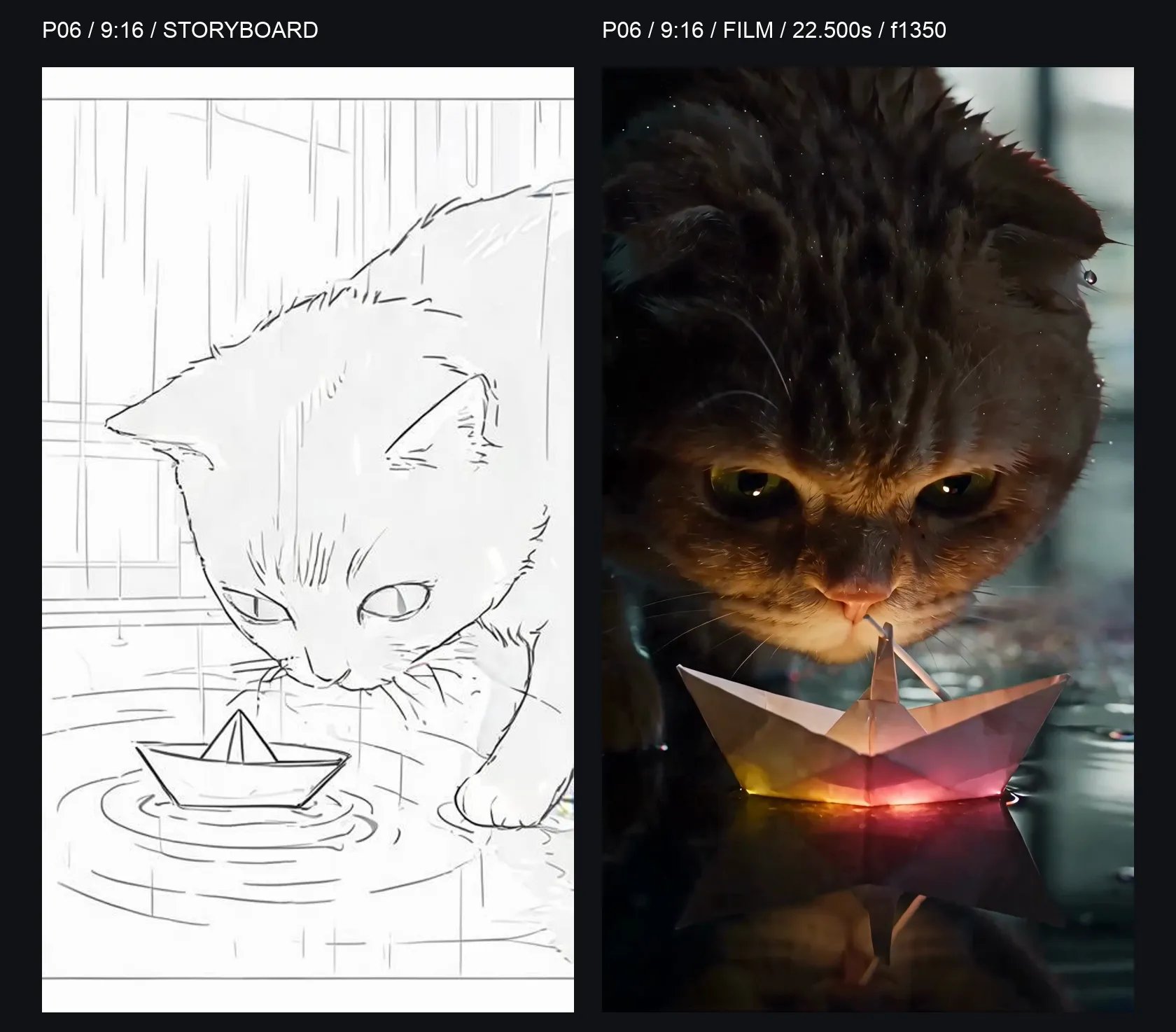
P06, 9:16. Representative frame: 22.500s, f1350.
Act 3: The Opening Frame Connects, Then Desktop Jumps Straight to Wide
Act 3 received the Act 2 tail frame in the same aspect ratio. That image defined the nose, boat, puddle, reflections and camera direction before P07 and P08 took over.
16:9 | Act 2 tail frame on the left; Act 3 first frame on the right
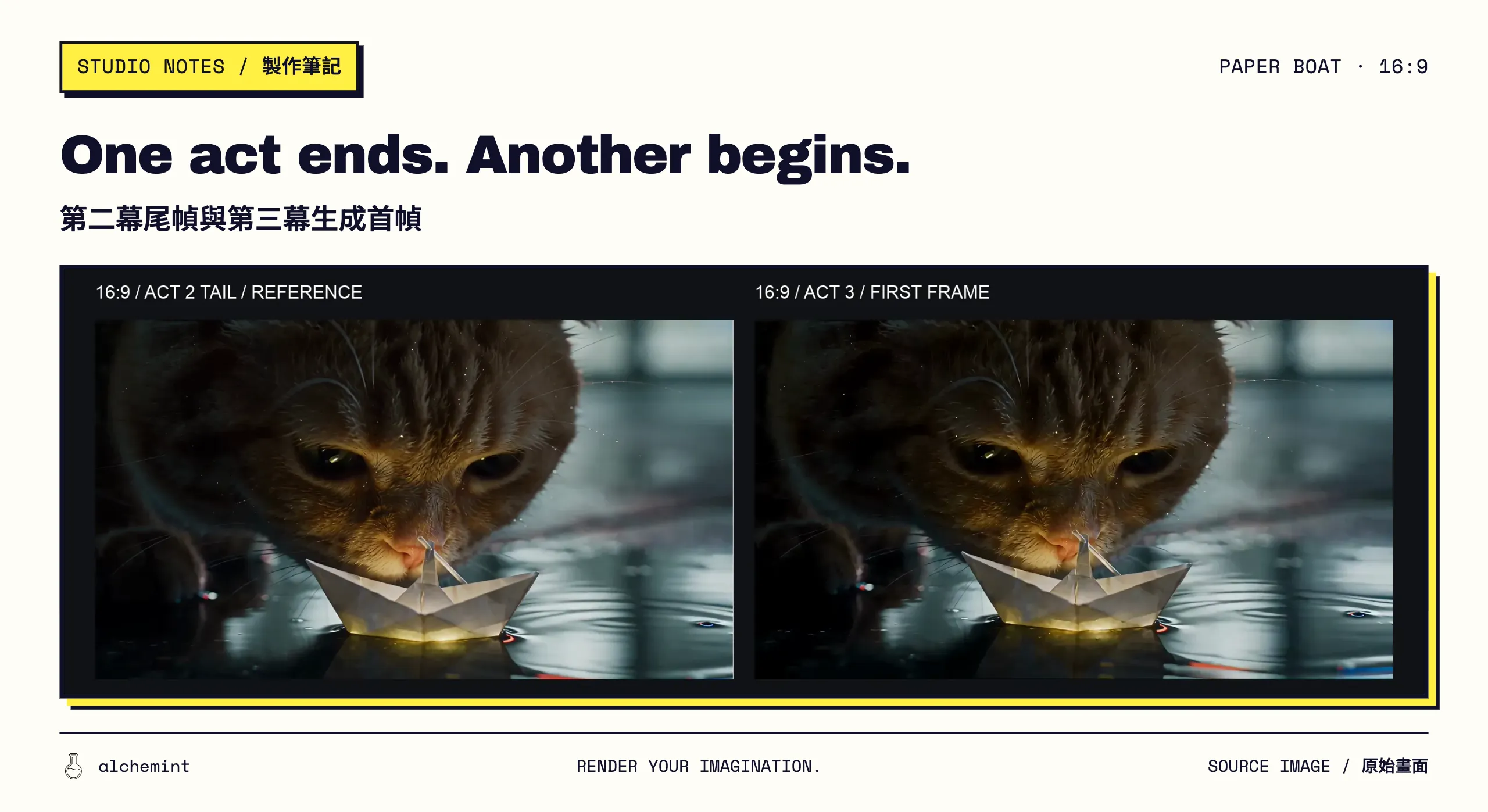
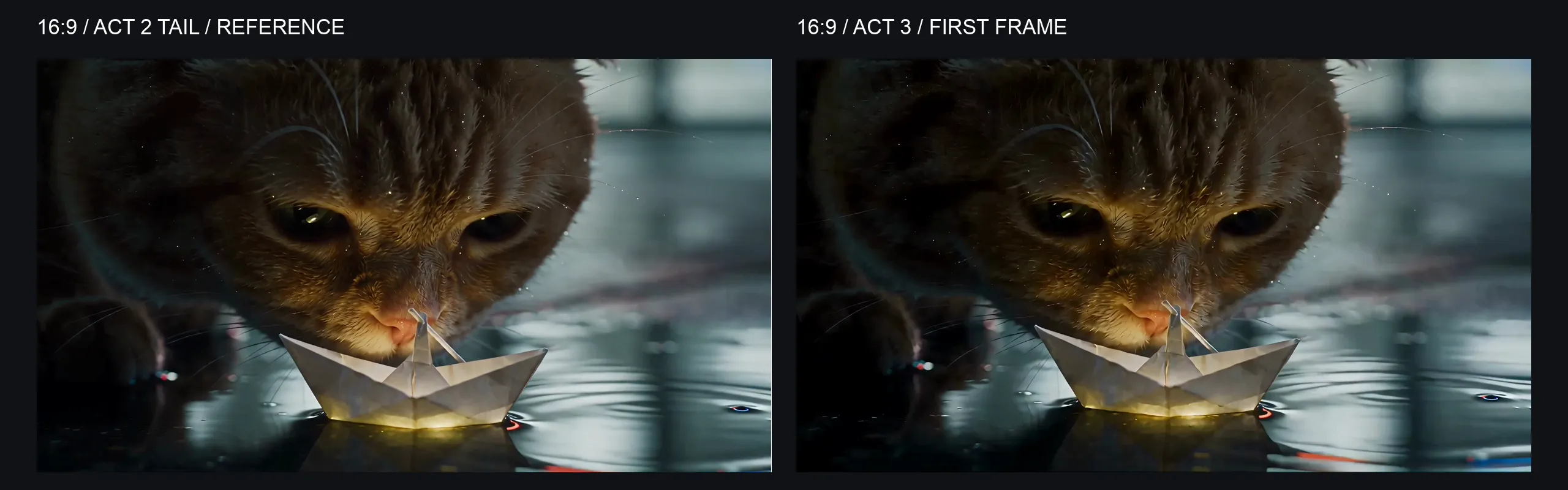
16:9 generation handoff. The composition holds while fine detail is recalculated.
9:16 | Act 2 tail frame on the left; Act 3 first frame on the right
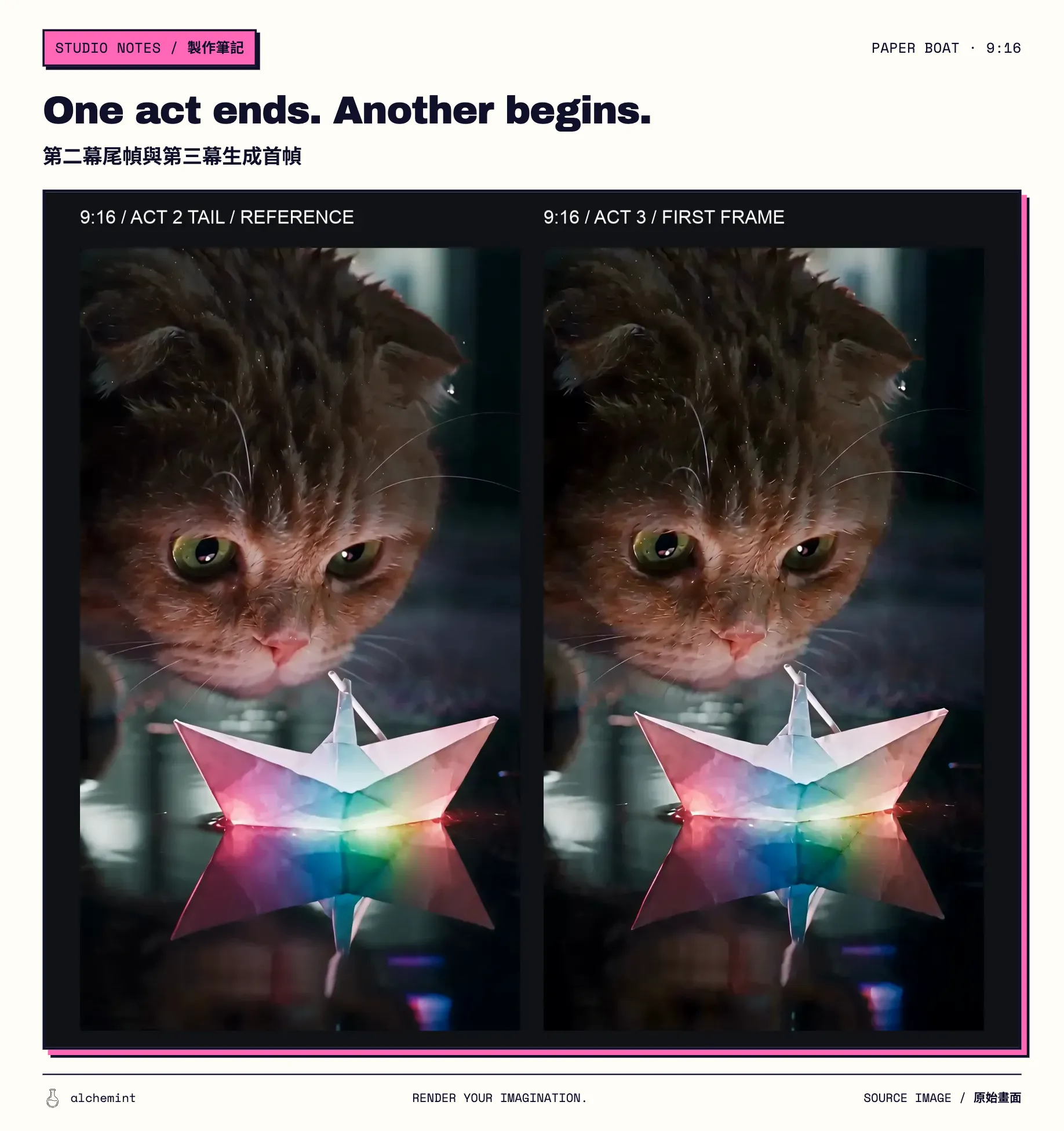
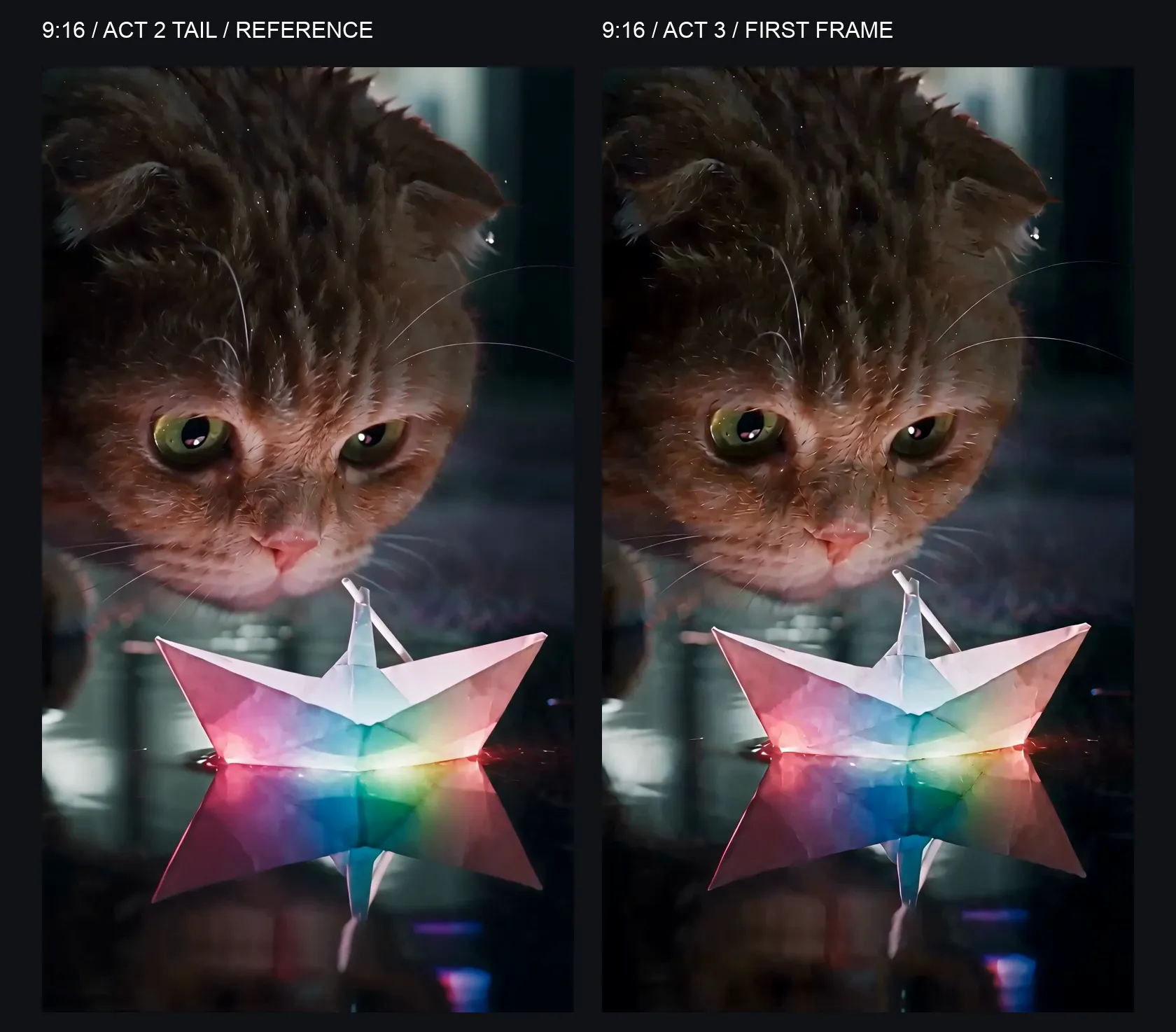
9:16 generation handoff. The opening-frame constraint worked; it never froze every pixel.
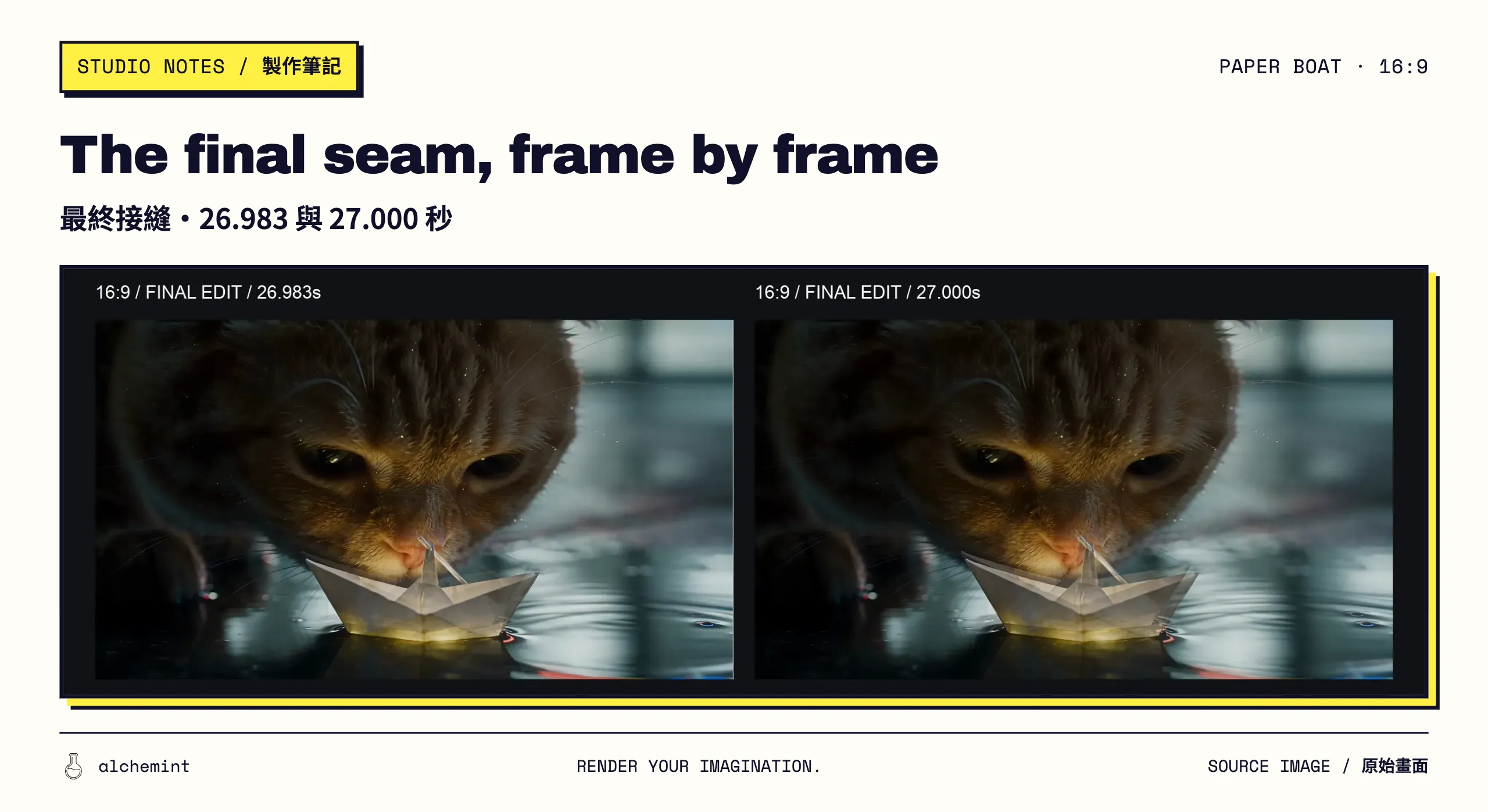
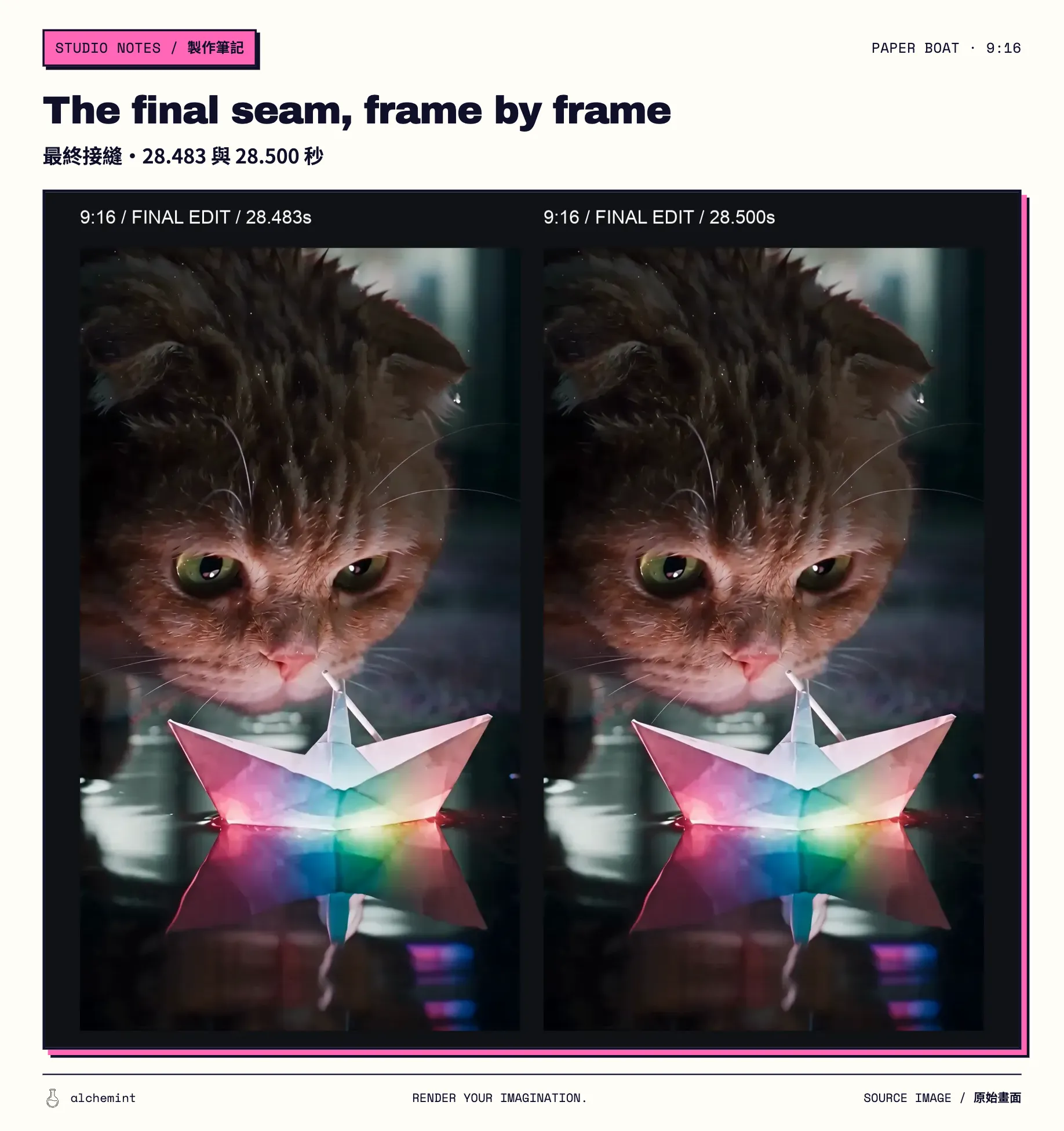
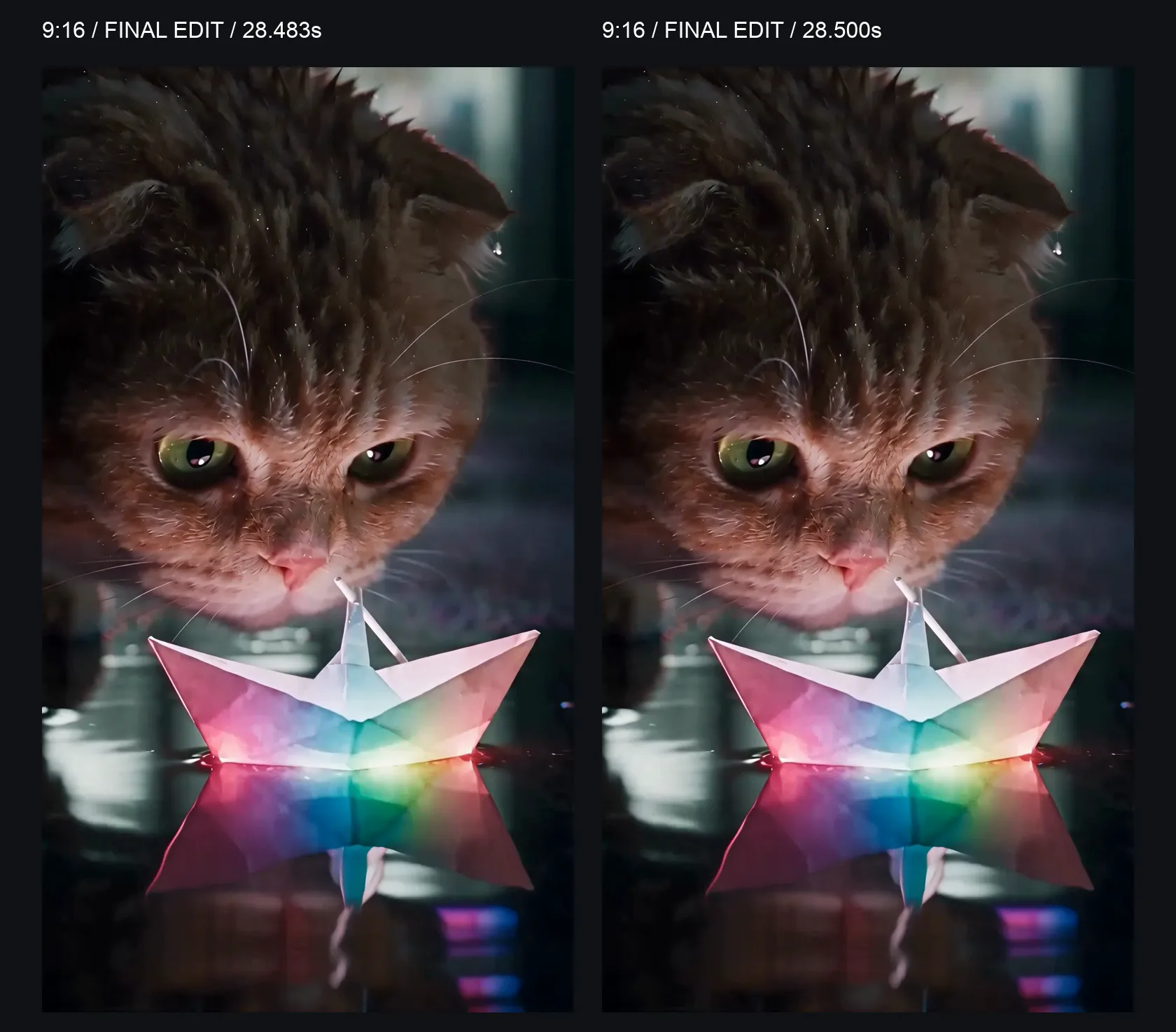
We chose a separate seam for the final edit. Landscape uses f1619→f1620, or 26.983→27.000 seconds. Portrait uses f1709→f1710, or 28.483→28.500 seconds. The reference frame helped generation start; it did not make our edit decision.
We used FFmpeg to compare the seams, trim to those cut points, and join the three Acts for each ratio into one film. We later turned the same checking and stitching workflow into the public Curtoom video-clip-stitching skill.
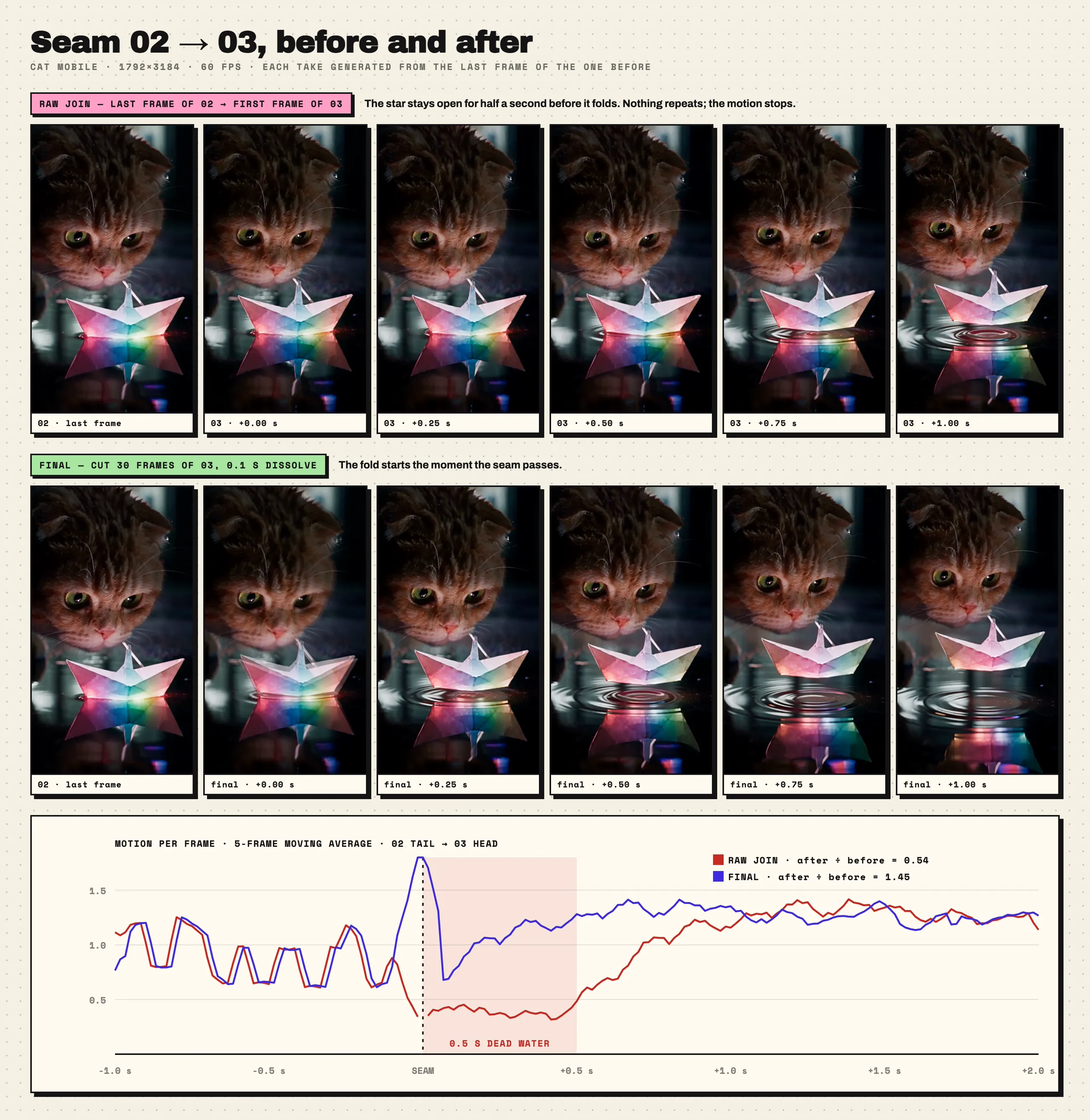
The same Mobile 02→03 seam. The raw join leaves about 0.5 seconds of dead water. Remove the first 30 frames of Act 3, add a 0.1-second dissolve, and the action keeps moving. The after-to-before motion ratio shifts from 0.54 to 1.45.
The same second of footage, looping at 0.5× speed. The raw join on the left stalls; the final cut on the right keeps moving.
16:9 | frame before the final seam on the left; frame after it on the right
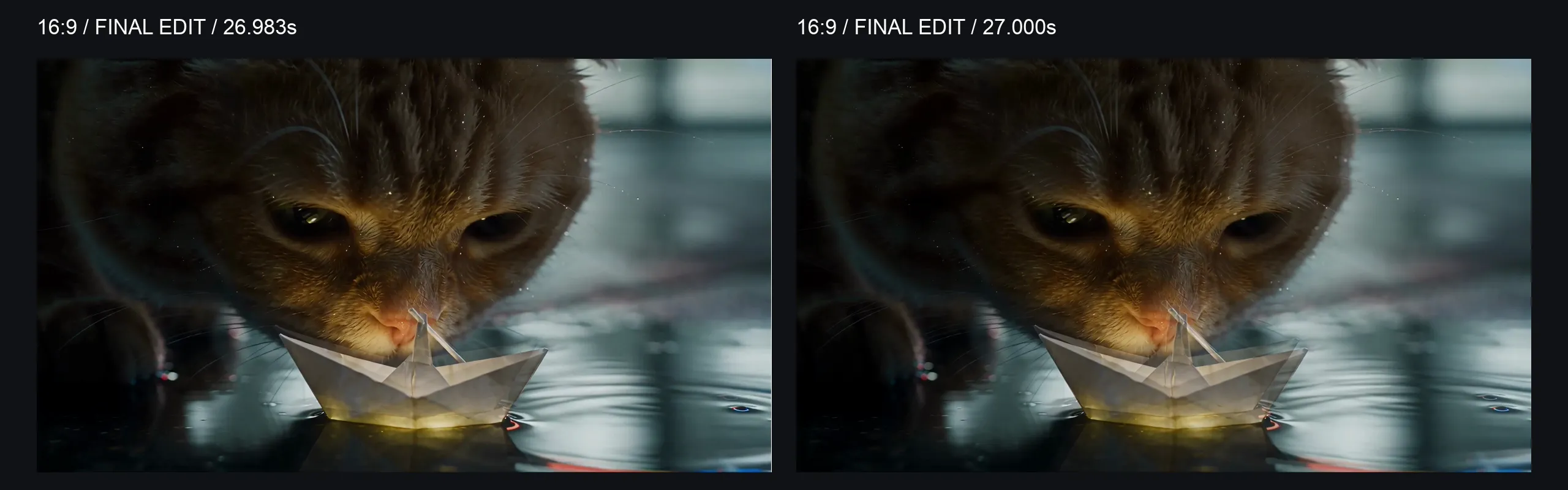
9:16 | frame before the final seam on the left; frame after it on the right
P07: Mobile reaches the full-body medium shot; Desktop barely settles
16:9 | formal storyboard on the left; final film on the right
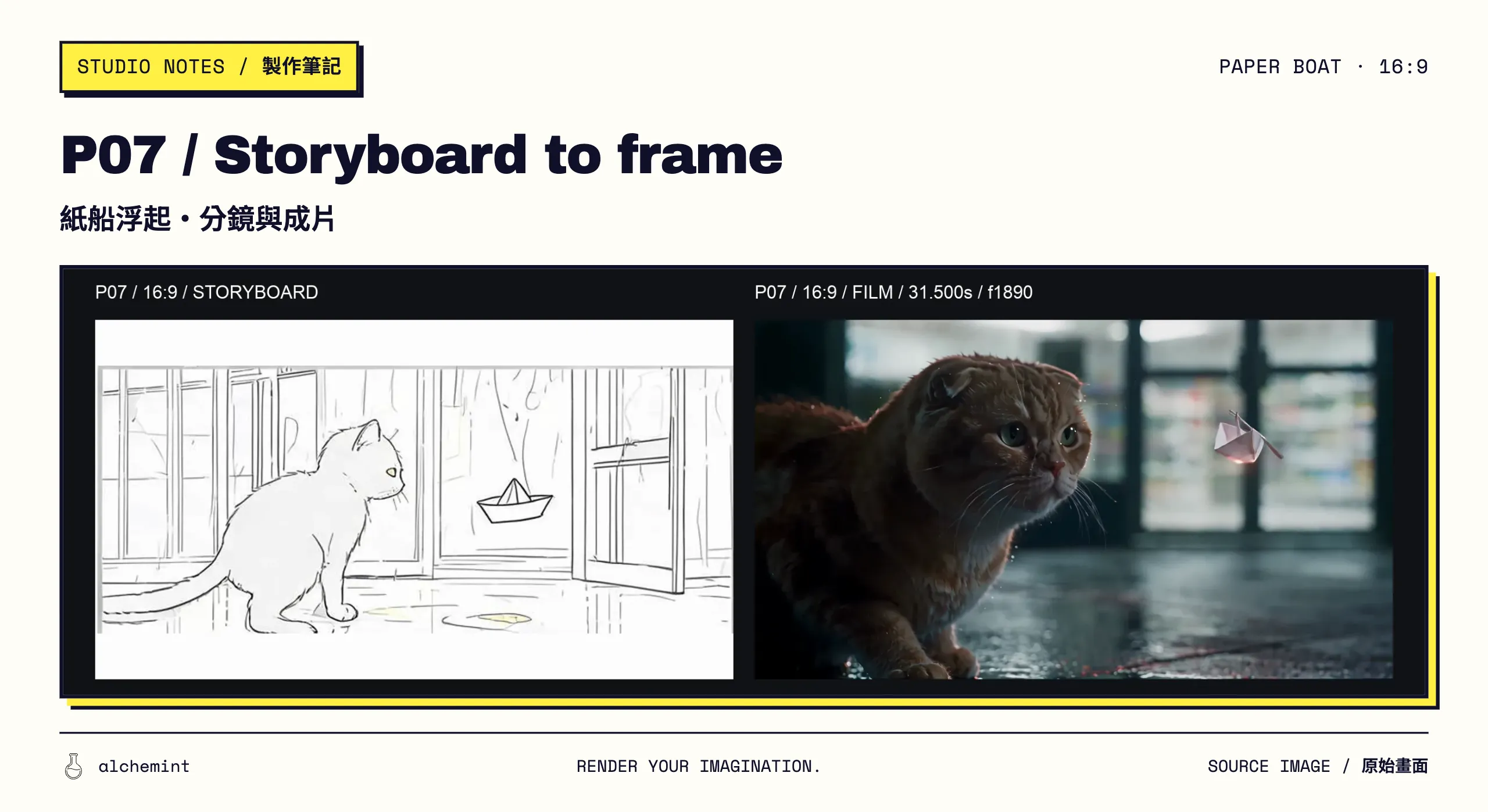
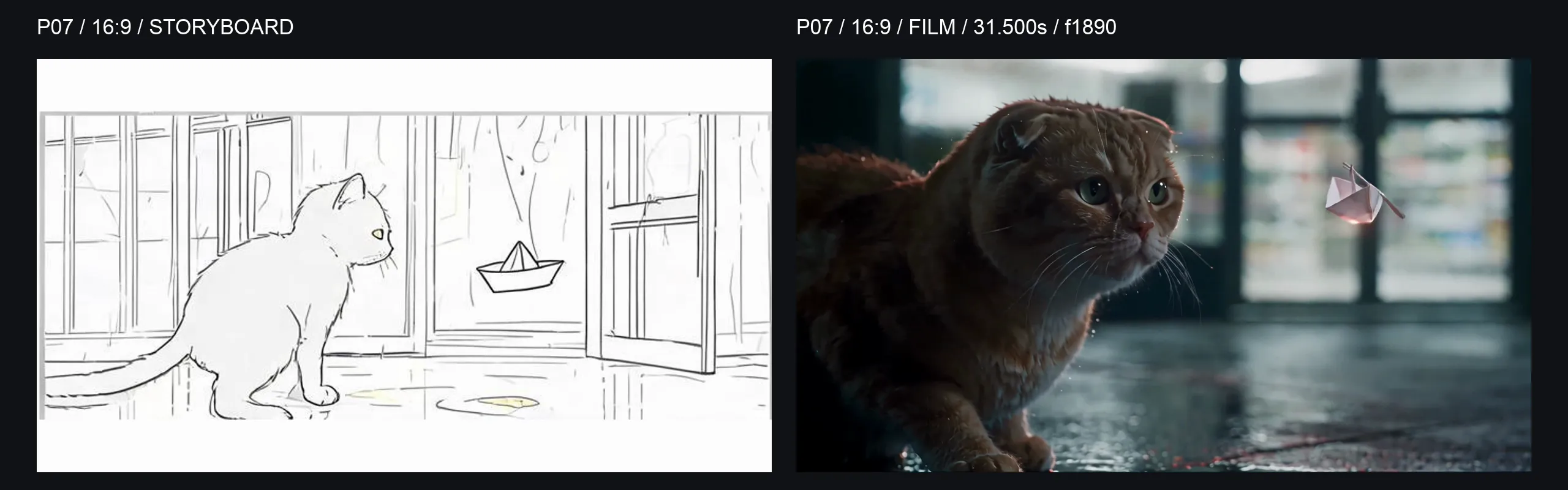
P07, 16:9. Representative frame: 31.500s, f1890. The lift happens while the framing stays tight.
9:16 | formal storyboard on the left; final film on the right
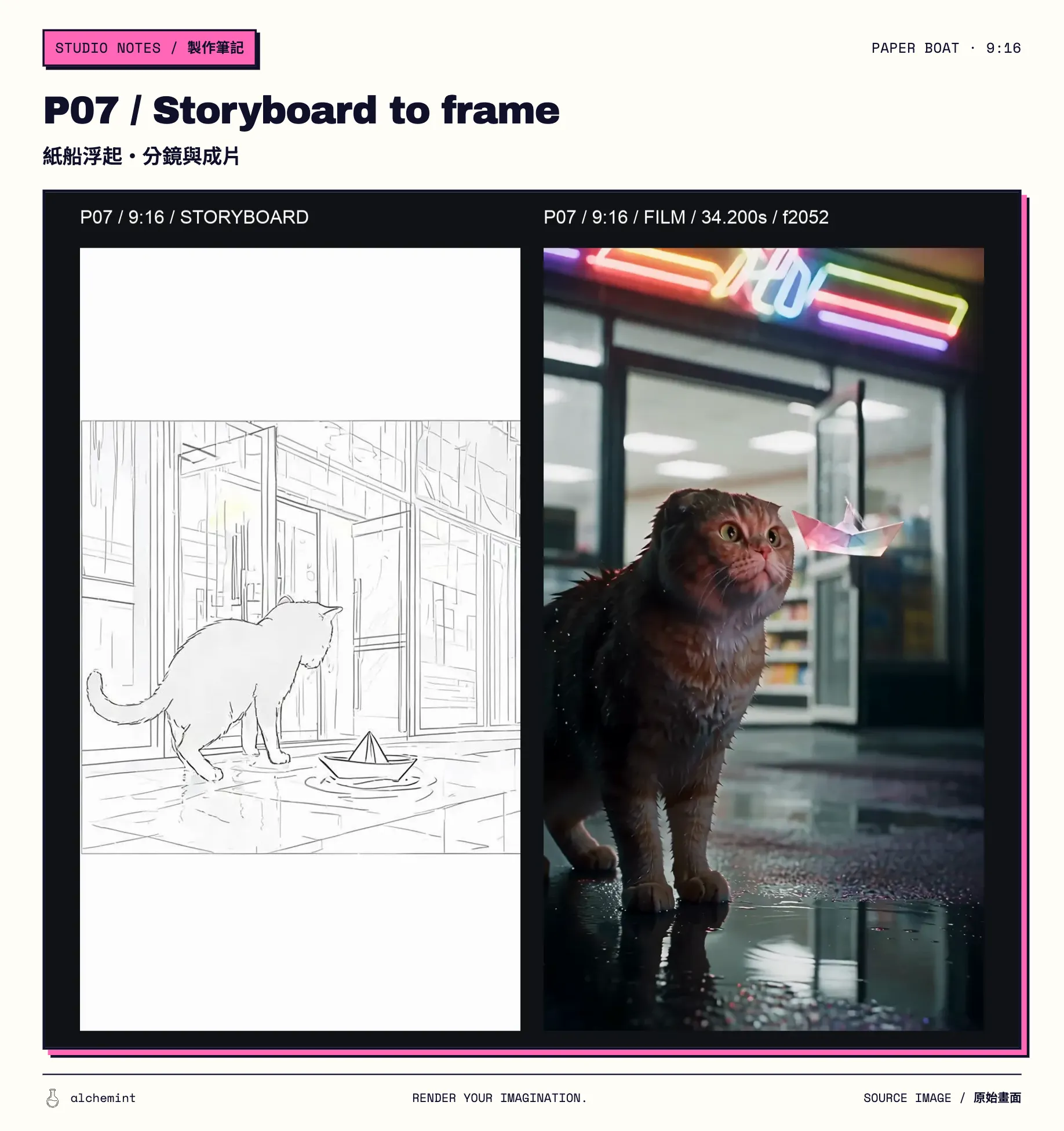
P07, 9:16. Corrected representative frame: 34.200s, f2052. The next labelled moment has already entered P08.
P08: both films leave; they choose different roads
16:9 | formal storyboard on the left; final film on the right
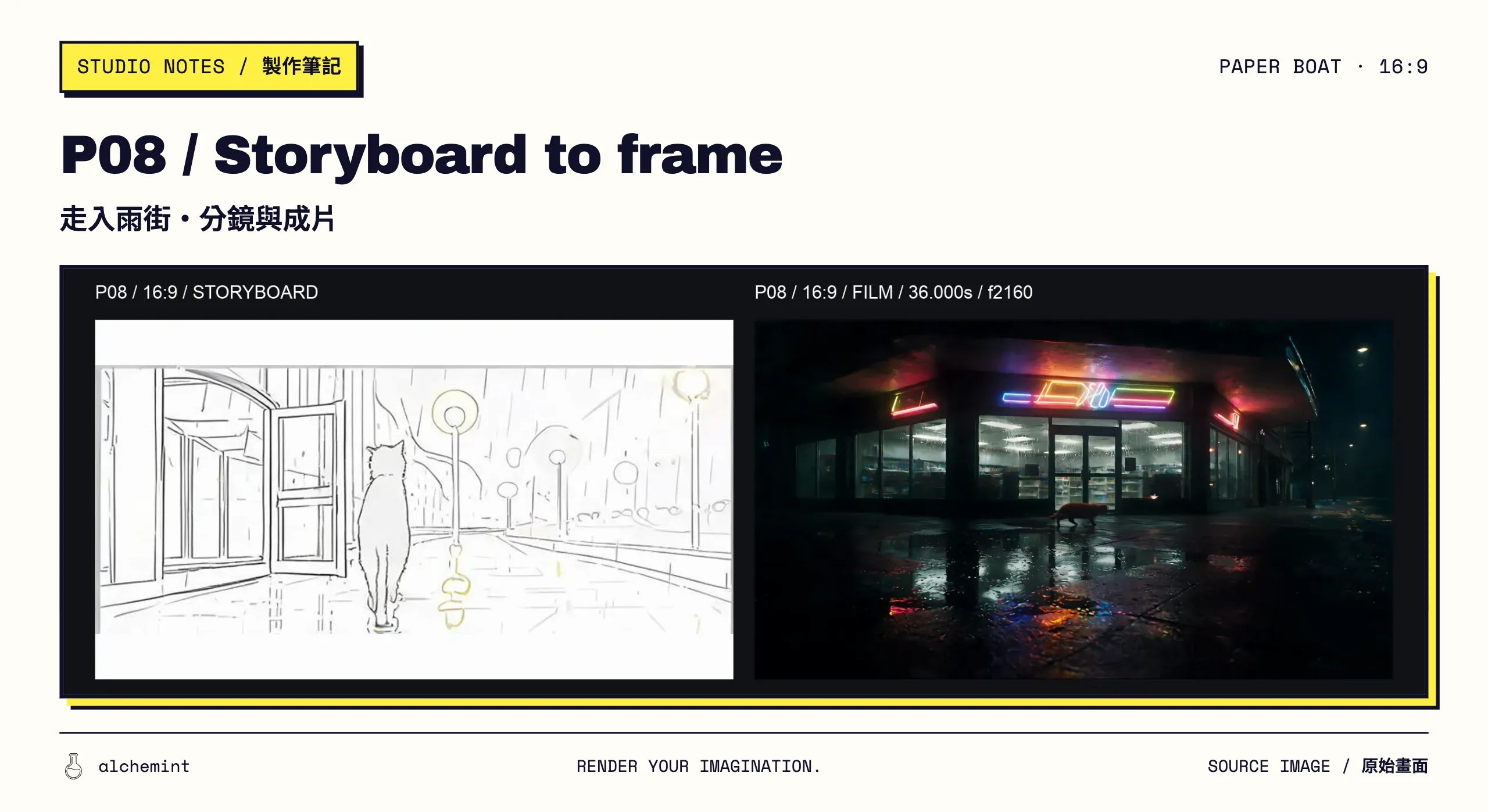
P08, 16:9. Representative frame: 36.000s, f2160. The departure remains clear and turns lateral.
9:16 | formal storyboard on the left; final film on the right
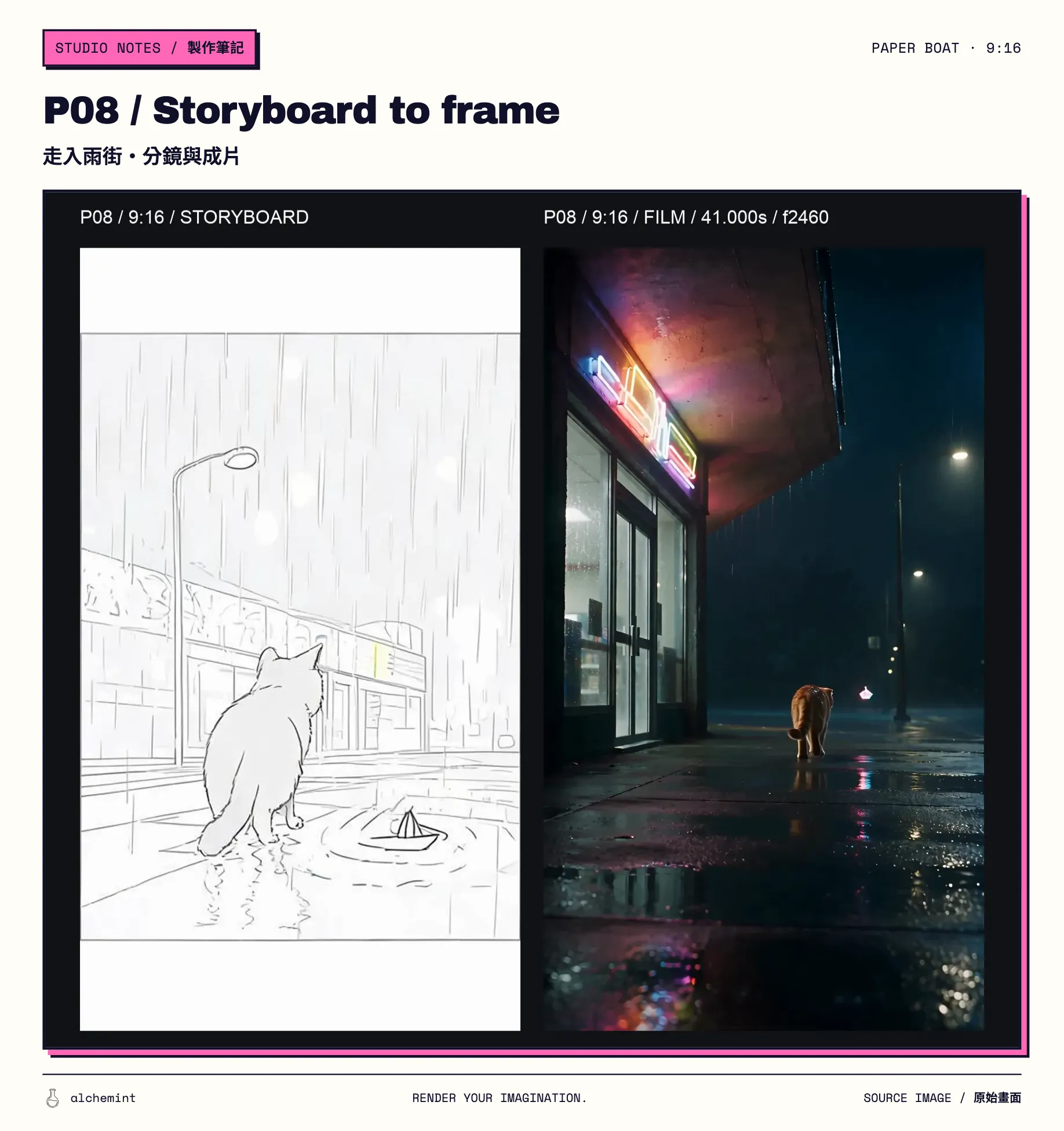
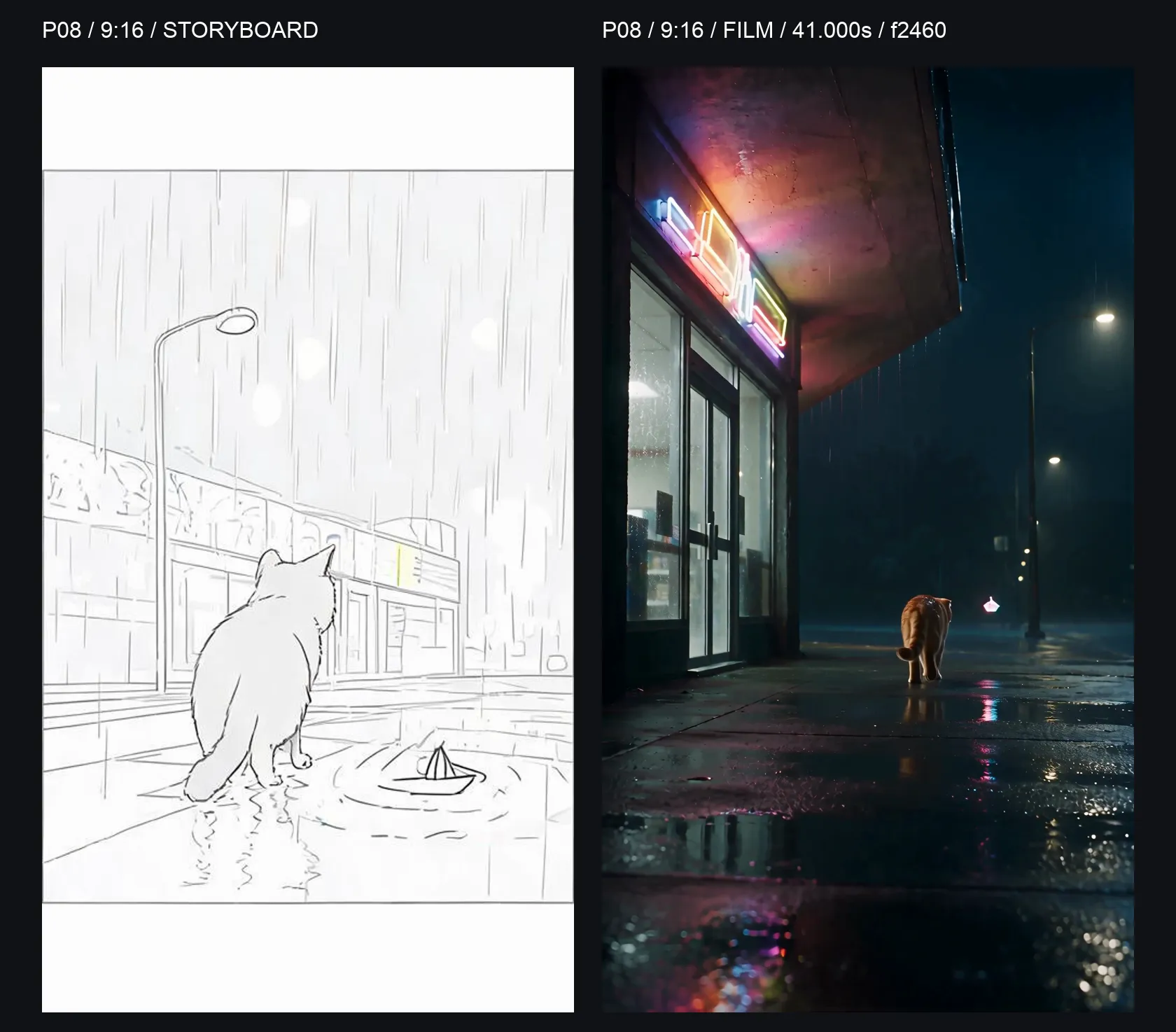
P08, 9:16. Representative frame: 41.000s, f2460. The back view and street depth both survive.
The Desktop jump lands near 32.77 seconds in the finished film. At 32.700 seconds, the cat and boat still fill a close frame. By 32.800 seconds, both have become small shapes in a storefront extreme wide. Mobile cuts at 34.300 seconds; its pre-cut frame has already reached a full-body composition, and the subjects stay readable after the cut.
16:9 | Desktop Act 3 before and after the cut
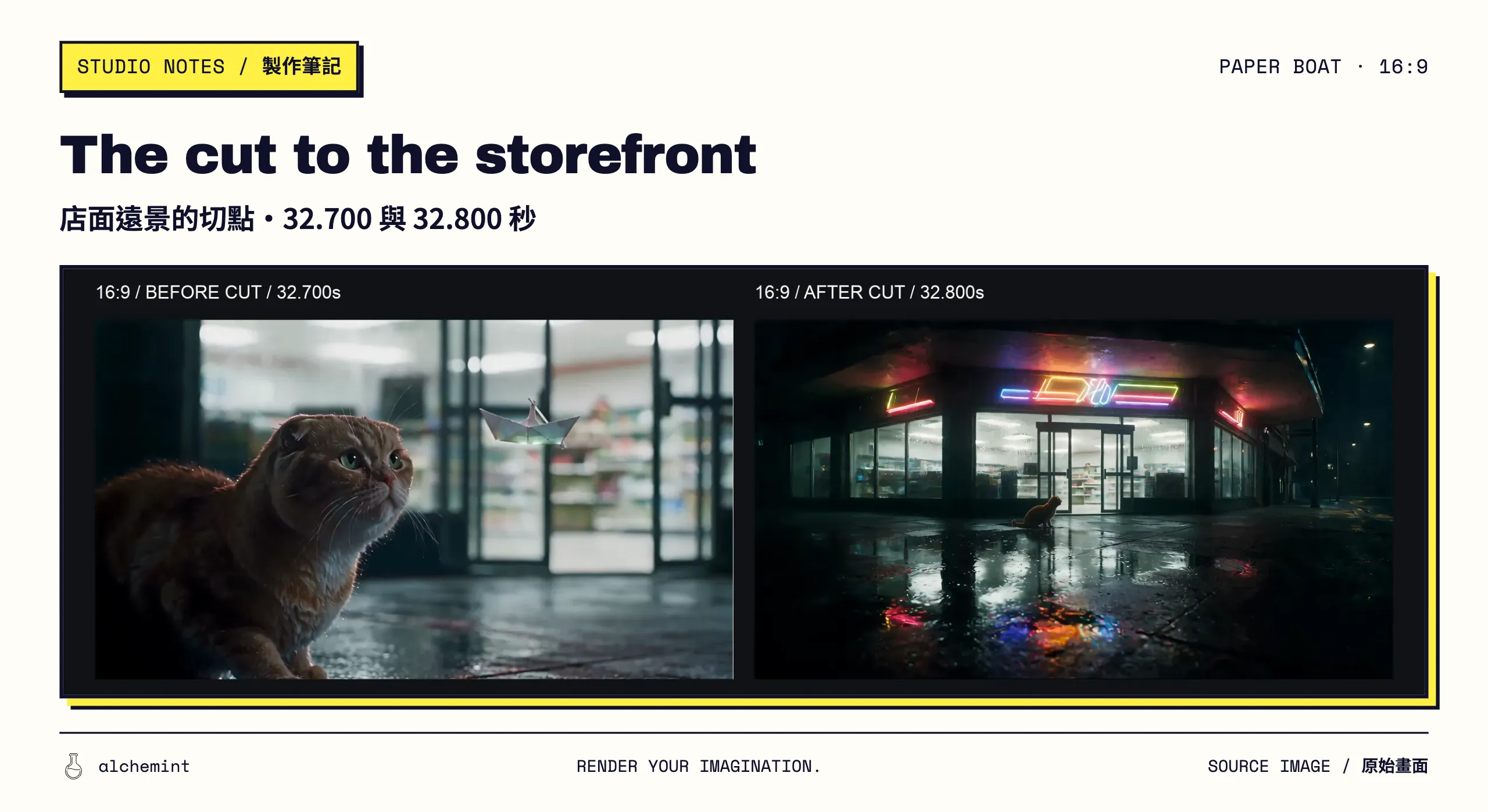
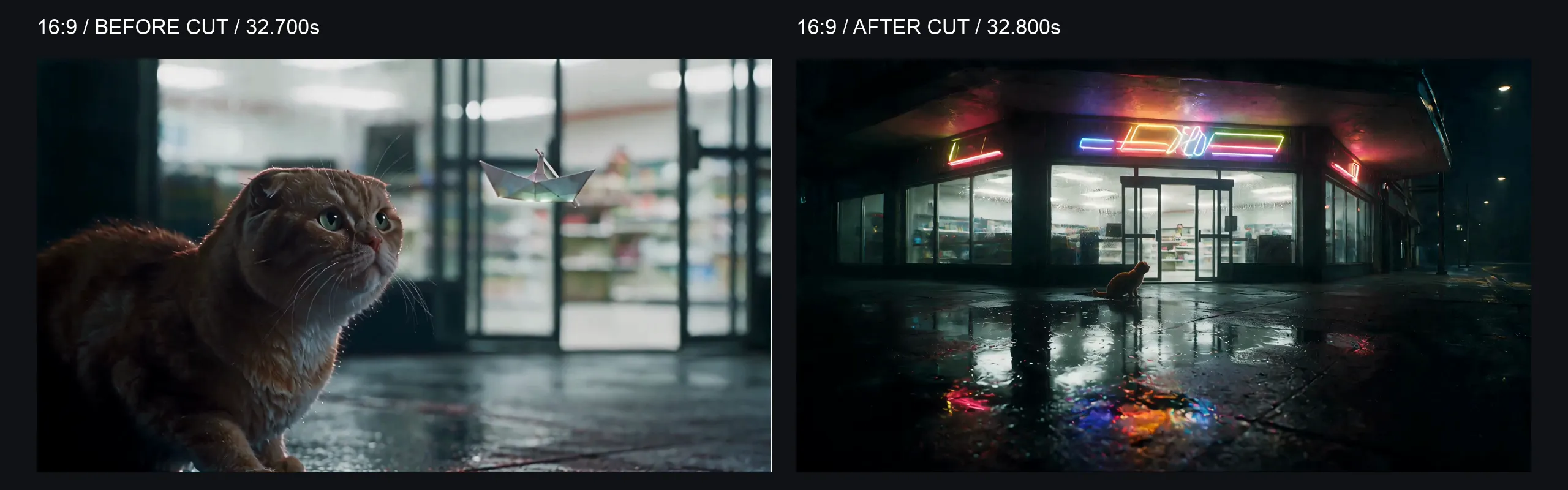
9:16 | Mobile Act 3 before and after the cut
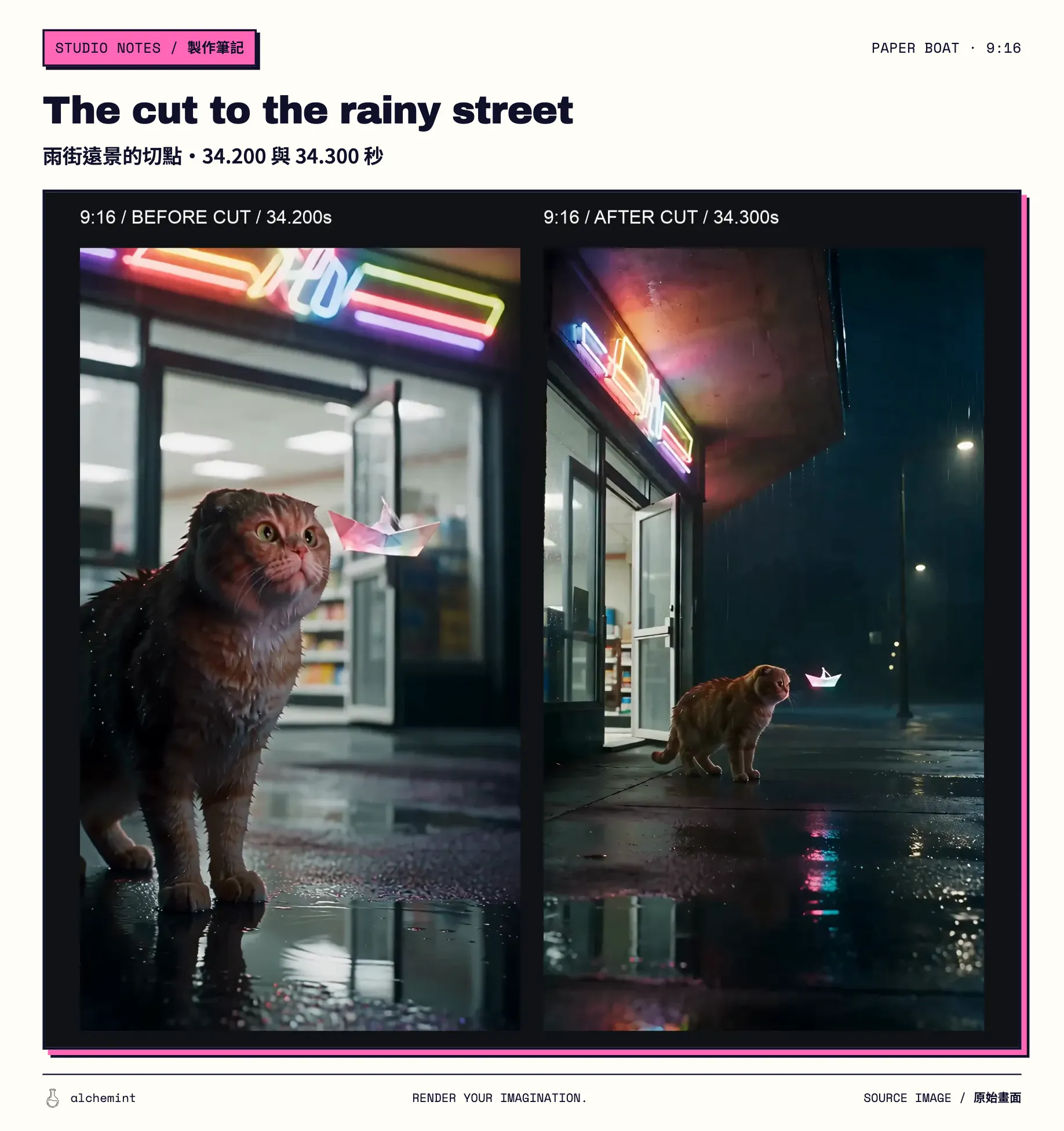
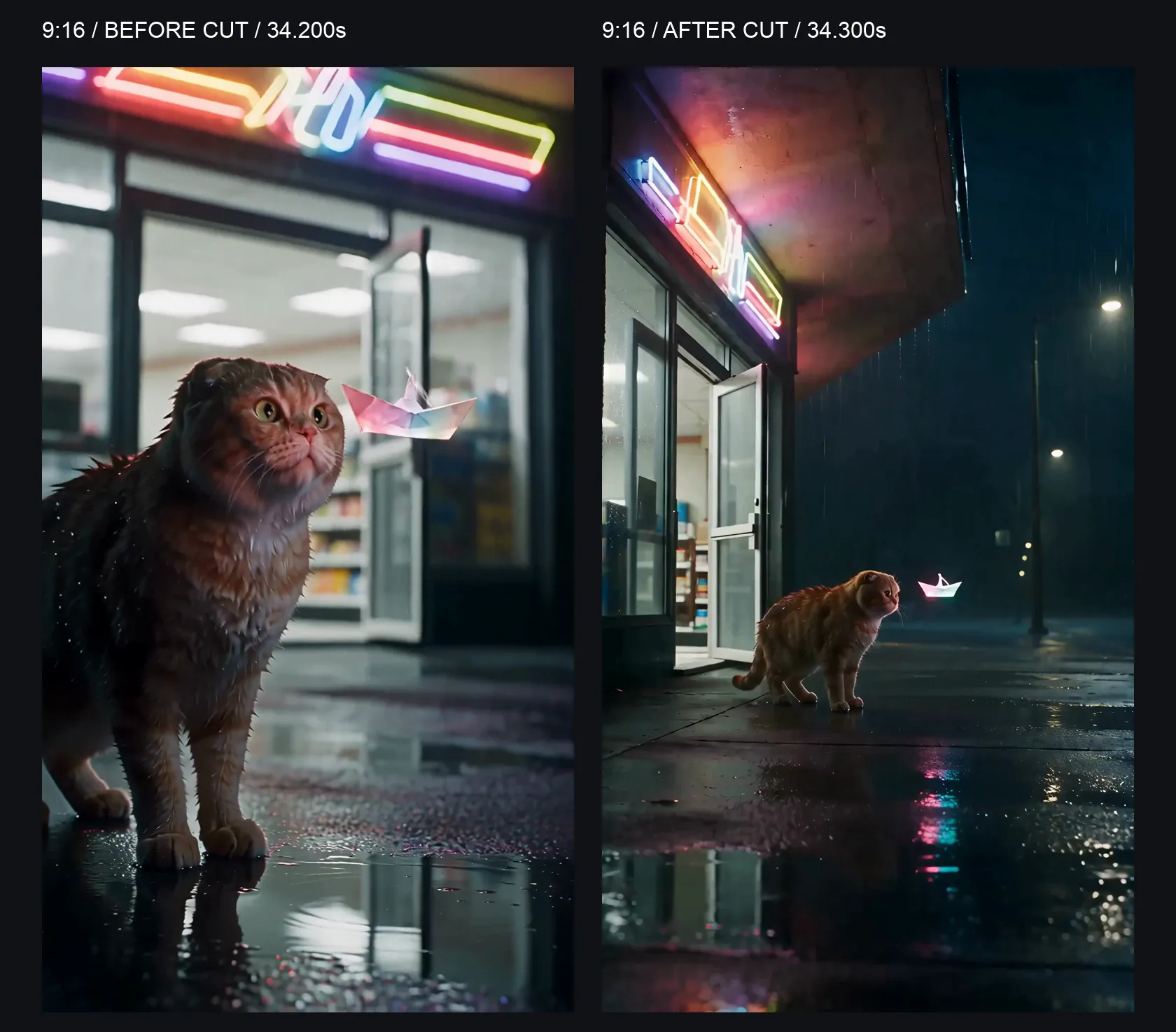
We had written the jump into the prompt. The excerpt below keeps the shot size and camera move while omitting asset tags and later actions:
P07, 0–6 seconds: begin naturally from the opening frame, continuously pull back and rise slightly, then end on a medium shot.
P08, 6–12 seconds: extreme long shot, camera slowly pulling back.
The opening objective also says the sequence contains two edited shots. Seedance cuts at roughly 5.8 seconds, nearly on the six-second boundary. P07’s “medium shot” becomes the previous shot’s destination. P08’s “extreme long shot” becomes the new shot’s launch position. “Slowly pulling back” starts after the cut. The model read our line. We just did not enjoy hearing it read aloud.
The picture in our heads needed a more precise sentence. This is a proposed revision, not another tested prompt:
Continue P08 from P07’s ending medium shot. First retain a readable full-body scale and the cat-and-boat left-right positions. Then pull back slowly, reaching the extreme long shot only at the end.
Moving “extreme long shot” from the opening condition to the ending state changes the entire move.
What We Left Under-Specified
The test left three production notes worth keeping:
- A timestamp still needs a new camera position after the cut. P02 and P03 have a boundary; their camera grammar barely changes.
- Shot size at the beginning of a line can become the starting state. Desktop P08 is a clean example.
- A camera move needs a start, direction, speed and stopping point. “Tracking” alone leaves us guessing where the camera starts and ends.
Some drift deserves to live. Desktop’s lateral departure keeps the central action intact: the cat follows the boat away. We accepted it. A missing subject, broken order or reversed departure relationship would have sent us back to generation.
Across the six submissions, both boards made it into their films and every panel can be found.
The storyboard tells the film where to go. The camera is still our homework.
For a general continuity workflow, see How to Make an AI Video Storyboard That Keeps Every Shot Connected. For the three submitted prompts and their first-draft differences, read Seedance 2.5 Prompt Test: We Wrote Too Much and Confused the Camera.