
Worldbuilding for AI Film Is Still the Creator’s Work
AI helps create characters and locations. Filmmakers still decide how the world works. Our heist animation explores that craft through maps, art and character roles.
After doing this, we think the most fun—and most crucial—job for a creative working today is defining the world. This is so, so, so, so, so important. Tolkien gave the peoples of Middle-earth their own languages, writing systems and histories.
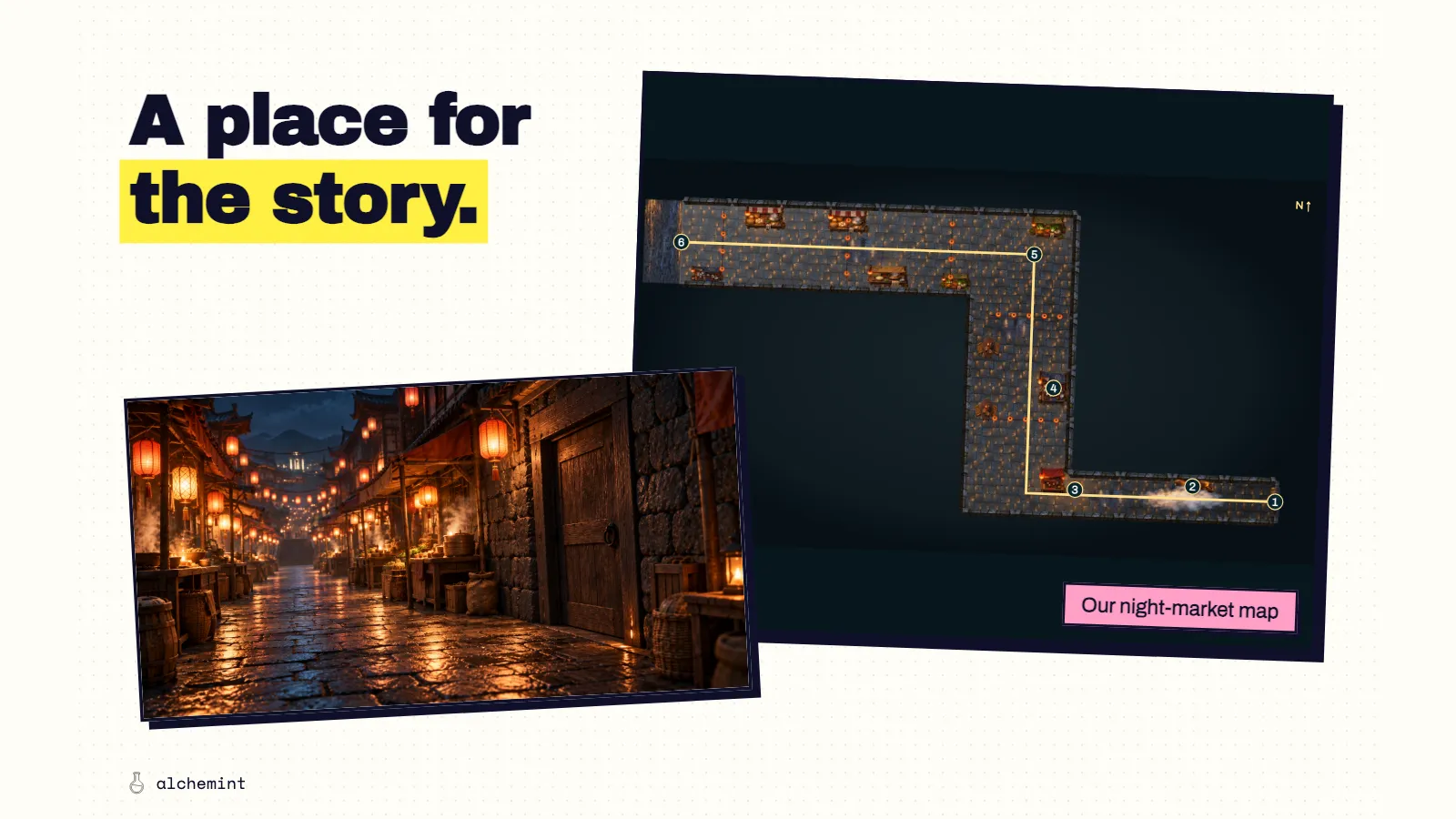
Likewise, after paying ByteDance, we finally understood what worldbuilding means! A map!!! The places where the characters in this film run around. It took at least twenty rerolls before we told Codex to hurry up and make a map. Otherwise, you get this:
They were supposed to escape into the night market. Instead, once the door opens, they walk back toward the tunnel. This version already used previz; the spatial relationship between the two sides of the door was still the problem.
I have absolutely no idea why the model made Shami throw backward??
Two parts of this source clip still made the final cut: 0–4.1 seconds at the beginning and 13.7–21.07 seconds later on. A problem doesn't mean the whole clip gets thrown away.
This was the clip that made it click:
This is the earliest version. We used filmmaking techniques, but Pi's gesture, the lights and the alarm are a complete mess. No previz, no blocking diagram, just the model figuring it out on its own.
By then, Pi's strange gestures barely surprised us. But video generation models really couldn't care less how you write your prompt. As far as the model is concerned, it's putting some images together for you.
An AI filmmaker has even more reason to build a believable world for the story. How people live, what limits their actions and why events happen are creative decisions. AI can help produce locations, character designs and previz. I have to choose which ideas belong and make them work together in the film I want to make.
Otherwise, take a look:
Serelya looks like she's performing with the Evergrande song-and-dance troupe.
The world's rules determine what can happen
In Coco, a dead person's return to the living world depends on being remembered and having their photo displayed there. The setting creates a concrete obstacle for a character. Its architecture has a premise too: new arrivals keep coming, so the filmmakers imagined a city that keeps growing upward. Pixar's production account describes how those decisions shaped the world.
Game environments also have to connect art, characters and props with possible actions. Epic's account of environment art describes turning concepts and previz into a world suited to its characters and story, while accommodating gameplay constraints.
That helps me identify what I need to prepare. Even a short heist needs a decision about how access works, why someone can get inside and what prevents the crew from simply taking the box. Access cards, magic seals, a cargo cart and a market can share a world. Each needs a function that gives the characters something to do.
In our plan, Serelya has already entered to undo the magic seal. The others collect the crystal, then install it in the cart to stop it and retrieve the sealed box. Someone creates steam to cover a handoff; another group carries the box to the roof. These choices create a need for cooperation. Different people must finish different jobs before the next action becomes possible.
What sort of world does this heist need?
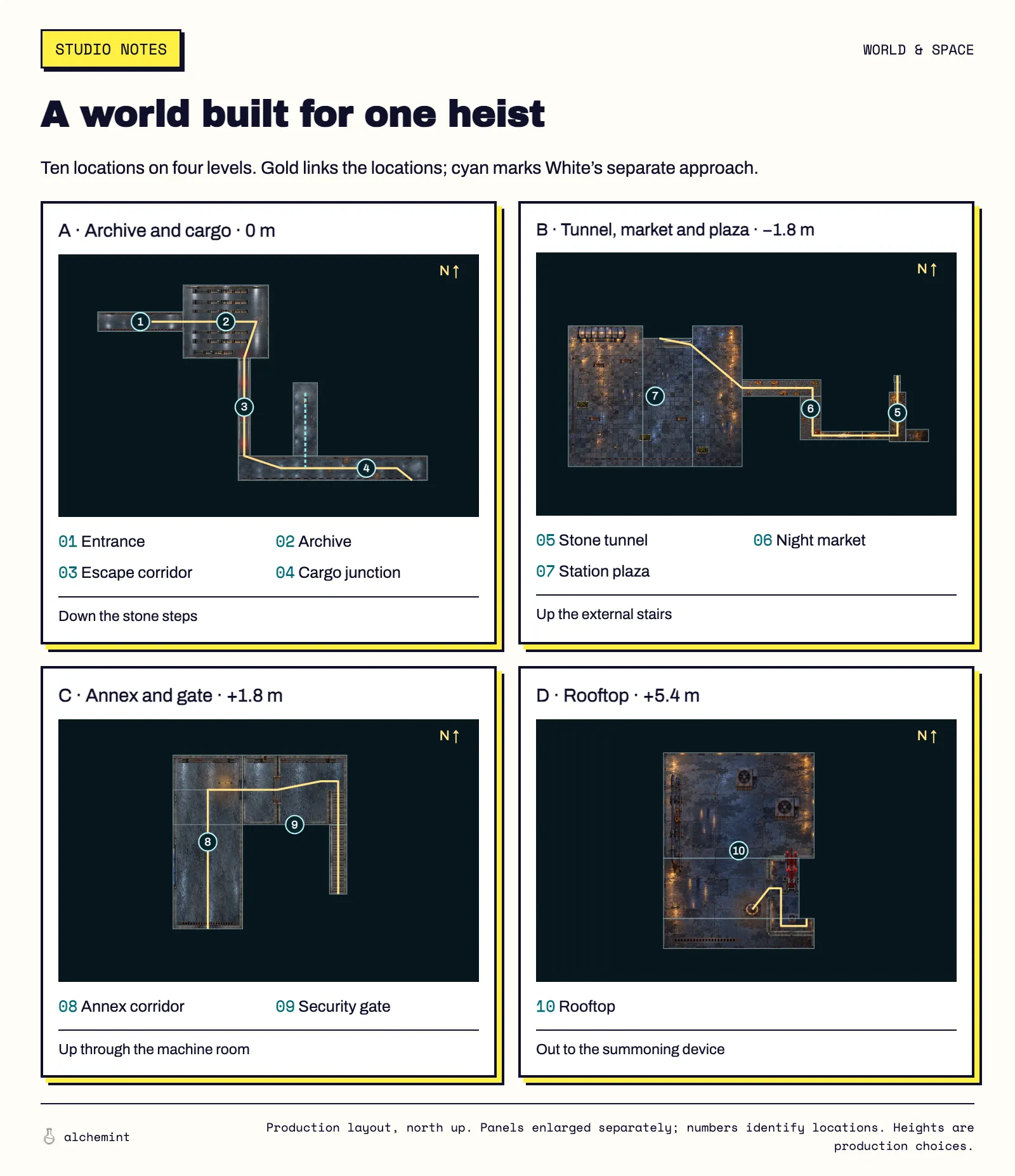
Ten production locations. Each panel is enlarged separately, with north at the top. Heights are relative dimensions chosen for staging; the gold line connects the story's locations.
The first stretch stays inside the archive complex. Three characters pass the entrance checkpoint and enter the archive. After retrieving a crystal, they escape through a side door into an alarm-lit corridor, then meet White and his lamp cart in the cargo corridor. The map has to accommodate the entry, the escape and a separate approach for the arriving cart.
A side door leads down stone steps into a tunnel. The group takes a branch, knocks over crates and discovers a wooden door with warm light beyond it. Outside is a market side alley, where steam and a crowd cover the transfer of the box to the next pair. The recipients turn through another alley onto the main street, then reach the station plaza.
The last stretch goes upward. An external staircase leads from the plaza into an annex. A short corridor and security gate lead onward through a machine room to the roof. A signal tower and summoning device await the box there. This is the complete route planned for production; the edit can decide which passages the audience needs to see.
We divided it into four levels. The archive and cargo corridor sit at the reference height. The tunnel, market and plaza are 1.8 meters below it; the annex corridor is 1.8 meters above it, and the rooftop is 5.4 meters above it. Viewers don't need those measurements. Building the previz does: stairs need a destination, characters need an exit, and the roof needs to be in a particular direction.
I used the overview to check that each meeting, escape and handoff had somewhere to happen. Once the locations were connected, the script, art and previz could work from the same geography.
Art makes the locations feel like parts of the same world
This story puts access cards, security panels and metal corridors alongside magic circles, a crystal and an enormous creature swimming through the sky. For those elements to inhabit one film, the art needs continuity and the places need connections.
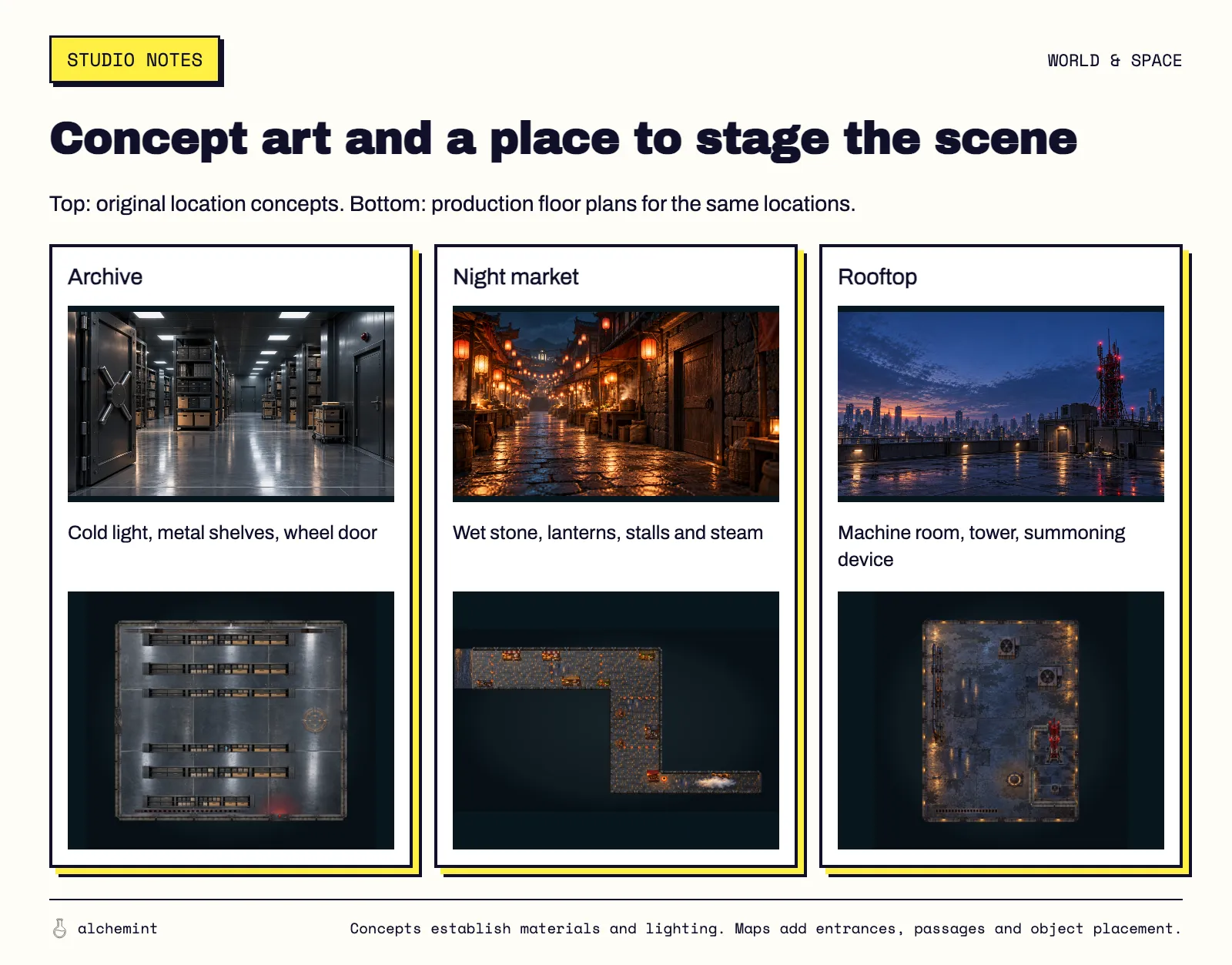
Top: the original location concepts, establishing materials, light and appearance. Bottom: the same locations arranged as spaces where action can be staged.
The archive uses cold overhead light, metal shelves and a heavy wheel-operated door. Red alarm light takes over during the escape. Rough stone and oil lamps lead toward a wooden door; beyond it are orange lanterns, wet paving and steam. On the roof, the frame opens onto a signal tower, the city skyline and a sky approaching dawn. Space, light and sound change as the characters move through the world.
Six locations excerpted from generated source clips, placed together to compare materials, light and space. This visual montage is silent and includes candidate footage not used in the final edit.
The individual images also had specific obligations to one another. The wheel door inside the archive had to be the other side of the door seen from the entrance corridor. The tunnel's wooden exit had to match the door in the market's stone wall. The red-and-white tower visible from the station plaza had to remain the same tower on the roof.
An individual concept image can omit everything outside its frame. Put the images together and gaps appear: doors don't connect, an exit runs into a wall, or an alley needed for the next scene doesn't exist. We used location images to establish appearance, then maps to resolve that missing space. Claude Code helped organize the script and location requirements; Codex helped turn maps, positions and Blender previz into editable files. I reviewed the images and footage and changed the decisions behind them.
Give the characters opportunities they can use
The original market concept had the atmosphere we wanted: wet stone, red and orange lanterns, stalls, steam and a wooden door. But the escaping group couldn't simply emerge and vanish into an attractive street. Ruk had to create a disturbance, White had to hide in the steam, and Biwa had to reach Shami with the box.
Those actions need an order and somewhere to happen.
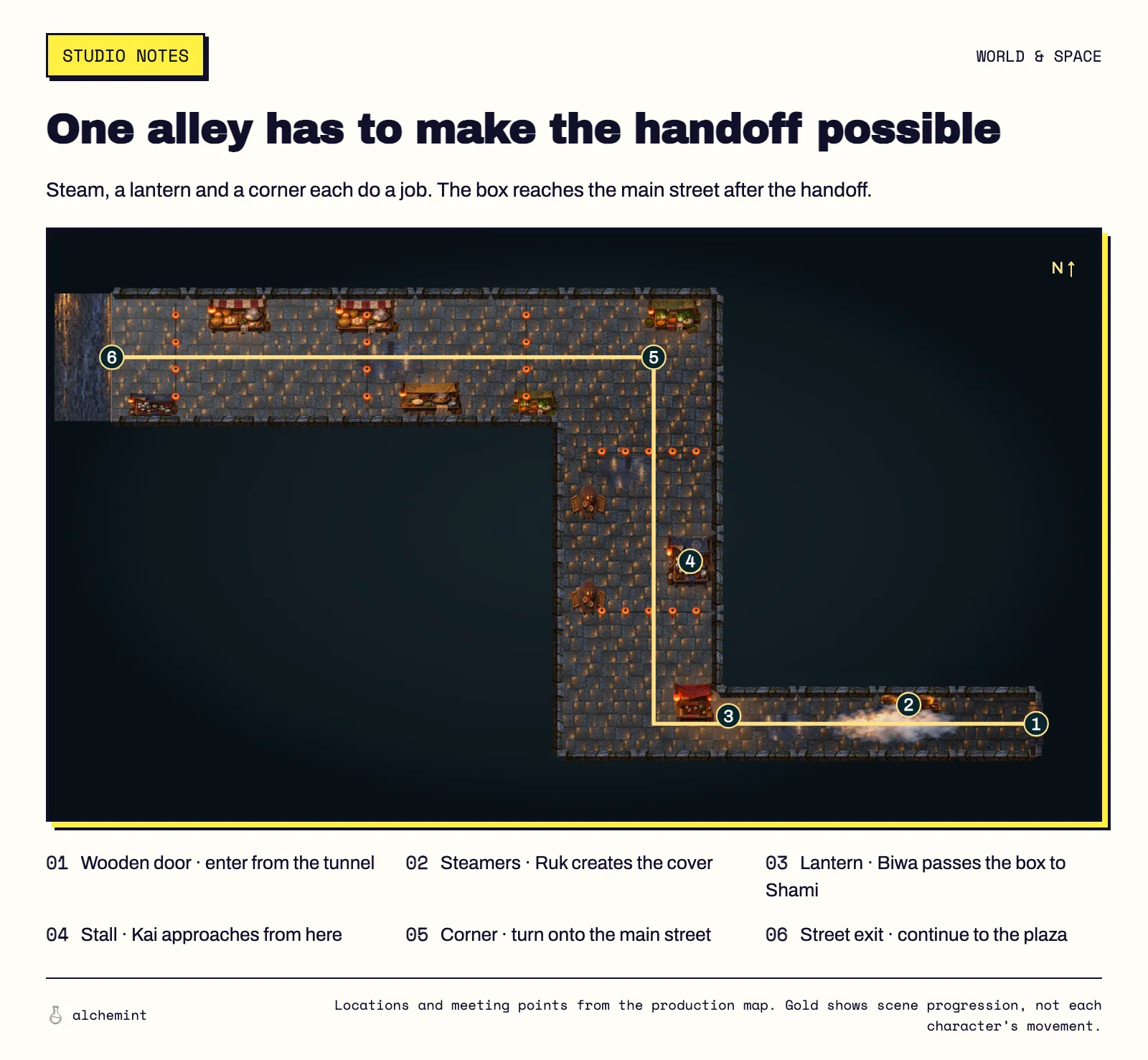
Six places from the production map. Gold shows the scene's progression; each character's precise movement is staged in previz.
The map puts the wooden door at the eastern end of a narrow alley, with a steamer stall about four meters outside it. Ruk knocks the steamers over before steam rises and White hides in it. The distance lets the exit and the creation of cover happen in one connected space.
Shami waits beyond the steam, under a red lantern near the corner. Biwa walks along the alley to meet her. Suseka and MeiHua stand on either side of the exchange, leaving room for the box to change hands. The lantern gives the characters a meeting landmark and gives viewers something recognizable after a camera change.
Only after receiving the box does Shami turn north into the next alley. Kai approaches from a stall. They subsequently turn onto the main street, where there is more space for their casual tosses. The first group has been escaping pursuit; the recipients stroll. The route gives that change of pace somewhere to occur.
The steamers, lantern and corner therefore affect the plot. Treat them as random decorations in a “busy night market” and the next generated scene may still look good while offering nowhere to perform the required action.
Character jobs connect the places and rules
We prepared references for ten characters and one fish-shaped creature. They could look very different, but each person needed more to do than occupy the frame. Much of the appeal of a relay heist, for me, is watching different people make the next step possible.
| Job | Characters and planned action | What the location needs |
|---|---|---|
| Retrieve the crystal | Serelya has already entered to undo the magic seal; Biwa keeps watch while Suseka and MeiHua approach her | An archive with distinct space for guarding the entrance and working inside |
| Stop the cart and take the box | White pushes; Ruk clears crates; Suseka passes the crystal to Biwa, who installs it and retrieves the box | Converging approaches, room to move crates and a passage alongside the cart |
| Transfer the box in the market | Ruk creates steam and White disappears into the crowd; Biwa passes the box while Suseka and MeiHua provide cover | A steamer stall, a meeting landmark and an alley where the group can disperse |
| Take the box upstairs | Shami leads, Kai carries the box, and Zlatia handles the security gate | External stairs, a side door, a corridor and an onward route above the gate |
| Complete the rooftop meeting | Pi operates the device, Serelya casts, and Kai raises the box for the creature | Space between the exit and device, plus sky for the creature to approach |
These are the script and previz arrangements. Each job changes the map: a lookout must see an entrance, an arriving accomplice needs an approach, and five people gathering at a device need space beyond the rooftop exit.
White's job led us to build an extra passage. The text said he arrived with a cart, but the early setting was one long corridor. His approach hadn't been established.
I wanted him to have a separate way in. Reusing the escaping trio's entrance would fail to establish two groups converging. We added a northern branch: the trio heads east from the western evacuation exit, White pushes south along his branch, and they meet at the T-junction before continuing toward the tunnel door to the east.
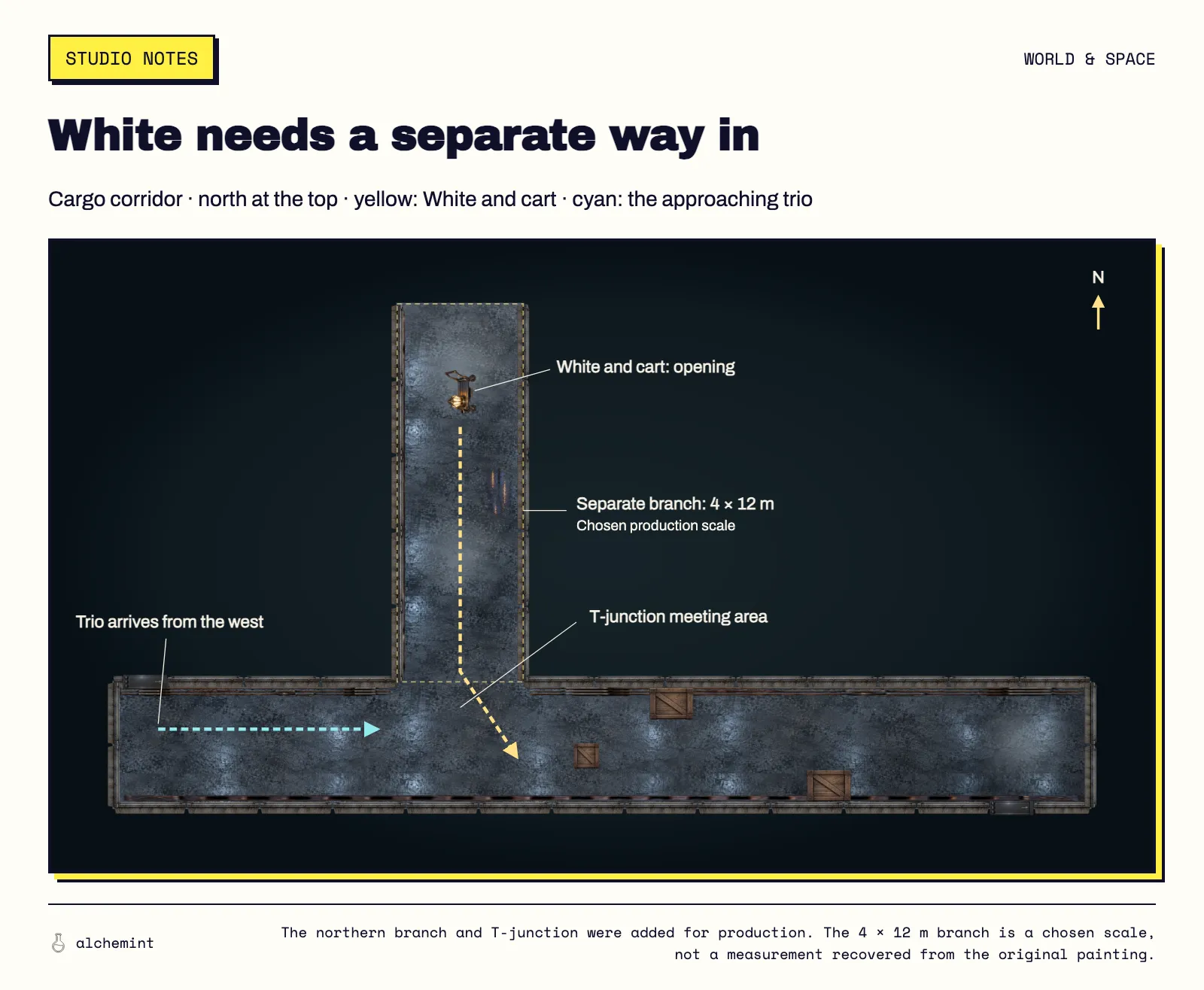
North is at the top. We added the branch for this meeting; its four-meter width and twelve-meter length are chosen production dimensions.
That change determined when White could appear, where the trio should look and where they could go together. “White arrives to meet them” had to become a route before we could stage the encounter.
Props have routes too. The crystal passes from Serelya to Suseka to Biwa, then stays in the cart's brake slot. The sealed box comes out of the cart, travels with Biwa into the market, passes to Shami and Kai, and continues to the roof. The crystal stops the cart; the box is the object that has to keep moving.
That route has to be performed. We once believed the earlier text contained the crystal handoff. It didn't, and the footage hadn't supplied it. Without that exchange, the next person's action lacked a necessary condition. Following each object's owner from scene to scene helps me check whether the rules I've chosen actually reach the story.
Use AI to make the world visible, then revise it
We didn't finish a world bible before starting. We began with eight technique prototypes. Watching them, I saw the possibility of an ensemble heist along the lines of Ocean's Twelve or Ocean's Thirteen. An early image of Biwa installing something on the cart also prompted a story decision: the object taken from the archive could be the crystal that stops it.
Generated footage can offer an unexpected idea. Once I choose it, I still have to give it an origin, a use and consequences. The story then needs a cargo corridor; the corridor needs another approach; the escape needs a tunnel and market. The world grows through those choices.
AI helped us try these ideas: organizing location requirements, building Blender previz from the maps, and generating characters and locations for me to review. Watching the results also gave me more specific questions. How many people need to fit on the roof? What needs to be behind that door? Who has the object when the previous scene ends?
For a similar AI short, I would prepare:
- A map of the places the story uses. Mark entrances, exits, meeting points and changes in level so the whole route connects.
- Appearance references for the same place. Match the two sides of a door, landmarks outside a window and the space beyond a corner. Decide what lies outside the images.
- Rules the characters must face. Decide who can open a door, what is required to obtain an object, and what magic or machinery does. Start with the rules this story uses.
- Jobs for characters and props. Establish what everyone does, who enables the next action and who holds the box on departure.
- A short previz of the hardest scene. Stage the meeting or handoff once, then watch it through the intended camera.
The first scene can be made before the whole city's history is written. I would establish the routes, objects and collaborators this story uses, then watch and revise them through previz and generation. Each addition to the world should help answer a question in the story.
Once the world allows events to happen, I still have to decide what I want the characters to express and what the audience will finally see. AI gives me a way to go through that whole creative process. Building this world is one part of learning to bring that story to the screen.