
Now That AI Filmmaking Is So Cheap, Shouldn't We Learn a Bit About Film?
AI lets small teams try a smirk or a split screen and have footage to discuss. Then comes the trouble: the model did it, and now we have to decide whether the scene is any good.
In AI filmmaking, the creator still has to decide what to say and what they hope an audience will feel. AI can help write a script, arrange an action and generate the images. I have to judge whether those proposals tell the story I want to tell.
Honestly, human input during the preparation of this animation added up to less than an hour. We even added the character roles on the fly, later on. As for the script, our team's entire brief was “Just give it that Ocean's Twelve vibe.” We weren't trying to show off some badass martial arts film. Most AI-generated fight scenes look like they were designed by people who've never trained in martial arts. We wanted to know what costs AI tools actually save. With video models like Seedance 2.5, MiniMax H3 and Wan 3, how far can an ordinary person jump ahead?
Script: we skipped it and designed the action in each shot directly. In Episode 1, for example, Biwa's bitchy little move of tossing the keycard to Suseka was meant to establish her character.
Worldbuilding: this took the most time. Only after generating multiple versions of Episodes 1 and 2 did we tell Codex to hurry up and design a map. Otherwise, leaving Seedance 2.5 to improvise gives you this:
An early generated version, 10–13 seconds in the source clip.
Have you ever seen a law of physics that could take a card thrown by Biwa at that angle and land it at Suseka's feet?
An early generated version, 0–3 seconds in the source clip.
Kai and Miren just disappear in front of the door??? A human artist couldn't draw a special effect this exquisite.
Sound effects: skipped. Six months ago, we kept rerolling Suno sound-effect prompts until we maxed out a credit card.
Voice acting: how much dialogue do you need in a heist? Actually, we skipped that too.
Video generation models can carry out a user's intentions through prompts. Artistically, an image doesn't have to be bound by Newton's apple. But does knowing how to write a prompt, plus an open-source model, mean you're ready to enter the Oscars?
AI tools can lower the barrier to filmmaking, but the fundamental creative work remains. We wanted to finish an actual film so we could see which work the tools do for us and which decisions we still have to make ourselves.
Why did Hollywood's screenwriters go on strike?
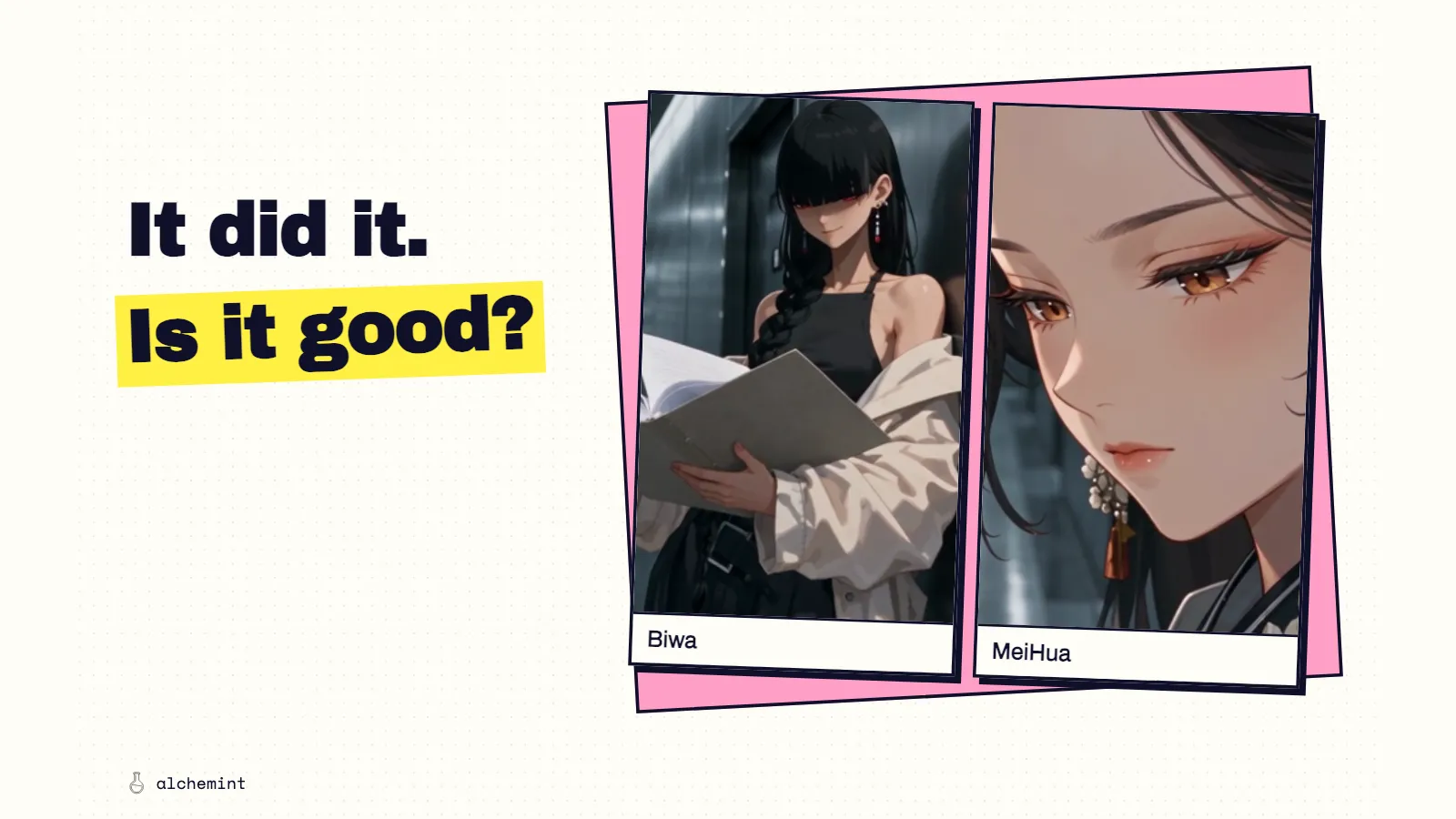
Our earliest video workflow skipped scriptwriting. We weren't looking down on ordinary people; polishing a screenplay just wasn't cost-effective for this way of creating. Deciding what happens in each beat, though, is something you cannot skip. An audience can understand a film without reading its script. Rather than write a passage explaining why Biwa is always so bitchy, just have her throw the card. But she's not actually that nasty, so we still have her pick it up and hand it to MeiHua.
In the relationships our team defined, MeiHua leads the Episode 1 trio and is its strategist. Biwa supplies the crucial contribution—the stolen keycard—and is experienced and calm under pressure. Suseka is a rookie and Serelya's younger sister.
But video generation models couldn't care less about your character backstories. We'd also suggest not wasting prompt space describing relationships. Describe the actions and what causes them. That's what the prompt needs to spell out. We discuss turning abstract intentions into filmable actions in What Does the Seedance 2.5 Prompt Skill Actually Handle?.
Once we used previz to give Seedance 2.5 guidance on shots and camera positions, the AI agent, Codex Astra Max, could focus on writing the prompts. Our reroll frequency dropped sharply. Episodes 3–8 were basically first-try passes.
That brought the Hollywood writers' strikes of a few years ago to mind. In the future film and television industry, when the cost of producing a piece of footage falls almost to the x-axis, will screenwriters once again face an unequal share of the value? During our production, the team spent most of its time defining images, rather than what the film looked like on the page.
For a small team, once you've written the right prompt for the script, characters and trial shot, Seedance can give you a clip to evaluate in about five minutes. You could also use an open-source model like Wan 2.2 for less money. If you can get your hands on a 5090, it can even be faster.
We won't make grand predictions for the whole film and television industry. But for a small team, interactive creation through prompts is the smallest working unit of video production.
The model's floor is our imagination's ceiling
“Give it that Ocean's Twelve vibe” can help us find an atmosphere: a group dividing up the work, passing things along and getting something done. But when we get to this keycard, we still have to decide how we want the audience to see Biwa.
The prompt for Episode 1, Shot 1, at 16–19 seconds said, translated from Chinese: “MeiHua first looks toward Biwa, who is leaning against the corridor wall, then lowers her gaze to the card holder and continues down to the keycard on the floor. Her expression shifts from exasperation to understanding.”
EP1 Shot 1, 16–19 seconds in the source clip. This clip used an earlier prompt version that said, translated from Chinese, “first look at Biwa, then at the number on the card holder in her hand.”
Why have Hongguo's short dramas attracted so many viewers so quickly? Is it the unhinged scripts? Is it because the models are so good?
Yes, it's because the models are so good. But why? Because, after paying ByteDance a pile of money, the studios learned how to use what those models can do.
Want a character to smirk?
A prompt excerpt, translated from Chinese:
Biwa leans against the wall, watching the two people at the door press the button three times without success. The corner of her mouth lifts into a smirk.
An earlier generated version of EP1 Shot 1, 9–10.5 seconds in the source clip, showing the corner of Biwa's mouth lift.
Want different editing techniques?
The prompt actually submitted for this clip, translated from Chinese:
0–5 seconds | Split screen: In the left panel, Biwa reads the documents in a folder. In the right panel, Suseka looks down at the keycard by her feet. They raise their eyes at the same time and look at each other across the central dividing line. At the end of the section, the split screen ends and the image returns to a single full frame.
EP1 Shot 2, 0–5 seconds in the source clip. The model generated the split screen directly. We also provided rough previz as a reference for the left/right composition, action and camera.
The model can do all of this. Welcome to the age of Vibe Video.
Ordinary people can start making films. We also need to start learning about film.
For a small team, the convenient thing now is being able to try an idea immediately. Want Biwa to smirk? Try it. Want two people looking at each other across a split screen? Try that too. A few minutes later, everyone has a clip to discuss, instead of each person shooting a different movie in their head.
Then comes the trouble.
The model made her smirk, but what is she smirking at? MeiHua glances at her; does the audience know what that glance means? We have a split screen, but does this moment actually need one?
Adding a few more instances of “cinematic” to the prompt won't make those decisions for you.
Take the keycard. We could have Biwa smile before throwing it. Or she could throw it first, and we cut back to her smirk only when Suseka looks down. Both get the card across, but they change when the audience catches on to the prank. Before trying another version, we at least need to decide what we want to change.
This is where being cheap helps. A small team can film an idea, see what's wrong, then go back and change the action, the previz or the prompt. Put the two versions side by side and see whether the new one is clearer. Each trial gives us something concrete to keep. We can finally discuss the same image.
Watching films again at this point gives us very practical questions. How does someone else film one person teasing another? Why can half a second of a reaction be funny, while three seconds makes the character look like they've frozen? For the same handoff, which camera position makes it immediately clear, and which just shows a crowd of people huddled together?
Try it with your own characters and you'll find out how annoying these questions can be. Performance, composition and rhythm need attention while you're filming, then again in the final edit. However complete a generated sequence looks, if it drags down the whole film, it still needs cutting.
Ordinary people really can start practicing this way now. If you don't understand why a technique works, shoot it yourself. If it turns out terrible, at least this time you know what you need to learn.