
Why I Edited the AI Film Myself
AI lowers the barrier to filmmaking. Editing our heist showed me what creators still decide: what viewers see, how the story unfolds, and when a film is finished.
I edited this AI short myself to decide what the audience would see and how I wanted to tell the story. AI made footage easier to produce. Choosing an image, holding a moment and deciding when to move on were still part of making the film.
I made this film to show that AI can lower the barrier to filmmaking while making the creator's remaining work visible. The world has to support the story, the characters need purposes, and someone must choose how to communicate them. A complete film gives us a way to work through those fundamentals in practice.
Claude Code and Codex helped with preparation and Blender previz, Seedance 2.5 generated the footage, and I edited it in CapCut. The production ran from September 24 to 28, across five calendar days of revisions to relationships, staging, cameras and prompts. A lower barrier let me turn those questions into images I could revise.
The completed heist animation runs 2 minutes and 52 seconds.
The audience sees the story I choose to keep
Whether the material comes from a camera, animation production or a generative model, someone has to decide what to show the audience. An attractive shot doesn't automatically belong. An action fulfilling its original brief doesn't necessarily deserve to play at its full length.
The sixteen sources selected for the edit totaled about 299 seconds. The film kept about 172 seconds, or 57.4%, a little over half. That proportion describes the duration retained from those sixteen selected sources. Even after choosing the footage, I still had to choose which parts would enter the work.
During generation, it's easy for me to concentrate on one clip: did the box change hands, did the character perform the action, did the camera move? Editing requires a wider view. What does the audience already know? Are they waiting for the exchange to finish, or for someone's reaction?
Those questions change how long a passage should last. Once the audience understands that the box has changed hands, explaining it again can hold the scene in place. A reaction that hasn't become readable may need more time. The pace should serve what the scene is trying to communicate.
Worldbuilding lets people and events belong to the same world. Creative intent gives me a reason to show them. Editing arranges those ideas into the sequence the audience actually experiences. I'm making decisions about the whole work here.
Choosing a few seconds is a way of telling the story
Around 1:26 in the finished film, a box visible in a drawer leads into Biwa looking down and holding it. That passage uses two takes. One supplies the opening, another the next part of the event. I could select what the scene needed from different versions.
The two source takes play across the top, with the actual final edit below. All three panels start at their own excerpt beginning and retain their original speed. Only the final-edit soundtrack plays; its panel is marked when that excerpt ends.
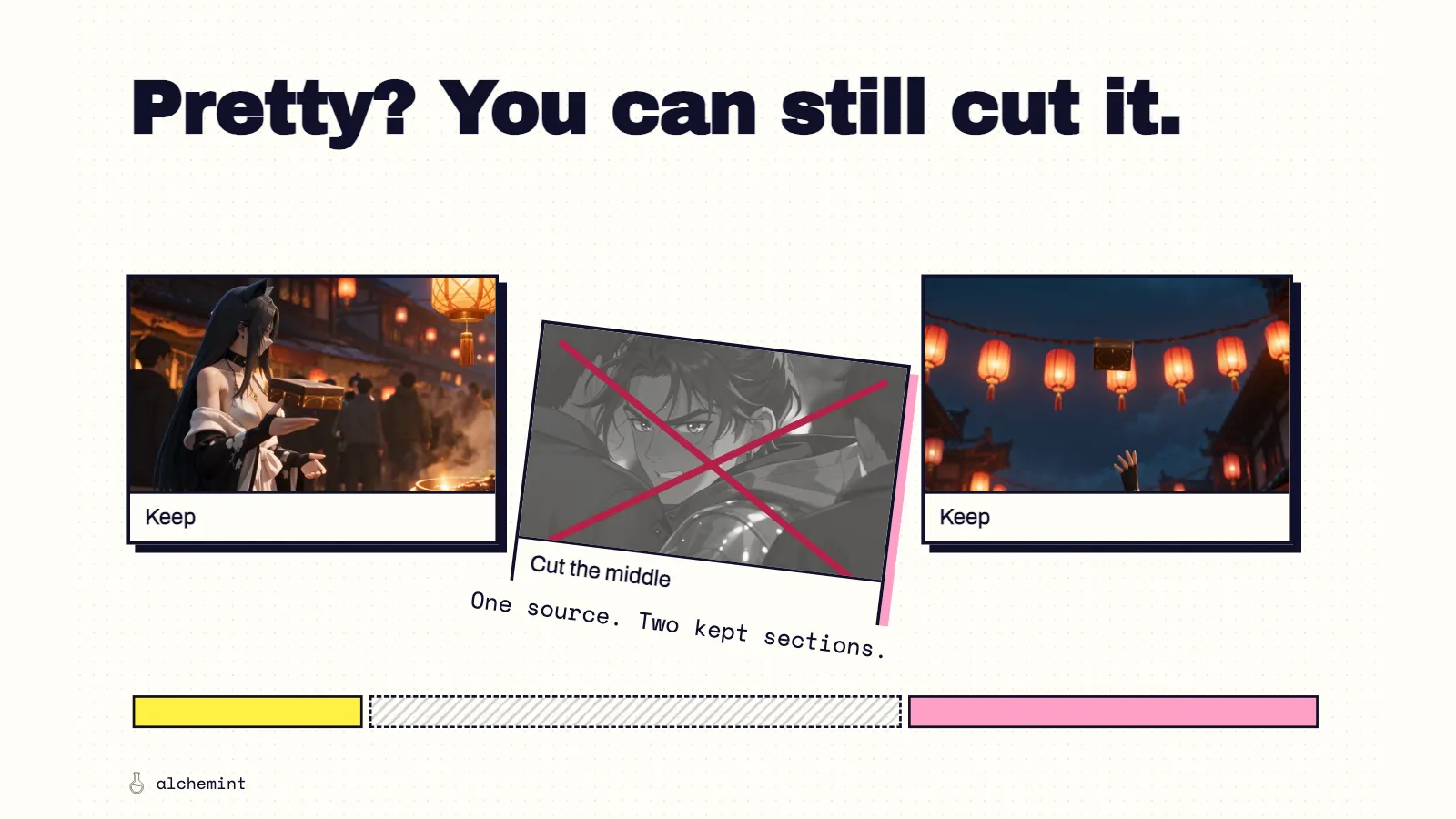
The market exchange makes another kind of choice. Around 2:21.5, Shami throws the box, we see it airborne, and Kai catches it. The edit uses the beginning and a later part of the same source, removing 9.6 seconds between them. Actions separated in the generated footage sit next to each other in the film.
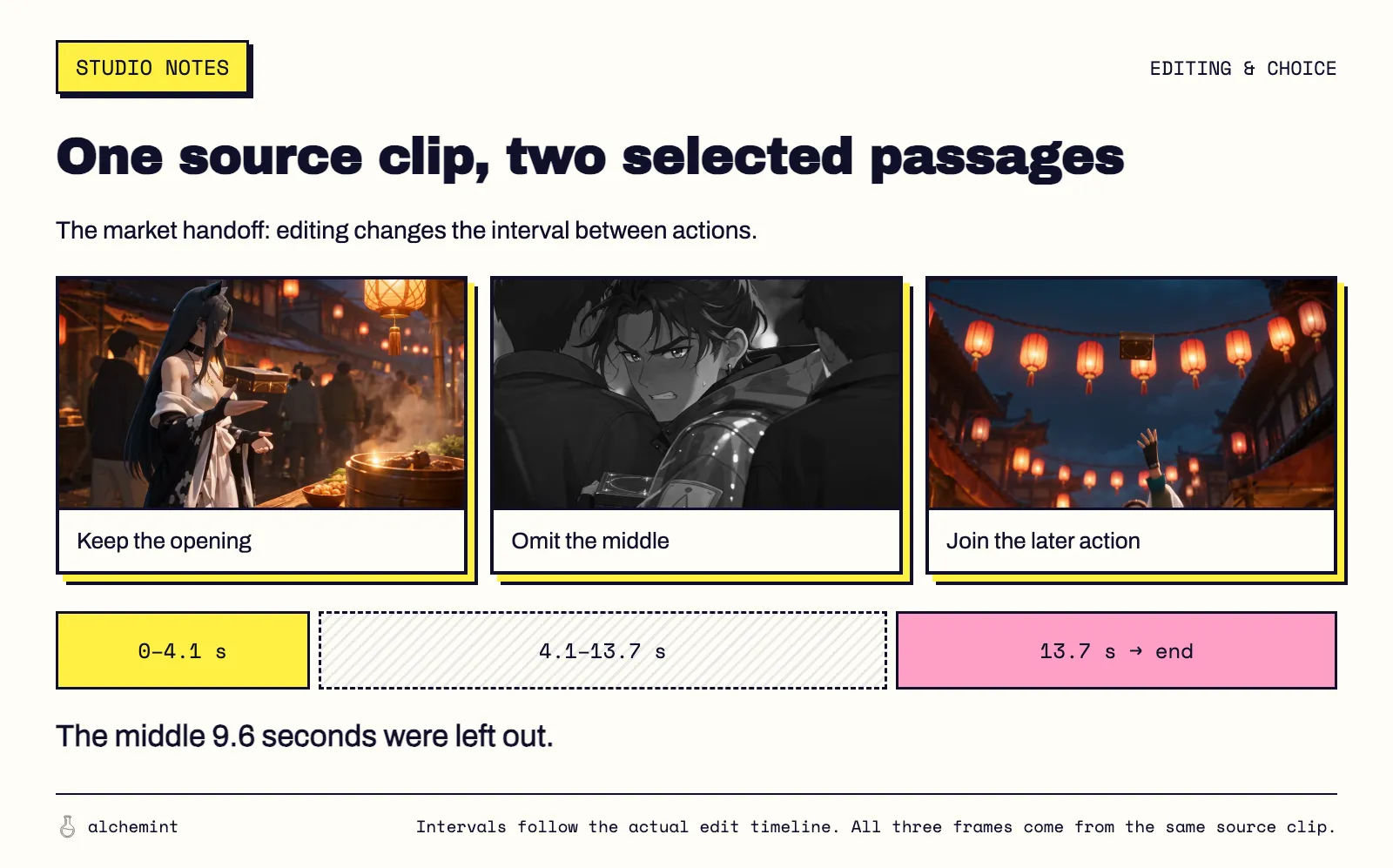
Intervals correspond to this film’s actual edit.
The full source plays on the left and the final edit on the right. Both start together at original speed. The edit finishes while the source is still playing; the middle 9.6 seconds have been removed. The green intervals in the diagram above mark the retained sections.
One generated video can supply several useful passages. One event can draw on more than one video. What matters is whether the audience can follow the characters and the prop once those passages are together. The file boundaries haven't decided how I should tell the story.
I like how concrete this work becomes. Put a reaction back and watch the surrounding scene. Replace the catch and see whether the exchange becomes easier to understand. Each choice can be watched, and watching can change the scene I thought I wanted.
Tools can handle operations while I judge the work
An AI agent can help organize material, mark intervals and try assemblies. That can save a creator considerable effort and leave more attention for watching. Have we said this twice? Did the cut leave a reaction too early? Do two neighboring images suggest something I hadn't intended?
Editing it myself was my choice for this film. A creator can also work with an editor or use tools to assemble the material. Someone still needs to watch the whole work and decide how it will meet its audience. Directing can happen through collaboration; it doesn't depend on personally pressing every button.
My judgment can be wrong too. A passage I consider clear may be difficult for a viewer to follow. A joke I want to keep may lack the setup it needs. Editing gives me a chance to see these problems and decide whether to change the order, add an image or give up the original arrangement.
At some point, the work needs a finished version. I have to choose what I'm willing to put in front of an audience this time and leave other experiments for another film. More generations can provide options, but they don't decide where this story ends.
An affordable way to begin practicing directing
The generation budget for this short showed me that a small AI animation is something I can start making now. Preparation, viewing and revision still take time. Within a budget I can manage, though, I can stage a scene, try different performances and cut it into a complete story.
That opportunity is worth using for practice. Begin with a small scene whose characters have clear purposes. Give it a beginning, a change and an ending. A work I can watch gives me somewhere to learn framing, performance and editing, and a concrete basis for deciding what to change next time.
What we've practiced throughout this series belongs to the existing craft of filmmaking: build a world, work out what we want to say, then choose how the audience will see it. AI gives more people a means of participating. Finishing a film gives us another chance to learn how to tell a story.
Starting to direct is now within reach at a very low cost. I want to use that opening to finish work: make a story, let people watch it, and bring what I learn to the next film.