
Damien Jalet and the Storm AI Trend: What Platforms Can't Contain, and Where the Law Falls Short
Thirty seconds of Storm became an AI template, and its choreographer is studying legal options. Hosted tools can be policed; open weights cannot. We lay out the ethics, the statutes and the cases.
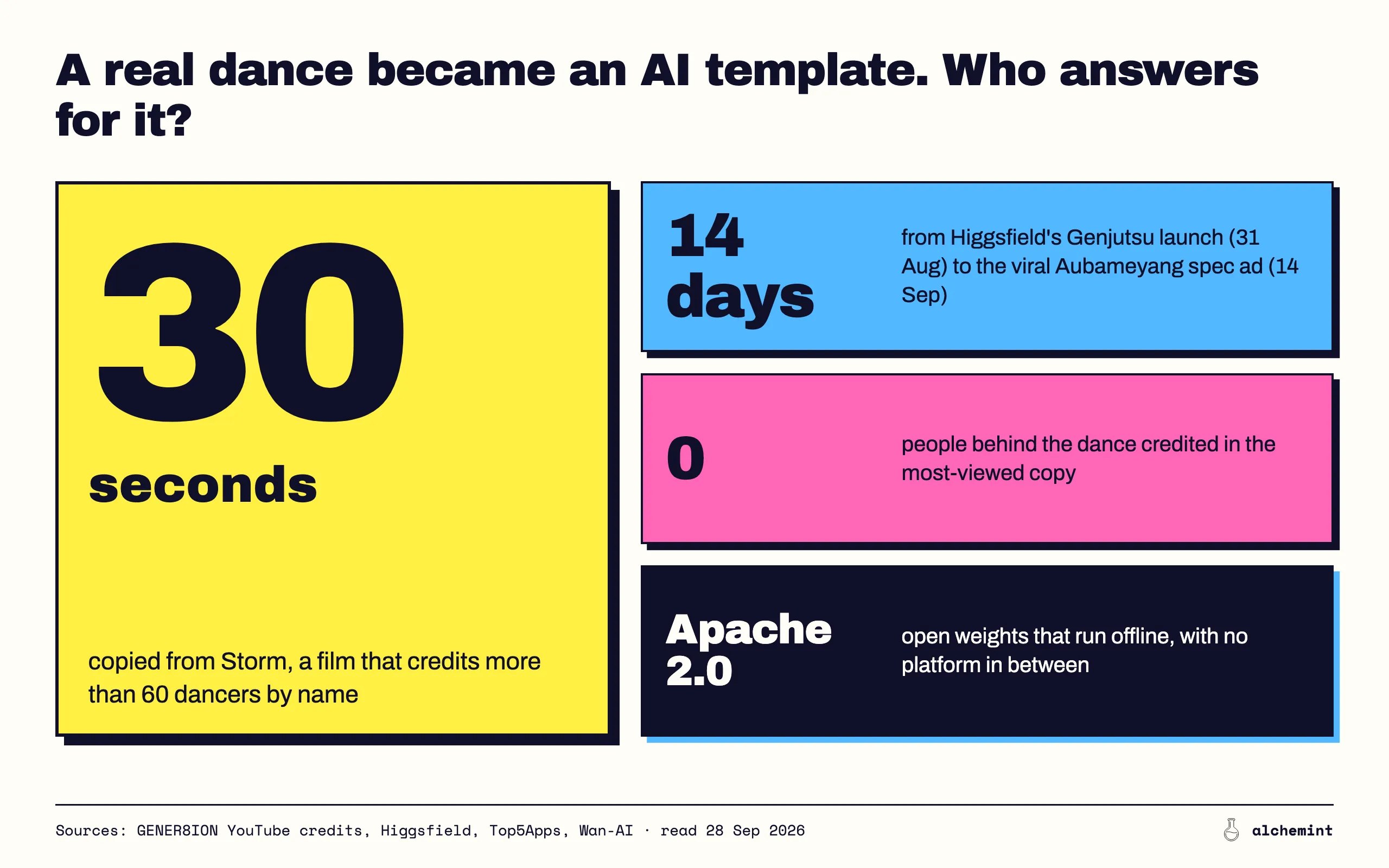
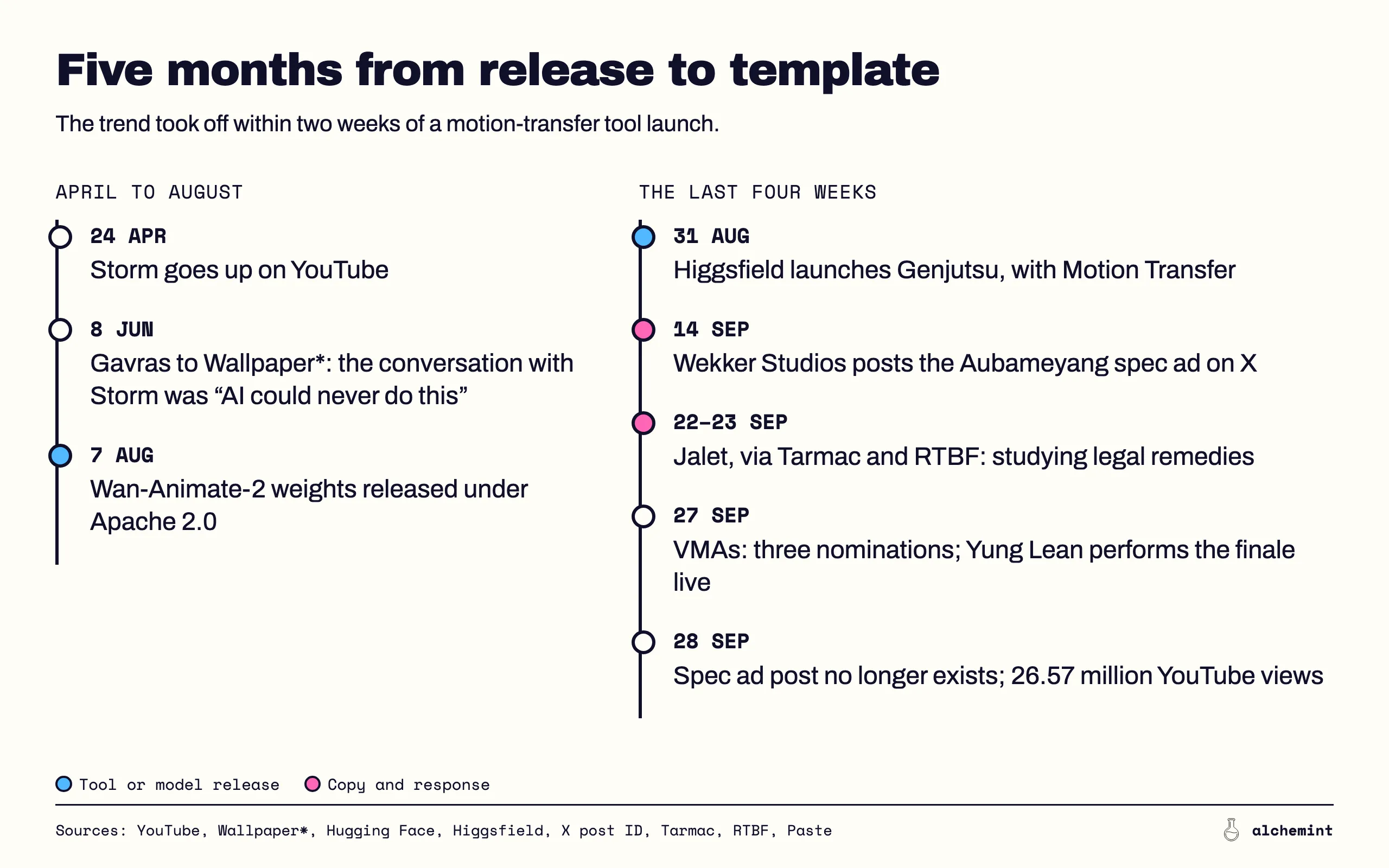
On 14 September 2026, an account called Wekker Studios posted a "spec ad" on X for a Pompeii x RC Deportivo football kit. The post described it as creative direction and production with AI, and noted it was not affiliated with either brand. It put the footballer Pierre-Emerick Aubameyang's face and the new kit onto a crowd sequence of synchronised waves. Top5Apps reported 16.9 million views on an account with a few hundred followers.
The crowd, the formation, the timing and the camera moves came from the last minutes of Storm, the Gener8ion film starring Yung Lean, directed by Romain Gavras and choreographed by Damien Jalet. The post named the kit brands and left out everyone who made the dance.
A week later, Jalet answered a question from Tarmac, the hip-hop and urban-culture brand of Belgian public broadcaster RTBF. His reply, as Tarmac posted it on 22 September and RTBF published it on 23 September:
« Cette danse a été faite en résistance à l'IA. Voir cette trend est à double tranchant. Elle révèle l'ampleur du phénomène culturel de la vidéo. Mais en même temps, elle piétine complètement la version originale. Nous n'avons pas dit notre dernier mot. J'ai commencé à étudier les recours légaux à notre disposition qui sont encore très flous sur beaucoup de niveaux. »
In English: "This dance was made in resistance to AI. Seeing this trend cuts both ways. It shows how big a cultural phenomenon the video has become. But at the same time, it completely tramples the original version. We haven't said our last word. I have started studying the legal remedies available to us, which are still very unclear on many levels."
We make videos with AI, and we use reference videos to control motion in almost every project we publish, so his statement is about us too. What do the people making these copies, and the companies supplying the tools, owe the people who made Storm? And why does a choreographer with a strong case still find the legal remedies "very unclear"?
What is the Storm AI trend?
Storm is a short film for Gener8ion, the duo of Romain Gavras and the producer Surkin. It went up on YouTube on 24 April 2026 and had 26.57 million views when we checked on 28 September. It is set in a British boys' boarding school in 2034. In the finale, rows of uniformed schoolboys break into synchronised, jerking waves while Yung Lean stands motionless in the middle.
The dancers are real. The YouTube description credits more than 60 of them by name, plus a choreographer's assistant and four second assistants. Gavras told Wallpaper* in June that he wanted "young kids where you don't feel like they're dancers", and that Jalet "did a lot of auditions" and built the choreography with four boys, then five, and so on. The preparation was "almost military", and the shoot took four days in Belgium, at the Collège Cardinal Mercier in Braine-l'Alleud according to La Libre Belgique. The credits thank France's national film agency, the CNC.
Gavras set the film against AI from the start. In the same interview he compared it with an older piece built on Charlize Theron's emotions: "that can be done with AI. Whereas the conversation with 'Storm' was 'AI could never do this'."
On 27 September Storm was up for Video of the Year, Best Direction and Best Choreography at the MTV VMAs. Madonna's Confessions II won the choreography award. Yung Lean and Gener8ion performed the finale live the same night.
Higgsfield launched a tool called Genjutsu on 31 August 2026. Its launch post describes Motion Transfer as using "the motion from an existing video as a reference", then applying that movement to a new character or rebuilt scene. The Aubameyang ad appeared two weeks later. The do-it-yourself tutorials we read all describe the same three-part method:
- A reference video: the segment Top5Apps timed at 4:47 to 5:17, downloaded or screen-recorded.
- A motion-transfer model. The one named in nearly every English tutorial is Genjutsu, which in Higgsfield's words "keeps the motion, camera and timing while rebuilding the scene from your references".
- One or two reference images: the new lead, and one person to be cloned across the crowd.
Alongside the tutorials came paid templates. Starrd sells a Storm video for 250 credits, about 12.50 US dollars, and says the original clip "supplies the crowd's routine and the timing" while your photo supplies who you are. SuperMaker's guide notes that its generator asks for neither a prompt nor a reference clip. Vmake, Media.io and EaseMate host Storm II pages too. On these services the user uploads a photo, and the Storm segment is supplied by the service.
Part 1: The ethics of users, platforms and open models
Dance culture settled the credit question years ago
In 2019 Jalaiah Harmon, then 14, made up the Renegade. It spread across TikTok through bigger creators without her name attached, until The New York Times profiled her in February 2020. "I was happy when I saw my dance all over," she told the paper. "But I wanted credit for it." In June 2021 Black TikTok creators declined to choreograph a dance for Megan Thee Stallion's "Thot Shit", in protest at their routines repeatedly going viral under other people's names.
Belgium has its own precedent. In 2011 Beyoncé's "Countdown" video closely resembled movement and staging from two works by the Brussels choreographer Anne Teresa De Keersmaeker, Rosas danst Rosas and Achterland. In a public statement she wrote:
"People asked me if I'm angry or honored. Neither."
She wrote that she was glad Rosas danst Rosas might reach a mass audience that a dance performance could never reach on its own, and that "there are protocols and consequences to such actions". No lawsuit followed. Fifteen years later, Jalet described the same two sides in almost the same terms.
Many of the Storm copies we found skip even that. InsideHook found that some of the posts came from AI influencers selling the prompt for the video. The most-viewed copy credited two kit brands and nobody who made the dance. A credit line costs nothing, and it is what choreographers have asked for in every one of these disputes. Selling someone else's routine as your prompt is the part they have objected to most.
The trend also has a real upside, which Jalet named himself: it shows how far the film has travelled. That doesn't change what the copy took.
Platforms that sell the name
Hosted tools are where copies like these are easiest to police, and so far their makers have done little about it.
Higgsfield's Genjutsu launch post says nothing about whether you need rights to the footage you upload. Its terms of use have a copyright notice procedure and a policy to terminate repeat infringers, and both come into play only after someone complains.
ByteDance's Dreamina runs a page titled "STORM II AI Crowd Dance Video", powered by Seedance 2.5. Its FAQ asks "Can I use a real dance video as a reference?" and answers: "Only use footage you have permission to edit. Avoid unauthorized celebrity likenesses, copyrighted choreography or music, private footage, logos, and protected characters unless you hold the necessary rights." The page uses the work's name to attract searches while telling users not to use the work.
The template sellers charge per generation under Storm's name. Vmake's page credits Gener8ion and Yung Lean and leaves out Jalet and Gavras.
This pattern predates Storm. In 2024 the motion-transfer app Viggle grew through memes that put the Joker's face on footage of the rapper Lil Yachty entering a festival stage. When TechCrunch reported its funding round that August, Viggle confirmed that its model was trained on public sources including YouTube. YouTube's chief executive had said earlier that year that using YouTube videos to train a text-to-video generator would be a clear violation of its terms. Motion-transfer products have repeatedly found their audience through other people's footage.
The minimum we would expect from a hosted service is modest. It should not title pages or templates after someone else's work, should say plainly at upload that reference footage needs rights, should carry a credit through when a template is built from a known work, and should keep the AI labels the law now requires.
Nobody moderates open weights
Even if every hosted service adopted those rules tomorrow, anyone could still make a copy of Storm.
Alibaba's Wan team released the weights of Wan-Animate-2 on 7 August 2026 under the Apache 2.0 licence, and ComfyUI added native nodes a day later. It takes a character image and a driving video and animates the character with the video's motion. We have run it ourselves: on a rented RTX 5090 with 32 GB of memory, three 2.7-second clips at 480 by 848 pixels took between 119 and 127 seconds each. The model card makes no claim about multi-person scenes, so on its own it would handle the lead.
The crowd would need a different open model. Wan2.1-VACE, released in May 2025 under the same licence, accepts depth or pose video as a control signal, so a depth pass of the 30 seconds would in principle carry the formation and timing of the whole crowd. We have used the same principle with Seedance to turn a game recording into a motion reference. We have not tried it on Storm.
The only governance on these weights is a sentence in the model card: "You are fully accountable for your use of the models, which must not involve sharing any content that violates applicable laws". After download, the model runs offline. There is no account to suspend, no content filter, no upload log and no address for a takedown notice. The EU AI Act exempts open-source model providers from its documentation duties but still requires a copyright policy and a public summary of training content (Article 53). Those rules cover what went into the model. Nothing in them reaches what a user feeds it after download.
On this route, the decision rests with the person at the keyboard. These are the rules we follow:
- Treat the upload as the copy. When you feed another person's film to a model as a reference, you have made a copy of it, whatever the output looks like. Running it locally only changes whose disk the copy sits on.
- Treat commercial use as a separate decision. Once a brand, a client, a paid template or a monetised channel is involved, license the source or make your own reference.
- Credit the source every time. It is the least dance culture has asked for, and it keeps an imitation overt. It does not replace permission.
- Change something that matters. If a version changes only the faces, it is the same sequence performed by different faces.
- Build the motion yourself when you need it. Film friends, block it out in Blender, or hire a choreographer. The cost is time, which is also what Jalet's team spent.
- Get separate consent for real faces. Putting a real person into a copied sequence adds their image rights to everything above.
Part 2: The statutes, the cases and the gap
One clip, several rights holders
The 30 seconds carry several separate rights. Using the credits in the YouTube description:
| Layer | Who holds it | What the trend takes |
|---|---|---|
| Choreography | Damien Jalet, as author | The sequence, formation and timing, which motion transfer is designed to keep |
| The film | Romain Gavras as director, presumed a co-author under French law. Iconoclast as producer | Camera moves, framing and editing rhythm, plus a full copy of the segment at every upload |
| Music | Gener8ion and Yung Lean. The recording is credited "(p) Iconoclast Music" | The track, when a video uses the original audio. Meta's music guidelines prohibit commercial or non-personal use without appropriate licences |
| Performers | The dancers credited by name | Their recorded performance is inside every uploaded copy |
The Aubameyang ad adds a fifth layer: the image rights of the footballer whose face was used. That claim belongs to him.
What the statutes say
| Jurisdiction | Legal basis | What it means for a motion-transfer copy |
|---|---|---|
| United States | Copyright Act §102(a)(4) protects choreographic works. Circular 52 excludes social dances, simple routines and "short dance routines consisting of only a few movements or steps". §106(2) reserves derivative works to the owner. §107 sets out fair use | A 30-second ensemble with formation, timing and camera is well beyond "a few movements". Any defence runs through fair use |
| France | Intellectual Property Code L112-2 protects choreographic works "fixed in writing or otherwise". L122-4 makes unauthorised adaptation, transformation or reproduction "by any art or process" unlawful. L121-1 gives the author a perpetual right to respect for the work. L122-5 allows parody and pastiche. L212-3 requires a performer's written consent to fix, reproduce or communicate a performance | Motion transfer is a reproduction by a process. The integrity right answers Jalet's "tramples" directly |
| European Union | InfoSoc Directive Articles 2 and 3 (reproduction, communication to the public) and 5(3)(k) (pastiche). DSM Directive Article 17 (sharing platforms). AI Act Articles 50 (labelling) and 53 (model providers). Rome II Article 8 (law of the country where protection is claimed) | Harmonises the rights and leaves enforcement to each member state and each platform |
| China | Copyright Law protects dance works. The Implementing Regulations define them as works expressing thoughts and emotions "through continuous movements, postures, expressions, etc." | Courts have extended duties on AI platforms further than any Western court so far (below) |
On paper, each system protects this choreography. The cases show how far that protection reaches.
Is dancing copyrighted? What the choreography cases say
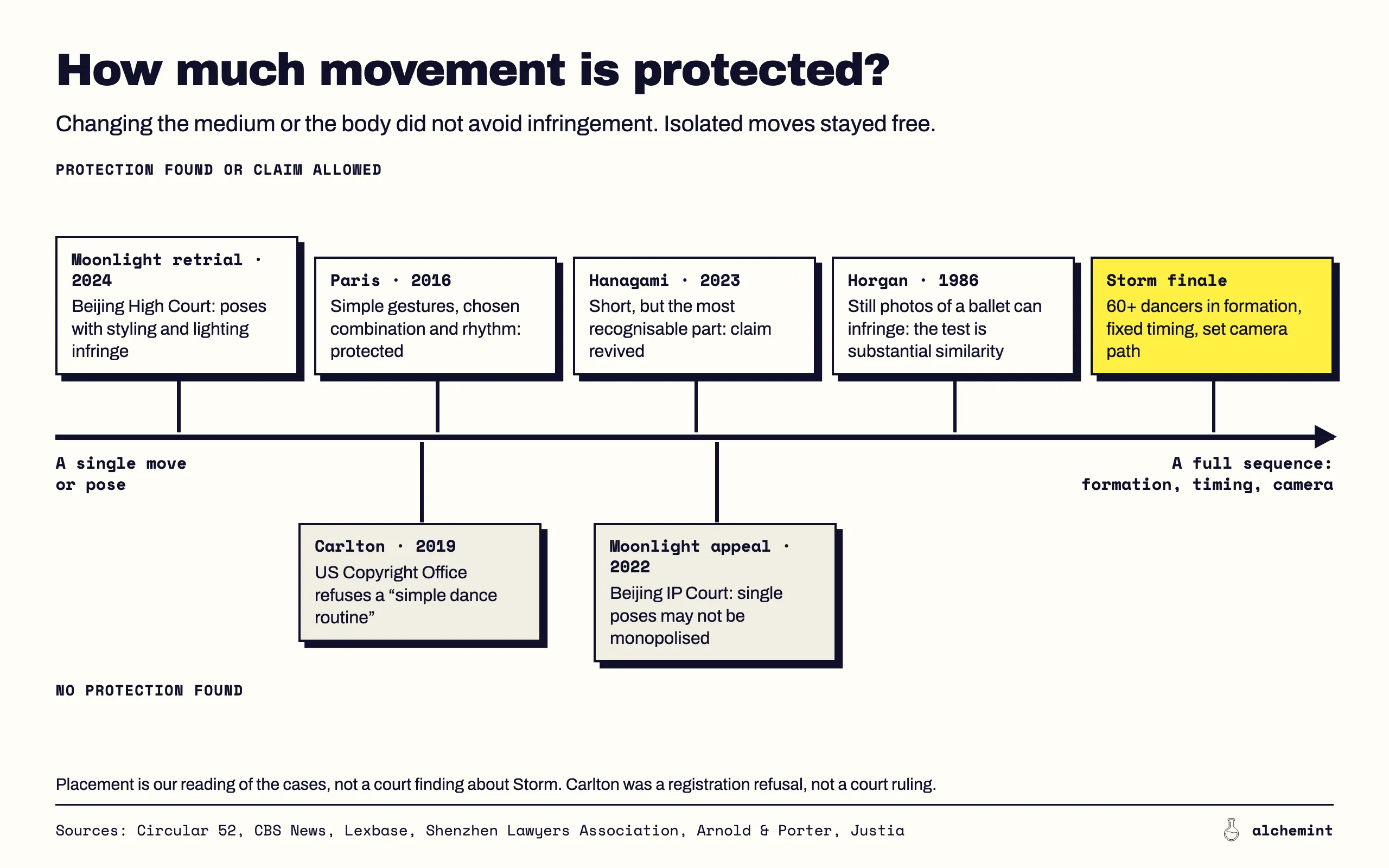
- Horgan v. Macmillan (Second Circuit, 1986). A book of photographs of Balanchine's The Nutcracker. The district court held that still photos could not infringe choreography because the flow of steps could not be recreated from them. The appeals court reversed: the test is whether the copy is substantially similar to the choreography, not whether the choreography could be rebuilt from the copy.
- The Carlton (2019). The U.S. Copyright Office refused to register Alfonso Ribeiro's famous dance as a "simple dance routine". He dropped his suits against Epic Games and Take-Two over Fortnite emotes.
- Hanagami v. Epic Games (Ninth Circuit, 2023). The court said that reducing choreography to poses would be like reducing music to notes, and that protection lies in the selection and arrangement of movements. A short copied portion was not automatically too small, since Hanagami alleged it was the most recognisable part of his routine. The case settled in February 2024.
- Paris, 2016. A Paris court protected a set of meditative movement sequences made of simple gestures, holding that neither their purpose nor their simplicity prevented protection.
- Yang Liping's Moonlight (Beijing, 2018 to 2024). A restaurant chain decorated its walls with silhouettes of poses from the Chinese dancer's solo. The first-instance courts found infringement. The Beijing Intellectual Property Court reversed on appeal in 2022, reasoning that single movements should not be monopolised by anyone. The Beijing High People's Court, in a retrial ruling reported in January 2024, restored the finding of infringement, holding that the specific poses combined with styling, costume and lighting were original expression.
Two lines run through these cases. A change of medium or body does not avoid infringement: photographs in Horgan and wall silhouettes in Moonlight both could infringe. Isolated moves stay free, as with the Carlton and the Moonlight appeal. The Storm finale, 60-odd bodies moving in formation to a fixed timing and filmed with a set camera path, sits on the protected side of both lines. It is also the most recognisable part of the film, which is the point Hanagami's claim turned on.
The dancers and the faces
The dancers are in a weaker position than the choreographer.
In Garcia v. Google (Ninth Circuit, en banc, 2015), an actress sought to remove a film from YouTube on the basis of her performance in it. The court held that she had no copyright interest in that performance, noting that she "played no role in fixation". In the United States, Storm's dancers would have to rely on their contracts and on publicity rights.
European performers' rights attach to recordings of a performance. They cover copying the footage, which is what happens at every upload. Whether they cover the same movement performed by synthetic bodies is an open question.
Denmark tried to answer it. In June 2025 a broad majority agreed to add two sections to the Danish Copyright Act: § 73 a, covering everyone's face, voice and body against realistic digital imitations, and § 65 a, protecting performing artists' performances against being imitated and shared. When the draft went through the EU notification procedure, the European Commission commented in February 2026 that "there is no definition of what would constitute an imitation of a performance", and that a deepfake labelled under Article 50(4) of the AI Act could remove the likelihood of confusion the Danish text required. The bill had not yet been introduced when Prime Minister Mette Frederiksen called an election on 26 February 2026, and pending legislation lapsed. A new government took office on 2 June. When we checked on 28 September, we found no sign that the bill had been reintroduced, and no such law appears in Retsinformation, the official Danish legal database.
The closest precedent to a Storm template comes from Beijing. In a case the Beijing Internet Court published in October 2024, a company took videos of a creator known for historical-costume clips and turned them into paid face-swap templates. The court found no infringement of her portrait rights, because her face had been replaced and she was no longer identifiable. It still ruled against the company, holding that processing the facial features in her videos was handling her personal information without consent. A Storm template works the same way: the body and the motion stay, the face goes, and so does any claim that depends on recognising the face.
When a tool maker is liable
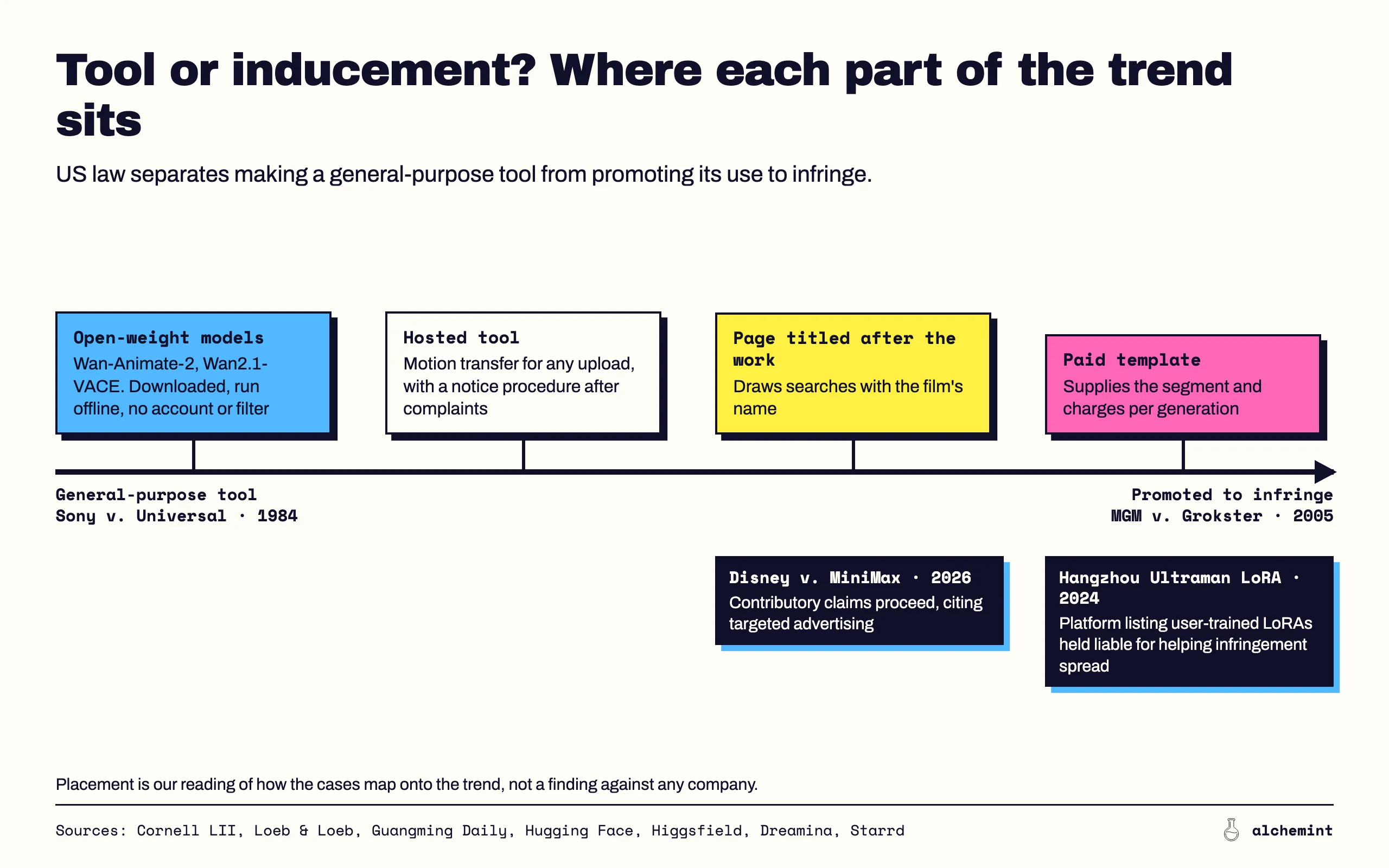
US law draws a line between making a tool and promoting its misuse.
- Sony v. Universal (1984). The maker of the Betamax recorder was not liable for users' copying, because the device was capable of substantial noninfringing uses.
- MGM v. Grokster (2005). "One who distributes a device with the object of promoting its use to infringe copyright, as shown by clear expression or other affirmative steps taken to foster infringement", is liable for the resulting infringement, "regardless of the device's lawful uses".
- Disney v. MiniMax (Central District of California, May 2026). Disney, Universal and Warner Bros. Discovery sued the maker of the Hailuo video model. The court denied the motion to dismiss and let the contributory infringement claims proceed, citing allegations that the defendants took affirmative steps to induce infringement through targeted advertising. The case is in discovery.
Chinese courts have gone further on platform duties.
- Guangzhou Internet Court, Ultraman (February 2024). In what was reported as the first effective judgment against a generative AI service, the court held the provider liable for reproducing and adapting the Ultraman character. It said providers owe a reasonable duty of care, including a complaint mechanism, risk warnings and prominent labelling.
- Hangzhou Internet Court, Ultraman LoRA (September 2024, upheld on appeal in December 2024). Users of an AI platform uploaded images to train Ultraman LoRA models, which the platform listed for other users to apply. The court found the platform was not a direct infringer, because the users uploaded the material, but held it liable for helping the infringement spread and ordered it to delete the models and stop offering them. A LoRA packages a character. A Storm template packages a choreography.
Taken together, the cases map onto the trend. Open weights sit on the Sony side: a general-purpose tool with many lawful uses. A hosted tool with a notice procedure sits in the middle. A page titled after Storm, or a paid template that supplies the segment, looks much more like Grokster, the MiniMax advertising, or the Hangzhou LoRA list.
Does crediting Storm, or calling it a pastiche, make it legal?
On 14 April 2026, in Pelham II (C-590/23), the Grand Chamber of the EU Court of Justice defined pastiche for the first time. The exception:
"covers creations which evoke one or more existing works, while being noticeably different from them, and which use, including by means of sampling, some of those works' characteristic elements protected by copyright, in order to engage with those works in an artistic or creative dialogue that is recognisable as such"
At paragraph 49 the Court added that pastiche "cannot cover concealed imitations of protected subject matter or plagiarism". A meme that names Storm and fills the rows with cats has an arguable case. An ad that credits no one and calls the result its own creative direction sits close to what paragraph 49 excludes. A template that returns the same 30 seconds for every customer has no visible dialogue. A credit makes an imitation overt. It does not supply the dialogue, and it does not work as permission.
In the United States, Andy Warhol Foundation v. Goldsmith (2023) held that when a use shares the original's purpose and is commercial, the first fair use factor is likely to weigh against it unless there is some other justification for copying. Swapping a footballer onto Storm to sell a kit comments on nothing in Storm.
Where the law and practice come apart
Put the statutes and cases side by side and Jalet's word "flous" becomes specific.
- Enforcement works one post at a time. Article 17 of the EU's 2019 copyright directive requires sharing platforms, to avoid liability, to act quickly on sufficiently substantiated notices and make best efforts to prevent re-uploads. The US uses DMCA notices under Section 512. The trend turns one clip into outputs faster than notices can be filed, and each notice lands on a fan.
- The clearest liability sits with whoever markets the work by name. That is a small part of the trend. The anonymous users who make most copies, and anyone running open weights, are practically out of reach.
- Performers have no clear right against imitation by other bodies. Garcia rules it out in the US, European rights attach to recordings, and the Danish attempt lapsed.
- Copyright is territorial. Infringement is judged under the law of each country where protection is claimed, so one trend falls under French, Belgian, American, Chinese and other laws at once. France and Belgium give Jalet a moral right. The US gives choreographers no general equivalent.
- Labels carry no rights. The AI Act's labelling duty, in force since 2 August 2026, informs viewers and gives the choreographer nothing. The Commission also warned that a label might undercut a confusion-based claim.
Who can realistically be reached
| Target | What they do | Lever | Difficulty |
|---|---|---|---|
| Commercial posts, such as spec ads and brand content | Put the sequence to work selling something, often without credit | Takedown notice, demand letter, damages | Lowest. The poster is identifiable and the purpose is plain. The Wekker Studios post no longer existed when we checked on 28 September, and the account showed 539 followers and zero posts. We cannot tell whether it was removed after a notice or deleted |
| Template sellers and pages named after the work | Supply the segment and charge per generation, or draw searches with the title | Notices, demand letters, an inducement-style claim | Moderate. Identifiable companies, often outside the EU |
| Hosted model providers | Supply motion transfer to anyone | Notice procedures, pressure on how uploaded references are handled | Higher. One step removed from each copy |
| Open-weight users | Run the models offline | Only the published copy can be reported | Out of practical reach until something is posted |
| Individual posts | Fans, memes, tributes | Platform notices at scale | Highest. Huge volume, a stronger pastiche argument, and the goodwill cost Jalet pointed to |
What to watch next
- What Jalet's team does. A letter to template sellers would test the most commercial layer. A claim against a provider would test the question no court has answered yet: what a service owes when users upload someone else's film as a reference.
- Disney v. MiniMax. Discovery into a video model's training and advertising is under way. It is the closest American case to a provider being held responsible for how its outputs are marketed.
- Denmark's performer clause. If the government reintroduces the deepfake bill in the parliamentary year that opens in October, § 65 a would be the first statute written specifically for imitated performances. Whether it would reach a motion-transfer copy depends on the definition the Commission said is missing.
- The NO FAKES Act. The Senate Judiciary Committee advanced it on 18 June 2026. It would create a federal right over digital replicas of a person's voice and likeness. If it passes, it would protect the footballer's face in the Aubameyang ad more directly than the dance.
How we checked this. Jalet's statement was read from Tarmac's Instagram post and comments (posted 21 and 22 September 2026) and from RTBF's article of 23 September 2026. The Wekker Studios post date comes from its X post ID, and the account's status was checked on 28 September 2026. View counts, the upload date and the credits come from the official YouTube page on the same day. The Dreamina FAQ, the Starrd price, the Genjutsu launch post and the Higgsfield wording were read on the services' own pages. The Wan-Animate-2 timings come from our own runs. Statutes and judgments are cited from the sources listed below. We ran no generation using Storm footage for this article.
This is an analysis of a public case, not legal advice. If a real client or real money depends on it, ask a lawyer who practises in the country where the work will be used.
Sources
The case
- Tarmac (RTBF) on Instagram, reel and comments, instagram.com/p/DdjXXS6k8mp
- RTBF, "Le clip 'Storm' de Genera8ion et Yung Lean repris par l'IA", 23 September 2026, rtbf.be
- GENER8ION, "STORM starring Yung Lean", YouTube, youtube.com/watch?v=x6_mbnsh6VU
- Wallpaper*, "Romain Gavras on Gener8ion, Yung Lean and Visions of 2034", 8 June 2026, wallpaper.com
- La Libre Belgique, "Qui est Damien Jalet, le chorégraphe du clip Storm tourné au Collège Cardinal Mercier?", 5 May 2026, lalibre.be
- Top5Apps, "How to Make the Yung Lean STORM AI Video (and What You're Actually Copying)", September 2026, top5apps.ai
- InsideHook, "Why Is Everyone Copying Yung Lean's 'Storm' Music Video?", 21 September 2026, insidehook.com
- Paste, 2026 VMAs winners list, pastemagazine.com
Tools and platforms
- Higgsfield, "Meet Higgsfield Genjutsu", 31 August 2026, higgsfield.ai; Genjutsu page and Terms of Use, higgsfield.ai/genjutsu, higgsfield.ai/terms-of-use-agreement
- Dreamina, "STORM II AI Crowd Dance Video", read 28 September 2026, dreamina.capcut.com
- Starrd, "How to Make the Storm Dance AI Video", 26 September 2026, getstarrd.app
- Wan-AI, Wan-Animate-2 model card, huggingface.co; Comfy-Org repackaged weights, huggingface.co
- Wan-AI, Wan2.1-VACE-14B model card, huggingface.co
- TechCrunch via Techmeme, Viggle's Series A and training on YouTube, 26 August 2024, techmeme.com
- Meta, Music Guidelines, facebook.com/legal/music_guidelines
Dance and credit
- The New York Times on Jalaiah Harmon, February 2020, x.com/nytimes
- CNN, "Black TikTok creators wouldn't post choreography for the latest Megan Thee Stallion track", 2 July 2021, cnn.com
- Culturebot, "Anne Teresa de Keersmaeker vs. Beyonce", October 2011, reproducing her statement, culturebot.org
Statutes
- U.S. Copyright Office, Circular 52, copyright.gov
- French Intellectual Property Code, Article L112-2, legifrance.gouv.fr
- EU AI Act, Articles 50 and 53, artificialintelligenceact.eu
- Directive (EU) 2019/790, Article 17, eur-lex.europa.eu
- Regulation (EC) No 864/2007 (Rome II), Article 8, eur-lex.europa.eu
- Congress.gov, S.4591, NO FAKES Act of 2026, congress.gov
Cases
- Horgan v. Macmillan, 789 F.2d 157 (2d Cir. 1986), law.justia.com
- CBS News on the Copyright Office's refusal to register the Carlton, 2019, cbsnews.com
- Hanagami v. Epic Games, Ninth Circuit, 2023, summary by Arnold & Porter
- Tribunal de grande instance de Paris, 13 May 2016, No. 14/05221, summary by Lexbase
- Yang Liping v. Yunhaiyao, Beijing High People's Court retrial, reported January 2024, in Shenzhen Lawyers Association, Copyright Law Bulletin No. 21, szlawyers.com
- Garcia v. Google, Ninth Circuit en banc, 18 May 2015, ca9.uscourts.gov
- Beijing Internet Court, AI face-swap template case, reported 30 October 2024, thepaper.cn
- MGM Studios v. Grokster, 545 U.S. 913 (2005), law.cornell.edu
- Disney Enterprises v. MiniMax, C.D. Cal., May 2026, summary by Loeb & Loeb
- Guangzhou Internet Court, Ultraman case, February 2024, reported by 21st Century Business Herald
- Hangzhou Internet Court, Ultraman LoRA case, reported by Guangming Daily
- Court of Justice of the EU, Pelham II, C-590/23, 14 April 2026, curia.europa.eu
- Andy Warhol Foundation for the Visual Arts v. Goldsmith, 598 U.S. 508 (2023), supremecourt.gov
Denmark
- Danish Ministry of Culture, "Bred aftale om deepfakes giver alle ret til egen krop og egen stemme", 26 June 2025, kum.dk
- Bech-Bruun, "Nyt lovforslag: Forbud mod deepfakes og beskyttelse af kunstneriske præstationer", July 2025, bechbruun.com
- COMMUNIA, "European Commission echoes concerns about Danish copyright proposal on deepfakes", 30 March 2026, communia-association.org
- K-News, "Forbud mod deepfakes møder europæisk modstand", 10 February 2026, k-news.dk
- Deloitte Denmark, "Så er der udskrevet folketingsvalg", 26 February 2026, deloitte.com
- 01Who owns what you make with AI? Read three clauses, not the headline
- 02Can you use AI-generated content commercially? It is four gates, not one
- 03Does the platform keep your prompts and train on them? Here is our whole supply chain
- 04Damien Jalet and the Storm AI Trend: What Platforms Can't Contain, and Where the Law Falls ShortYou are here