
Why Does MiniMax H3 Dialogue Sound More Natural? Pauses and Phrasing at 20–50 Steps
The 50-step dialogue sounds more natural to us, while the characters' pitch spans change in opposite directions. Four level-matched clips explore what extra sampling might change.
The same lines sound more natural to us in the 50-step MiniMax H3 output. The pauses feel more natural too, with less of a script-reading quality. That was my immediate reaction to this comparison.
Yet the full soundtrack has a smaller loudness range, while the two characters' pitch spans change in opposite directions. What might the extra computation have changed?
We generated one 14-second Chinese dialogue scene at 20, 30, 40 and 50 steps using open H3 Ref2VA BF16. The prompt, five ordered reference images, lines and speaker assignments matched. There is one candidate per setting, without a fixed seed. We connect listening impressions with timing and acoustic features to form practical hypotheses. See the four-step visual comparison for pictures, lighting and recorded job times.
More breathing room at 30 steps, a different ending at 40 and 50
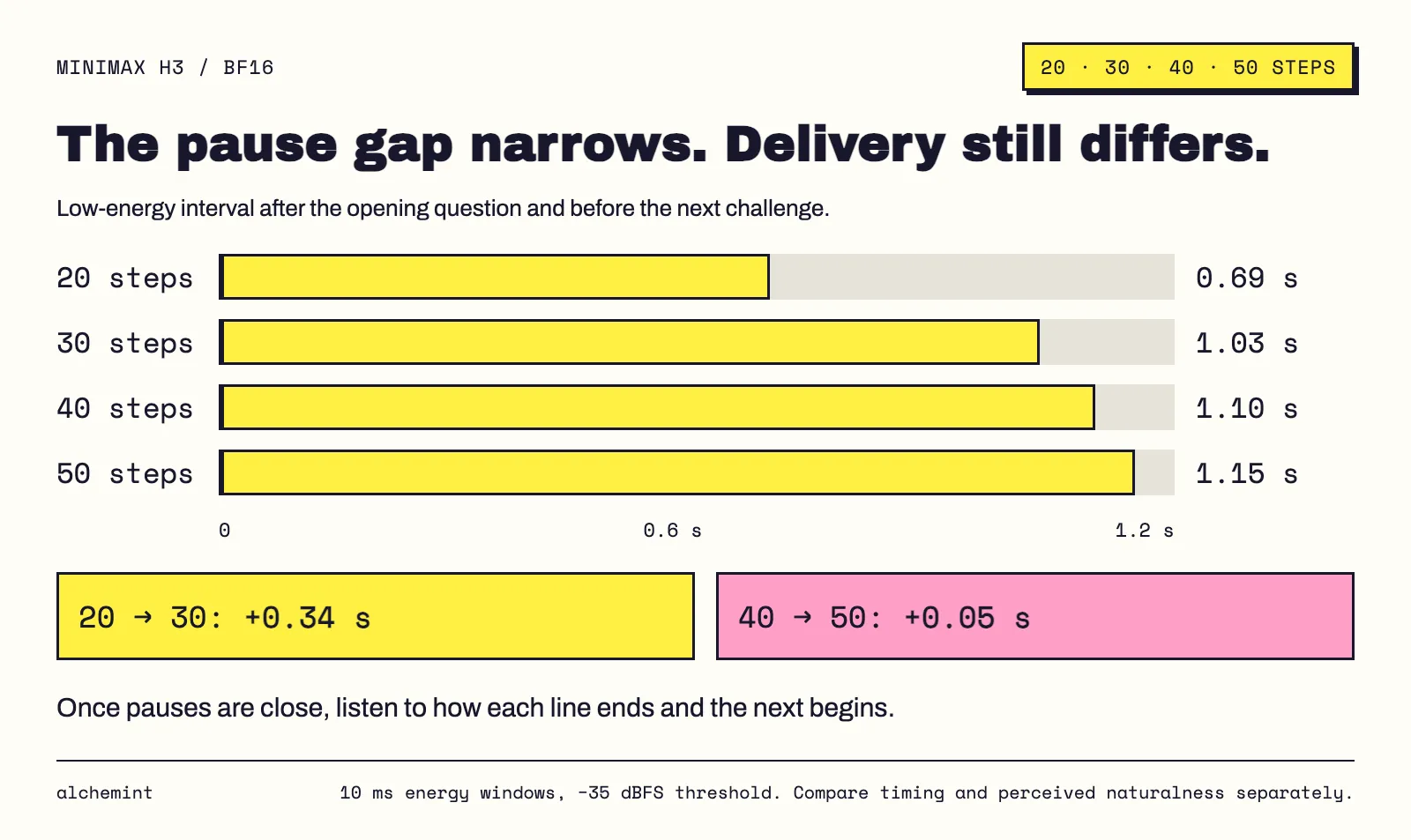
The 50-step preference comes from listening. Timing measurements identify at least one concrete difference: the pause after the woman's opening question, “真千金逆襲?”, gets longer across these four outputs.
| Steps | Low-energy interval after the question | Approximate duration of the clerk's final clause |
|---|---|---|
| 20 | 0.69 s | 2.58 s |
| 30 | 1.03 s | 2.60 s |
| 40 | 1.10 s | 2.74 s |
| 50 | 1.15 s | 2.80 s |
The interval uses 10 ms energy windows and a −35 dBFS threshold. The final-clause column uses automatic transcript boundaries for “這個世界線的特色是一妻多夫喔” and may include brief pauses. These are timing measurements, not naturalness scores.
The 50-step version leaves 0.46 seconds more than the 20-step version. Within a 14-second exchange, that is enough time to change how the lines relate: a question, a pause, then a challenge can suggest a character responding to the situation. The clerk's final clause is also slightly more spread out.
Yet the second question has estimated spans of 1.64, 1.66, 1.60 and 1.60 seconds. The whole performance has not simply slowed down. The pause increases by only 0.05 seconds from 40 to 50 steps, too. The useful question is how speaking time and pauses are distributed across the exchange.
The pause is already similar at 40 and 50 steps, yet 50 still sounds more natural to us. That is the more interesting clue. Our interpretation is that the remaining gain may concern how a pause is performed: how the preceding line ends, how the next begins, and how emphasis carries emotion across the gap. Longer silence alone cannot explain the whole listening preference. The model may be improving continuity in the delivery. That makes 50 steps worth trying when the picture works but the voice still feels like separate lines being read aloud.
The full soundtrack's loudness range is 3.2 LU at 50 steps, versus 4.7 LU at 20. Pitch needs to be separated by character: the clerk's estimated span falls from 8.63 to 8.15 semitones, while the woman's rises from 11.30 to 12.40. These spans are the P90−P10 of each character's estimated fundamental frequency; they do not indicate that all the dialogue becomes more restrained.
That suggests a more specific hypothesis: naturalness may involve how prosody is arranged between the characters. The woman's questions can use a wider pitch span while the clerk's answer stays more restrained. Together with line endings, entrances and pauses, that may make the exchange feel more responsive. Pitch span alone cannot verify this explanation, but the listening impression and acoustic differences offer a useful direction for the next selection: listen to how the characters respond to each other, beyond who speaks more slowly or with greater variation.
Listen before checking the step counts
Listen to the four soundtracks before checking the step counts. Fixed gain brings them close to −23 LUFS while preserving speed, pauses and within-line dynamics.
After listening: A = 40 steps, B = 30, C = 20, D = 50.
The original videos with unadjusted sound are also available: 20 steps · 30 steps · 40 steps · 50 steps.
What might extra sampling coordinate?
H3 generates picture and sound together. Its official architecture description says the H3-Omni-Transformer jointly predicts video and audio latents. The Diffusers implementation documentation describes separate noise schedules updated within the same transformer call. Extra sampling can therefore affect how sound takes shape too. Dialogue belongs alongside the picture when selecting a candidate.
A dialogue shot may still offer meaningful performance differences after its still-image detail has largely plateaued. A candidate need not add pores to be worth considering: better-fitting pauses and delivery can justify the wait. Sound was part of our reason for choosing this 50-step candidate.
Choose the voice together with the acting
Around 3–3.75 seconds, the 20-step woman's forward lean and mouth opening are stronger than in the 30-step version. Her final eye roll is more apparent, too. The 30-step performance is more restrained and ends closer to looking down at the ledger. If anger is the point of the scene, the lower-step candidate has a useful reaction.
The cuts also differ: 20 steps cuts to the clerk at 4.750 seconds; 30 steps at 5.250 seconds. Giving half a second to a different character changes the exchange.
A higher-step candidate needs to be selected again: it reinterprets lighting, expressions and cuts. The wall behind the woman is simpler at 50 steps, keeping attention on her. When the environment needs to communicate more, another candidate's background may serve the scene better.
When is dialogue worth a 50-step trial?
If the characters and scene already work at 20 steps but the exchange feels rushed, compare 30 for more breathing room. Compare 40 for another ending and overall rhythm. In this set, the pause measurements are already close at 40 and 50; the connected delivery is what makes us keep the 50-step candidate.
When the picture works but the dialogue still feels like separate lines being read, 50 steps is a useful next candidate. Listen to how one line ends, whether the pause carries emotion, and whether the next line responds to the previous one. Then put the voice back with the character’s expression. That is closer to the benefit observed here than simply maximizing pause length or pitch variation.
For unresolved materials or lighting, return to the visual step-count recommendations to decide which shots deserve the extra computation.