
MiniMax H3 at 20, 30, 40 and 50 Steps: What Changes in the Image?
Four BF16 renders of one scene reveal changes in human detail, creature eyes, tonal separation and color stability. What might extra sampling do, and which shots warrant a 50-step trial?
The most noticeable visual gain from raising open MiniMax H3 from 20 to 50 steps was in a toad's eye.
We generated four versions of the same 14-second dialogue scene. It was tempting to expect faces, hair and clothing to improve together as the step count rose. Yet the 20-step version already retained much of that detail. At 50 steps, the human face did not suddenly acquire visible pores, and hair and fabric did not improve across the board. The clearer local differences were parts of the toad clerk's radial iris texture and the lighting effect of eyelid creases and highlights.
The soundtrack gave us another reason to consider 50 steps. My reaction was that it sounded more natural, less like reading a script.
Across the moving shot, 50 steps also produces stronger separation between light and dark: a larger bright window area behind the dark character, clothing that retains its form, and prominent highlights on the skin and eyelids. The differences extend from one eye to the lighting and performance of the scene.
That makes the practical question more specific: what in this shot still needs more sampling—an already convincing human appearance, an unusual material, or the delivery of a line?
One prompt, four complete generations
A woman questions a toad clerk in an underworld office. He answers, and the shot cuts back to her reaction. The scene combines a human, a nonhuman character, fabric, an interior and Chinese dialogue.
The submitted inputs differed only in their step setting. They shared the prompt, five ordered reference images, dialogue and speaker assignments. We used open H3 Ref2VA BF16 through the Comfy-Org model packaging; returned model and weight revisions matched. Each output is 1344 × 768, 24 fps and 14 seconds, with 336 frames.
There is one output per step count, without a fixed seed or identical hardware across all runs. We use these four production candidates to suggest what to try next. Picture and sound are observations; what the model might have spent more computation on is our interpretation, not an internal processing order disclosed by H3's developers. The comparison supports practical trials, but cannot isolate steps as the cause of every difference.
Each run completed its own sampling process. The 20-step output is not the 50-step run stopped at iteration twenty, and 50 steps does not mean polishing the completed 20-step video thirty more times.
What does each step count bring to the scene?
Looking at production choices makes these differences more useful than a single quality score.
| Steps | What we see and hear in this candidate | How I would use it |
|---|---|---|
| 20 | Faces, hair bundles and fabric are already established. The woman's lean, mouth opening and final eye roll are stronger, with tighter spacing between lines. | Establish the characters, scene and action. Keep this performance in contention when a direct, impatient reaction fits. |
| 30 | About a third of a second more space after the opening question than at 20 steps; restrained acting, a lower camera angle on the clerk, and a different balance of warm wall and side window. | Try this when the human appearance is sufficient and the exchange could use more room for a response. Reassess lighting and camera position too. |
| 40 | Some face crops are softer, and the clerk's shot has darker midtones. The question-to-question interval is close to 50 steps, with a more spread-out final clause. | Compare the darker treatment and more relaxed ending. The changes here concern the overall interpretation of the scene. |
| 50 | More readable local iris texture and prominent eyelid highlights, stronger separation between bright windows and dark clothing; more natural overall dialogue and pauses to our ears. | Prioritize a trial when unusual materials, tonal separation or dialogue delivery determine whether the shot works. |
The working hypothesis is that extra steps may increasingly help complete relationships between elements once the main elements are already established: how a material catches light, how an eyelid covers an iris, or how one line leads into the next. The details below show what supports that interpretation.
Finding one: familiar human detail may reach a visible plateau early
Start with the face at two seconds, then the eye at eight seconds.
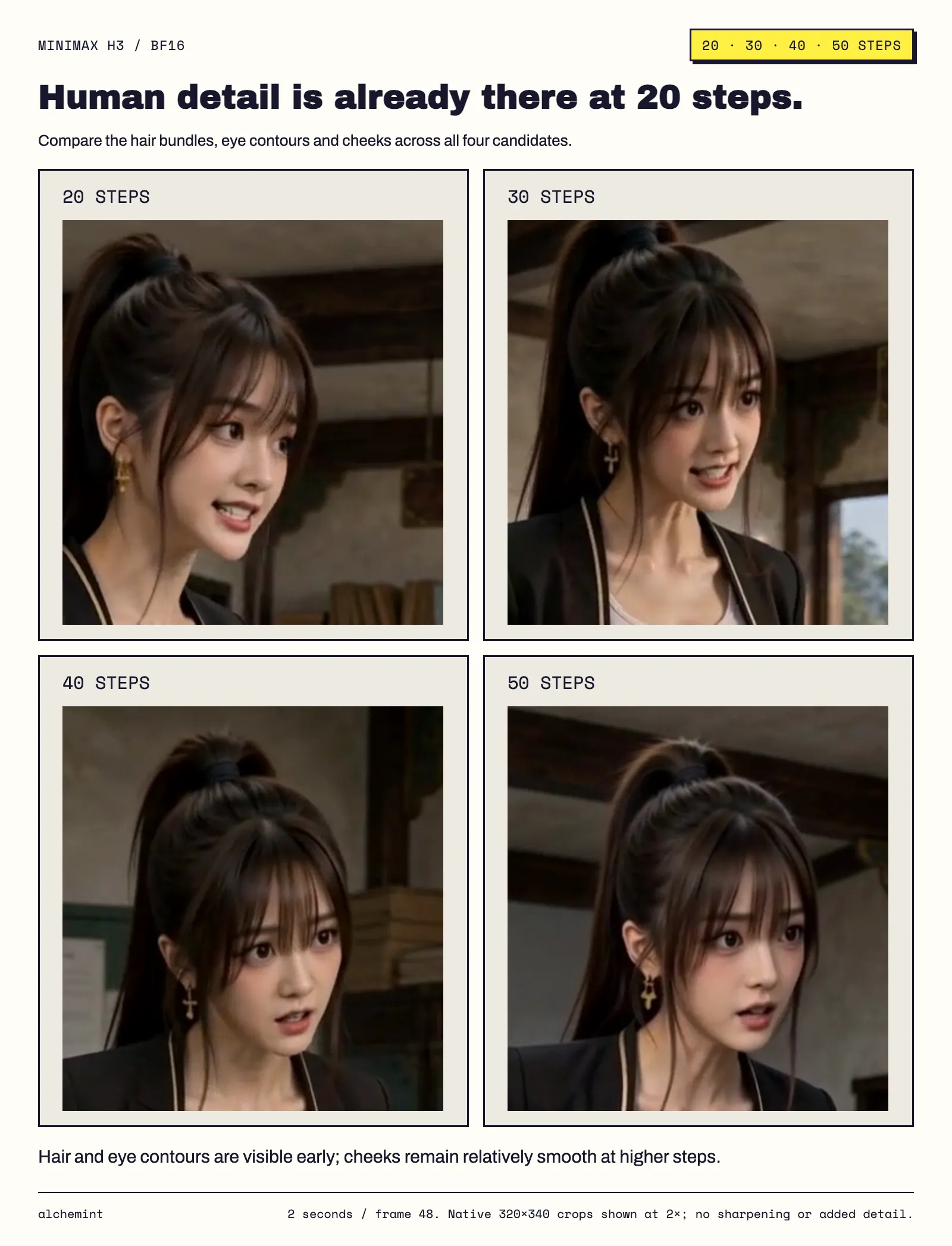
At 20 steps, the fringe already separates into strands. Flyaway hair, eye contours and the earring are visible. The 30-step version changes angle and lighting; some 40-step frames are softer. At 50 steps, the eye contours and fringe are fairly crisp, but the cheeks and forehead still have the same smooth appearance.
Fabric follows a similar pattern. All four versions retain seams and crossing textures on the blue robe. The 20-step version has not reduced the garment to a flat patch of color. There is no consistent progression in which each increase adds another level of fiber detail.
Our first hypothesis is that familiar human appearances may already fall within a stable part of the model's learned patterns at a lower step count. Faces, hair bundles, collars and fabric offer established visual relationships. More sampling may then yield relatively little visible improvement.
That also offers a possible explanation for the missing pores. If the current generation favors smooth skin, or output scale limits what can be resolved, extra steps may keep producing smooth skin. A reference image, lighting choice or prompt that actually calls for rougher, unretouched skin may be more relevant to that particular problem.
Finding two: unusual materials may be better candidates for more steps
The toad's eye gives a different signal. At eight seconds, branching markings on the right of the orange iris and radial markings along its lower edge are easier to distinguish at 50 steps. The eyelid shows a different combination of creases and reflected highlights. A small local advantage remains when we downscale the visible irises to roughly comparable widths.
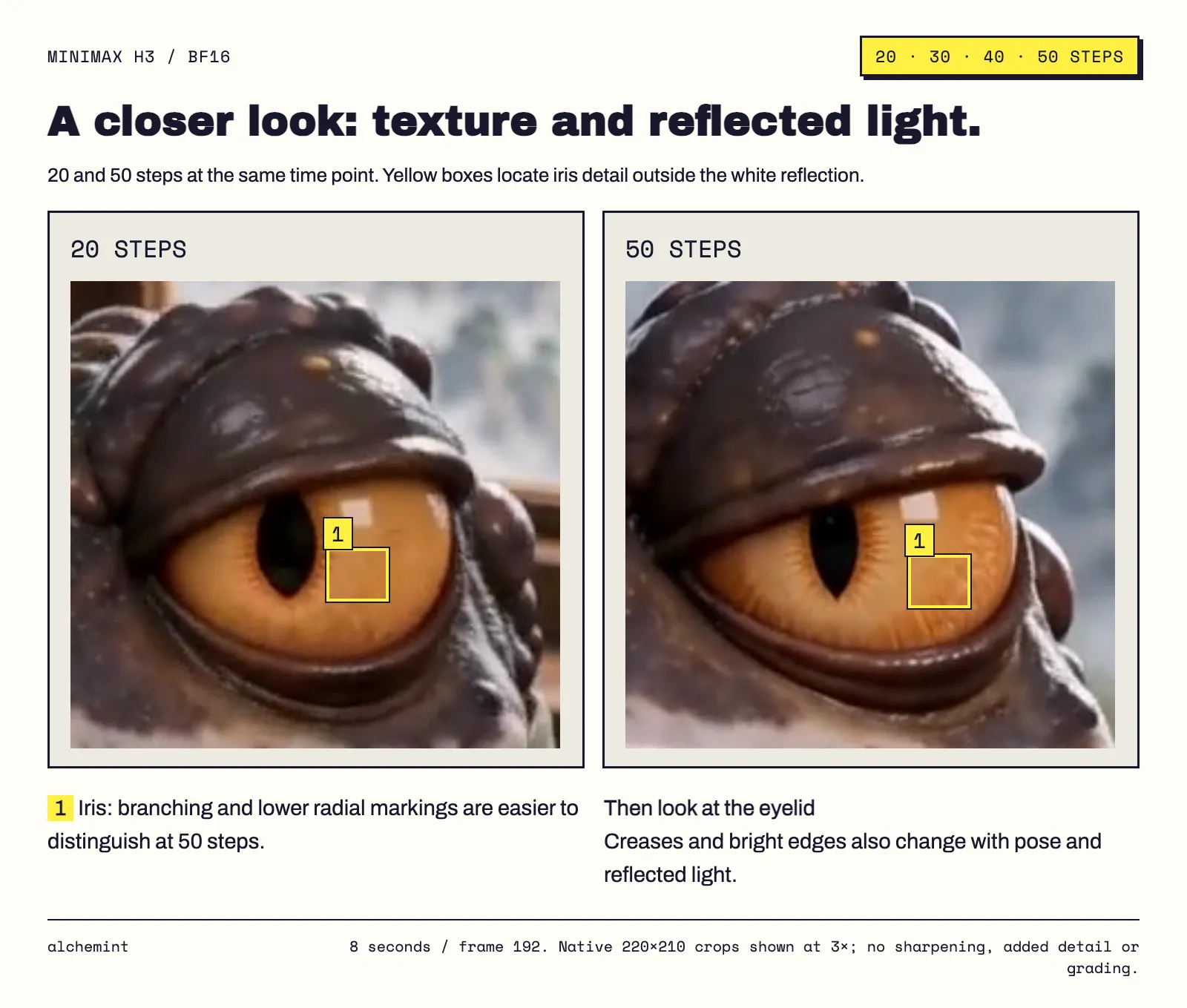
Across consecutive frames from 7.75–8.21 seconds, the 50-step eye markings remain readable as the head moves. At twelve seconds, the 30-step version also has fine radial markings. That gives a specific use for a higher-step trial: inspect the local feature you care about, then return to the moving shot to choose.
This eye combines fine radial patterns, a curved reflective surface and eyelid occlusion, next to the folds of a nonhuman character's skin. We suspect that unusual local features whose details need to work together may have more to gain from additional sampling than an already stable human appearance.
Diffusion research gives us one mechanism to consider. Beta Sampling is All You Need found larger changes in coarse image structure earlier in sampling and more fine-detail adjustments later, in the image diffusion models it studied. This offers a reference for interpreting the H3 outputs: a broadly complete picture may still leave room for computation to improve a complex local feature.
Hair is fine detail too, so “small details need fifty steps” would miss the point. A more useful hypothesis is that the return depends on how much difficult, unresolved detail remains in this particular content. Subject, material, screen size and references may all affect that difficulty.
I would therefore prioritize higher-step trials for a creature-eye close-up. Following the same hypothesis, reflective jewelry and intricate translucent materials would be useful subjects for the next comparison.
Finding three: the extra sense of form may come from light meeting material
Return to the full frame at eight seconds. At 30 steps, the camera looks up at the clerk with a large warm-gray wall behind him. At 40, the view is more frontal and the midtones are darker. At 50, bright windows sit behind the dark character, bringing out the relationships between light and shadow on his eyelids, skin and robe.

We measured every frame of the clerk's shot and took the median of each per-frame measure:
| Steps | Mean encoded brightness | Tonal span |
|---|---|---|
| 20 | 28.50% | 146 |
| 30 | 29.89% | 142 |
| 40 | 27.96% | 142 |
| 50 | 31.89% | 171 |
Brightness maps the video's encoded luma range of 16–235 to 0–100%. Tonal span is the difference between its 95th and 5th luma percentiles, in code values. These describe the distribution of light and dark in the footage, not sensor dynamic range or exposure stops.
The 50-step shot is both brighter and more widely spread across the tonal range. Native-size shadow crops show robe folds in all four versions; the 50-step fabric and throat retain form rather than becoming solid black patches. Near-white pixels occupy less than 0.02% of any frame across the four videos. The visible difference is specific: bright areas separate while dark areas retain shape, helping distinguish the character from the background and reflections from the underlying material.
That adds another explanation for the eye. A more detailed-looking iris can combine additional visible markings with stronger local contrast; the eyelid's bright edge describes its curved surface. I read this as material and lighting becoming more complete together. Additional sampling may help coordinate these interdependent relationships, making an unusual material feel more like an object that belongs in the scene.
The 30- and 40-step candidates are useful too. They show that the lighting treatment can change direction: 40 steps is darker than 20. Increasing steps offers another complete interpretation of the scene, with no fixed increment of brightness or sharpness every ten steps.
Color and temporal stability provide a useful clue about where to spend further effort. We tracked 24 background regions across three shots. Brightness and chroma changes were small in all four versions, including 20 steps; color intensity did not increase consistently with step count either. Once the human appearance, background exposure and color are stable, identify the unresolved part of the shot before increasing steps. Here, the more promising targets are unusual eye detail, tonal separation and vocal performance.
Dialogue can also justify more steps
The 50-step dialogue and pauses sound more natural to us. The interval after the question grows from 0.69 seconds at 20 steps to 1.15 at 50, yet 40 and 50 differ by only 0.05 seconds. The full soundtrack's loudness range is smaller, while the two characters' pitch spans change in opposite directions. We suspect extra sampling may also affect prosody between the characters, alongside line endings, entrances and transitions.
H3 generates picture and sound together, so still images can miss a performance benefit. The four level-matched soundtracks, timing measurements and full interpretation are in Why Does MiniMax H3 Dialogue Sound More Natural?.
What should the extra waiting buy?
| Steps | Recorded time inside the job | Known hardware |
|---|---|---|
| 20 | 46 min 41.2 s | RTX PRO 6000 Blackwell, 48GB MIG partition |
| 30 | 57 min 24.3 s | RTX 5090 32GB |
| 40 | 90 min 52.5 s | Actual GPU not read back |
| 50 | 116 min 44.9 s | Actual GPU not read back |
These worker-reported times include loading and workflow overhead. They are not isolated sampling times, complete queue-to-delivery waits or bills. Different hardware prevents using this table to predict a same-GPU slowdown from 20 to 50 steps.
For these jobs, however, the recorded work increased from about 47 minutes to almost two hours. That makes it useful to name exactly what improved.
These results suggest the following choices:
- Start at 20 steps for ordinary human scenes. Check the characters, action, fabric and staging. A candidate that already works deserves to stay in the edit.
- Compare 30 and 40 steps for alternative lighting and pacing. Here, 30 changes the question's breathing room, while 40 spreads out the clerk's ending and darkens the midtones. They offer different interpretations.
- Prioritize 50-step trials for important close-ups and dialogue. Unusual creatures, reflections overlapping with occlusion, or a convincing picture with disconnected vocal delivery are useful targets. Compare how material, lighting and performance work together.
Before changing the step count, I would name one concrete goal: a more convincing eye material, better separation for a character against a bright window, or a line that feels like a response to the one before it. Then I would check that goal in the higher-step candidate. The extra time has a return we can actually look or listen for.