Casting became asset locking, cinematography became prompt engineering: Hell Grind's 2.5 million words
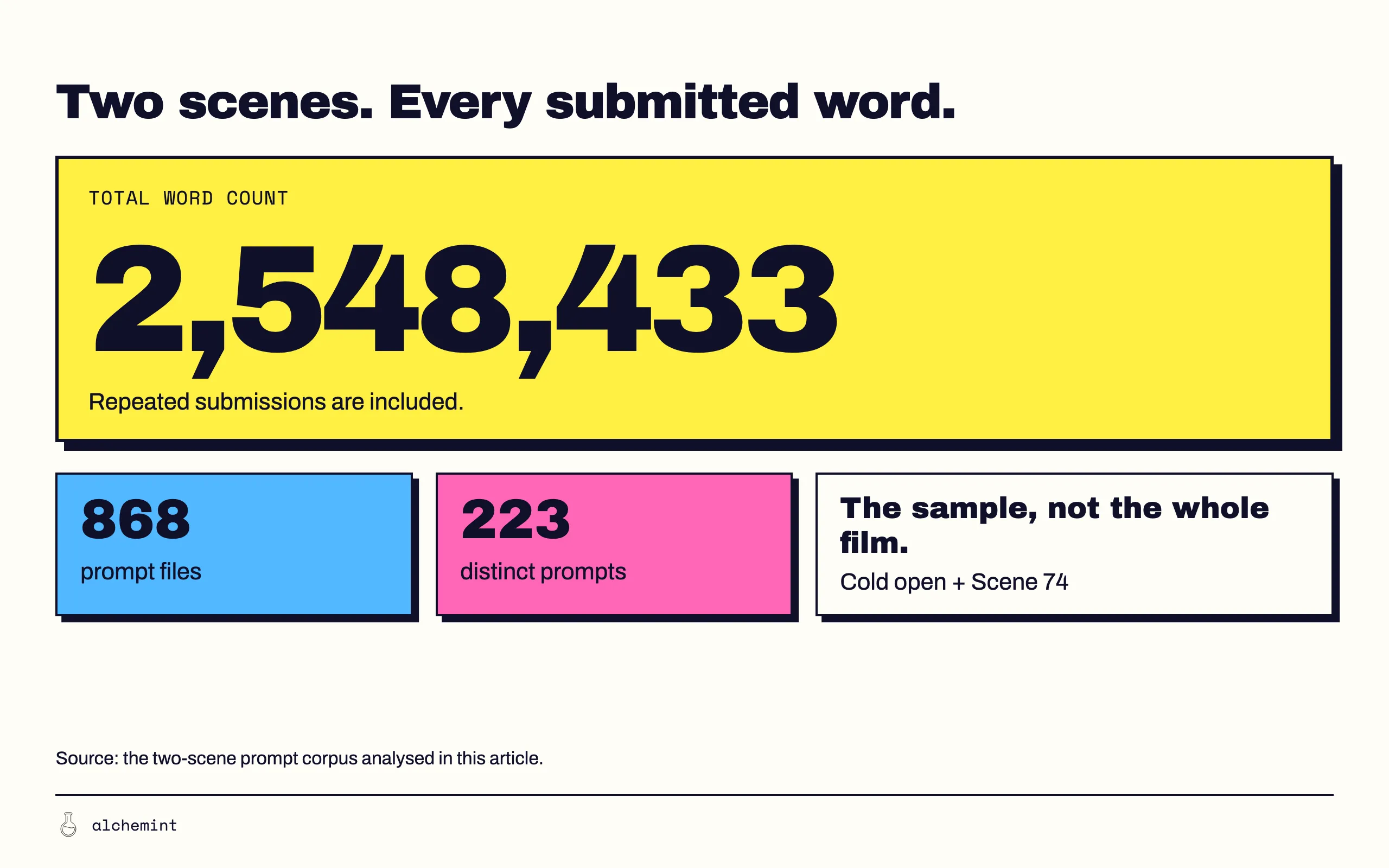
Two full scenes of Hell Grind's prompts: 868 files, 2.5 million words. There were 223 distinct prompts; the rest were repeat submissions. A production-grade prompt reads like a contract.
Last time we opened Hell Grind's books: 115,446 generations traded for 95 finished minutes. This time we go smaller — into the prompts themselves.
We have the complete prompt corpus for two of the film's scenes: 868 files, 2,548,433 words — 16.2 million characters. Start with the earliest one generated — the cold open, 251 finished clips and the complete prompt behind every one. Read them word by word and the headline finding is a single number: 251 clips came from just 65 prompts.
Behind that number are two film crafts quietly changing shape.
Casting became asset locking
Start at the top of the prompt. The first block of nearly every cold-open prompt is the same slab of text: a full physical description of the lead — 815 characters covering skin tone, the curve of the horns, the light in the eyes, right down to the electric blue glowing through the charred cracks in his left forearm. That block appears verbatim 160 times across 251 prompts. Not one word changed. The location block runs even longer (1,242 characters) and appears verbatim 230 times.
The repeated block gives each generation the same character description. Before production, the team defined each character as an asset: a locked text description plus reference images. Those assets supplied the identity cues for later shots.
Their reference-image method deserves its own note. Each character gets a face close-up, a full-body front, and a full-body back — and the full-body front has the head removed. They found the model reaching for the small, mushy face on the full-body image in wide shots; delete the head and the only face left to grab is the good one. Every state of a character is its own asset too: soaked, wounded, changed clothes, each with its own description, never blended. And nothing gets locked until it survives a stress test — generate it ten times, recognise it ten times.
Asset locking has a price, and the price is written all over the late-scene corpus. We separately analysed all 617 prompts from Scene 74 and found a third of the text fighting its own reference assets: NO SAFETY-GLASSES appears in 215 of them (34.8%), purely because that character's reference image is wearing goggles. NOT muscular and NOT bulky show up 142 and 122 times, because the model's prior insists on drawing the lead swole.
Put differently: locking an asset means inheriting everything else in that image too, including the parts you never asked for — and paying to shove them back out, once per prompt, forever.
Translate the whole routine into old film-set language and it is casting plus a costume test: decide what this character looks like, what each of their looks looks like, then freeze it for the shoot. The first thing you do when you tune a prompt is casting — the only difference being that this actor has amnesia every scene, so the costume test has to be stapled to every page of the script.
Cinematography became prompt engineering
After the asset blocks comes the shot itself. This section reads like a technical contract.
Cold-open prompts run a median of 12,619 characters, with an average of 10.4 hard constraint words — NEVER, EXACT, LOCKED, Do NOT. Space is pinned down by a locked text floor plan: altar centre-right, the body's head pointing toward camera, camera always stays on this side of the corpse field, never crosses the 180-degree line. Camera style is named down to the cinematographer: handheld, breathing, never locked off. Even the light has a conservation law — one source, one shadow direction, "never two suns."
Action instructions carry their own grammar rule: only write positive actions. Their recommendation is to write "pitch forward" rather than "do not fall backwards," specifying the desired action instead of only excluding one. Exclusions get written as inclusions: "exactly three figures, exactly one crystal arm, on the right arm, never past the shoulder."
That is what "cinematography became prompt engineering" concretely means: blocking, the eyeline axis, lighting ratios, staging — decisions that used to be executed by a crew on the day — all move forward into text, and have to be written as contract clauses that survive a model's creative interpretation. It is the same act as asset locking one section up: pin the uncertainty down before generation.
First you change nothing, then you change one line
Back to that number: 251 clips, 65 prompts.
54 of those groups are identical, character for character. On average each prompt was rolled 3.9 times, and the most-punished one was rolled 16 times with nothing changed. Line-diffing prompts within a group gives a median difference of zero lines.
Here is what 16 rolls actually looks like:
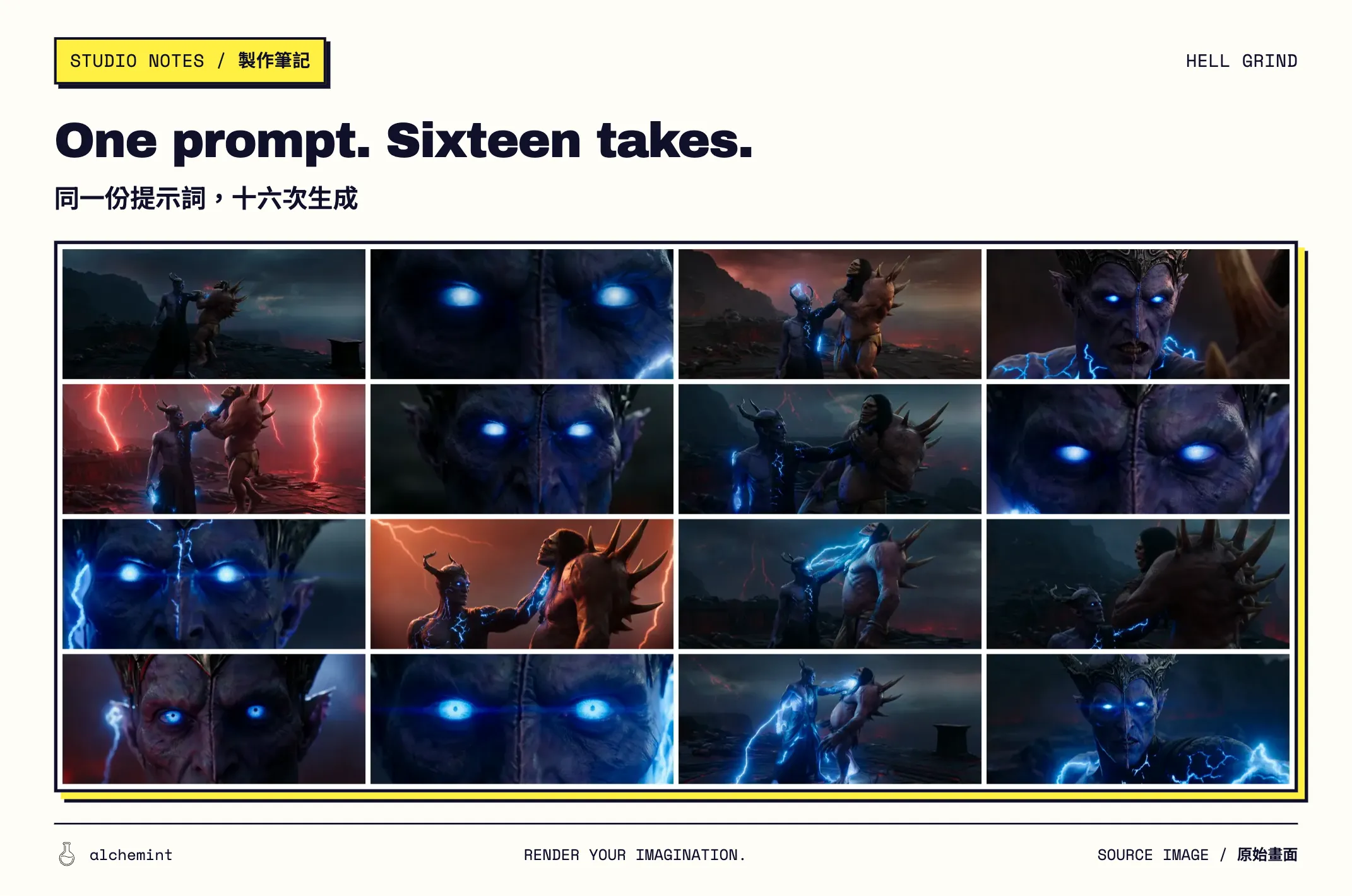
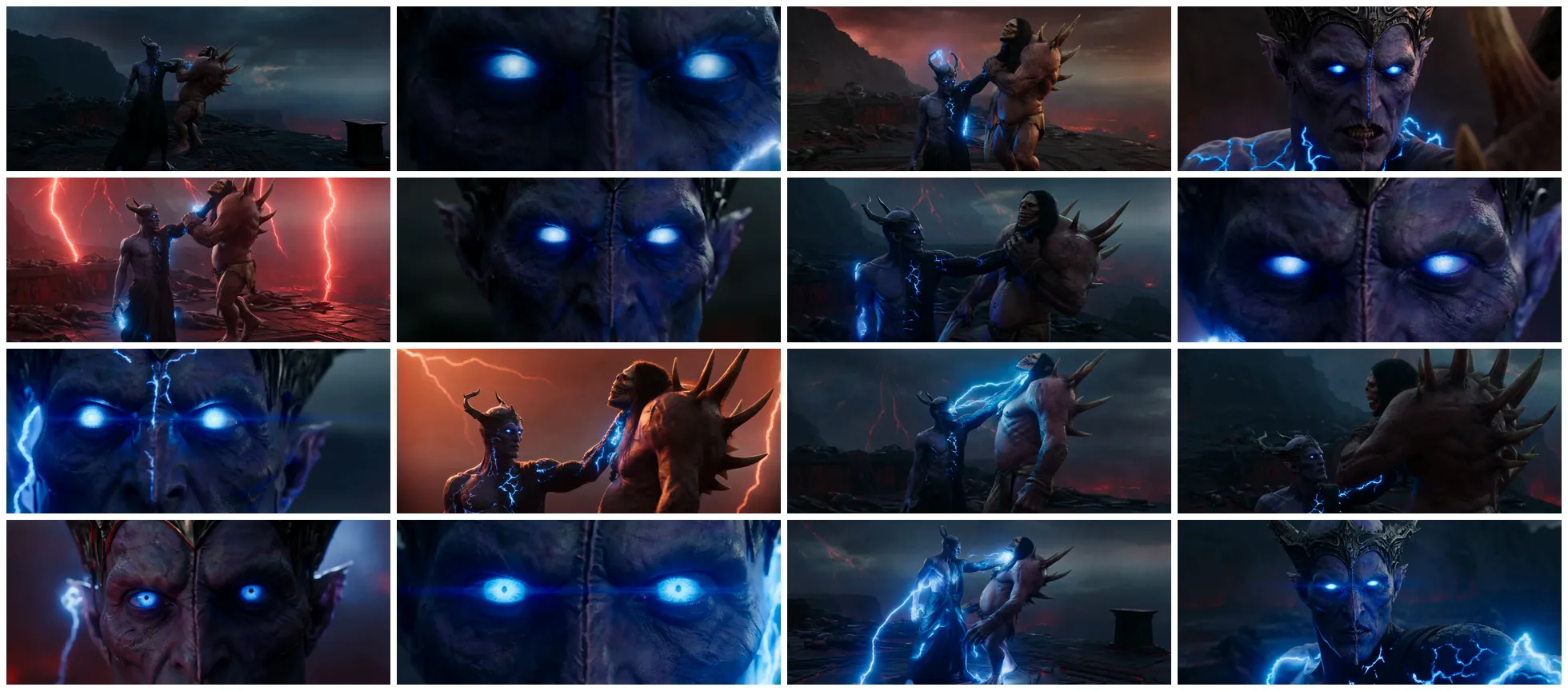
One prompt, not a word changed, rolled 16 times. Each frame comes from that roll's finished clip.
This picture makes two points at once. What was locked really did stay locked — the glowing blue eyes, the horns, the electric blue in the left forearm are there in all sixteen. Other visible details varied — shot size swings from wide vista to eye close-up, lighting from red lightning to blue arcs, and no two compositions match.
So rolling 16 times is a bet on the parts that cannot be written into the contract: whether this take happens to land at the right distance, whether this bolt of lightning happens to fire on the right beat. The contract governs who the character is. It cannot govern the luck of any given second.
Which means the cold open's iteration model runs: lock the text, roll repeatedly, pick from the results.
The late scenes make the shape of this even clearer. Scene 74's roll rate is almost identical to the cold open's (3.91 versus 3.86 on average, both topping out at 16), but the submission timestamps give it away: repeat submissions of the same prompt sit a median of six seconds apart, and 93% of multi-roll families are fully consecutive in the submission order. The six-second median interval suggests batch submission rather than watching every complete clip before requesting another. Across the scene, 73.8% of submitted characters are duplicate submissions.
Their official rule — "change one line at a time, log every change" — sits on top of a more basic discipline: first establish that the contract is worth executing at all, then talk about amendments. Rolling one prompt 16 times without touching a character means treating a prompt as a repeatable specification rather than a one-off wish.
Two weeks later, the template had been swapped out wholesale
The cold open is one of the earliest scenes generated. Scene 74, two weeks later, is the film's final scene — the blizzard has stopped, the lead is on his knees in the snow, his comrades' bodies lying either side of him.
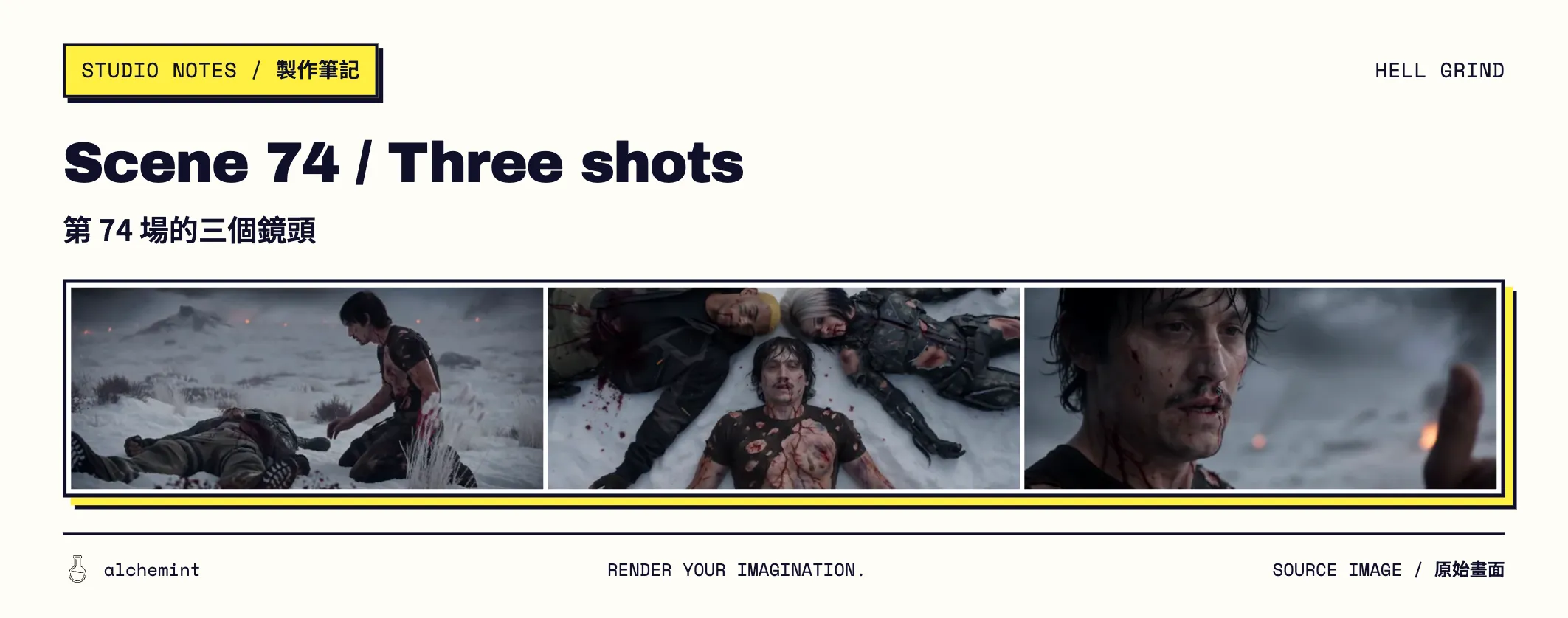

Three shots from Scene 74, one frame from each finished clip. The exact opposite world from the cold open's lava and hellscape.
Lay the two prompt skeletons side by side and they are obviously not the same kind of document. The cold open is three uppercase markers, and then everything gets stuffed under STRICT: in one continuous block — camera, five beats, dialogue, negative constraints, all in the same paragraph:
EXACT 2 CHARACTERS
GEO SPATIAL LAYOUT (locked across every CO shot — pure spatial map):
STRICT: ...BEAT 1... BEAT 2... BEAT 3... BEAT 4... BEAT 5... (all in one block)
Scene 74 breaks it into eight named sections, each responsible for one thing:
SCENE NOTE          LIGHTING
CHARACTERS          COLOR
CONTINUITY          SKIN
SPATIAL LAYOUT      ACTING
(In the original each header is flanked by a flame character on both sides; dropped here without affecting the structure.)
This scene's prompts run a median of 20,963 characters, about 60% longer than the cold open's 12,619. But length is the surface. The real finding is zero inheritance.
We ran a 12-gram comparison across the two corpora: zero overlap. Splitting one corpus in half and comparing it against itself gives a 97.4% positive control. The method could detect repeated sequences within that corpus, but found no shared 12-grams between the two scene corpora. The cold open's skeleton disappeared wholesale: STRICT fell from 100% to 6%, GEO SPATIAL LAYOUT from 70% to 0%. In their place, a set of symbol-flanked named headers used by 100% of the 617 prompts.
Even the constraints changed generation. The cold open swings at something vague — "don't look like a game cutscene." Scene 74 swings at a dozen specific failure modes: NO LUT (98.9%), NO BREATHING (42%), NO SOBBING (35%). Descriptor copying fragmented too: the cold open pasted one 1,242-character location block across the whole scene, while Scene 74 splinters into hundreds of shot-local blocks (repeated long lines still account for 44.5% of unique volume).
And the replacement did not only happen between scenes. Inside Scene 74's seven days, the team went through three generations of their own: T1 was the giant prompt (median 25.6k characters, six cuts crammed into one, the full camera section); T2 cut it into four segments and pulled the visual style out into a LOOK PRESET; T3 grew character anchor blocks (ANCHOR / HARD LOCK going from 0% to about 90%) and started spelling out the duration of every shot (4% to 87%).
So the line runs jagged: a series of teardowns.
It is not hard to see why: each small team owned its own scenes, nobody unified the format mid-flight, and it only got tidied into a single "production bible" after wrap. What you can read today is the retroactive summary of 14 days of fighting — and the cold-open prompts we hold are the fossil from before it set.
The boundary, and what's next
The honest edges of this analysis: all 868 prompts we hold (251 cold open, 617 Scene 74) are video prompts. The production side of the character asset images — face generation, image editing prompts — is not in our hands, and that part is quoted from their public production notes. What we measured is the consumption end, where an asset gets referenced, and the verbatim-copy discipline is fully verified at that end.
As for the 65 prompts themselves — they are already open source. The next thing we want to do is more direct: actually run them, and see what the same contract gets executed into by a different model.
Data and method: The prompt corpus is two full-scene captures from the public Hell Grind project — 251 paired prompts and clips from the cold open (obtained and analysed 2026-08-14), and all 617 prompts from the late Scene 74 (2026-08-17, complete for that scene). Word counts are whitespace-split over prompt bodies with metadata stripped: 510,977 words / 3,294,500 characters across the 251 cold-open files, 2,037,456 words / 12,914,457 characters across the 617 Scene 74 files, totalling 2,548,433 words / 16,208,957 characters. Duplicate detection used whole-text grouping plus line-set comparison; all length statistics are character medians over the full corpora, and must not be mixed with the length series derived from earlier API sampling (60 most recent per scene) — this article uses the former. The 12-gram comparison ships with a same-corpus split-half positive control (97.4%) to rule out method failure. Character asset production descriptions are quoted from Higgsfield's public production notes (verified 2026-08-14).