
$500,000, 14 days, 115,446 generations: what efficiency actually looks like
Higgsfield open-sourced Hell Grind — 95 minutes plus the entire pipeline. We counted the whole project: 115,446 generations, 88.8% of them video, about 180 clips behind every finished shot.
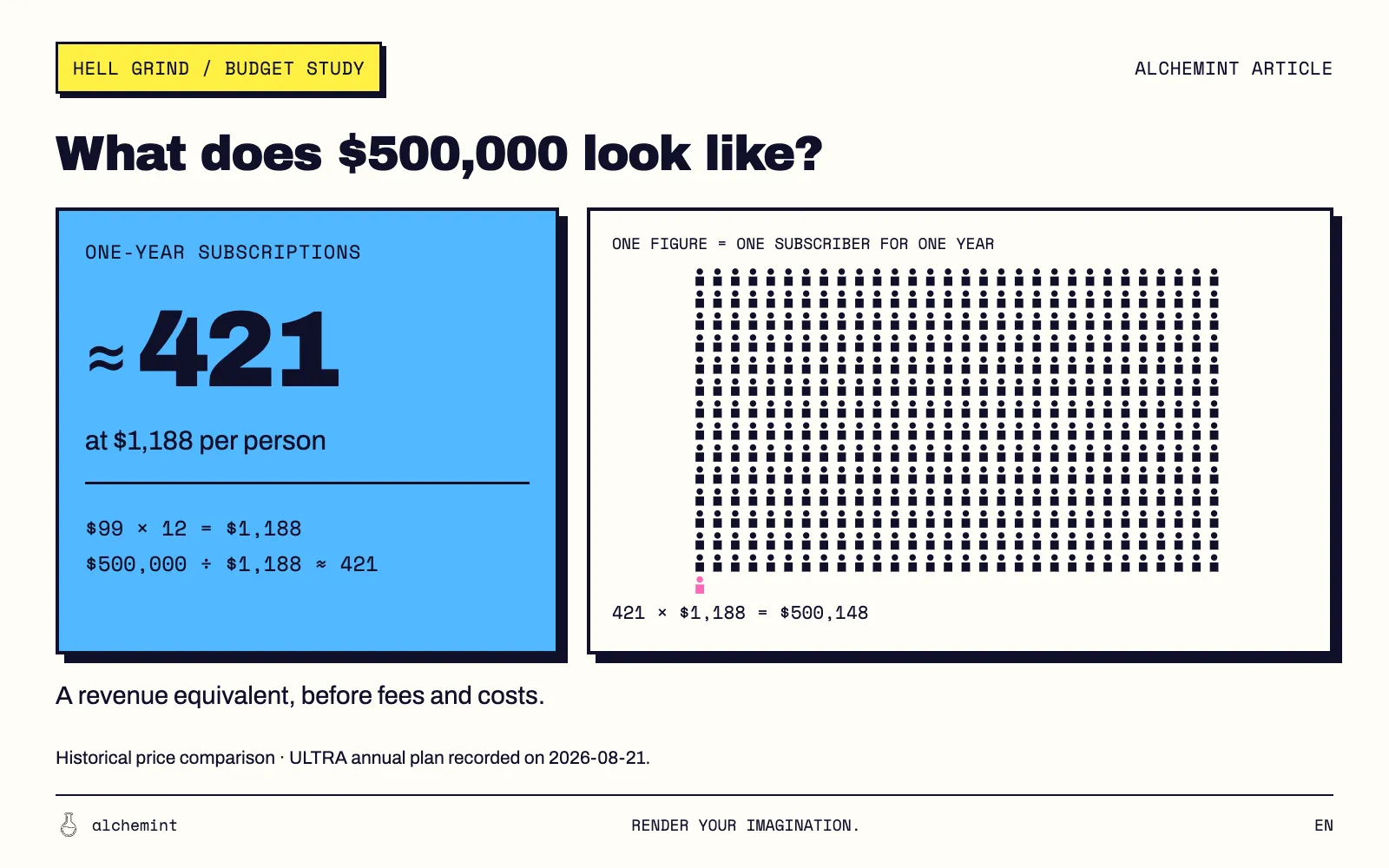
How many subscriptions does it take to pay back a $500,000 film?
Using the price list we recorded on August 21, 2026: ULTRA was $99 a month billed annually, so $1,188 a year. Half a million dollars is about 421 people subscribing for one year.
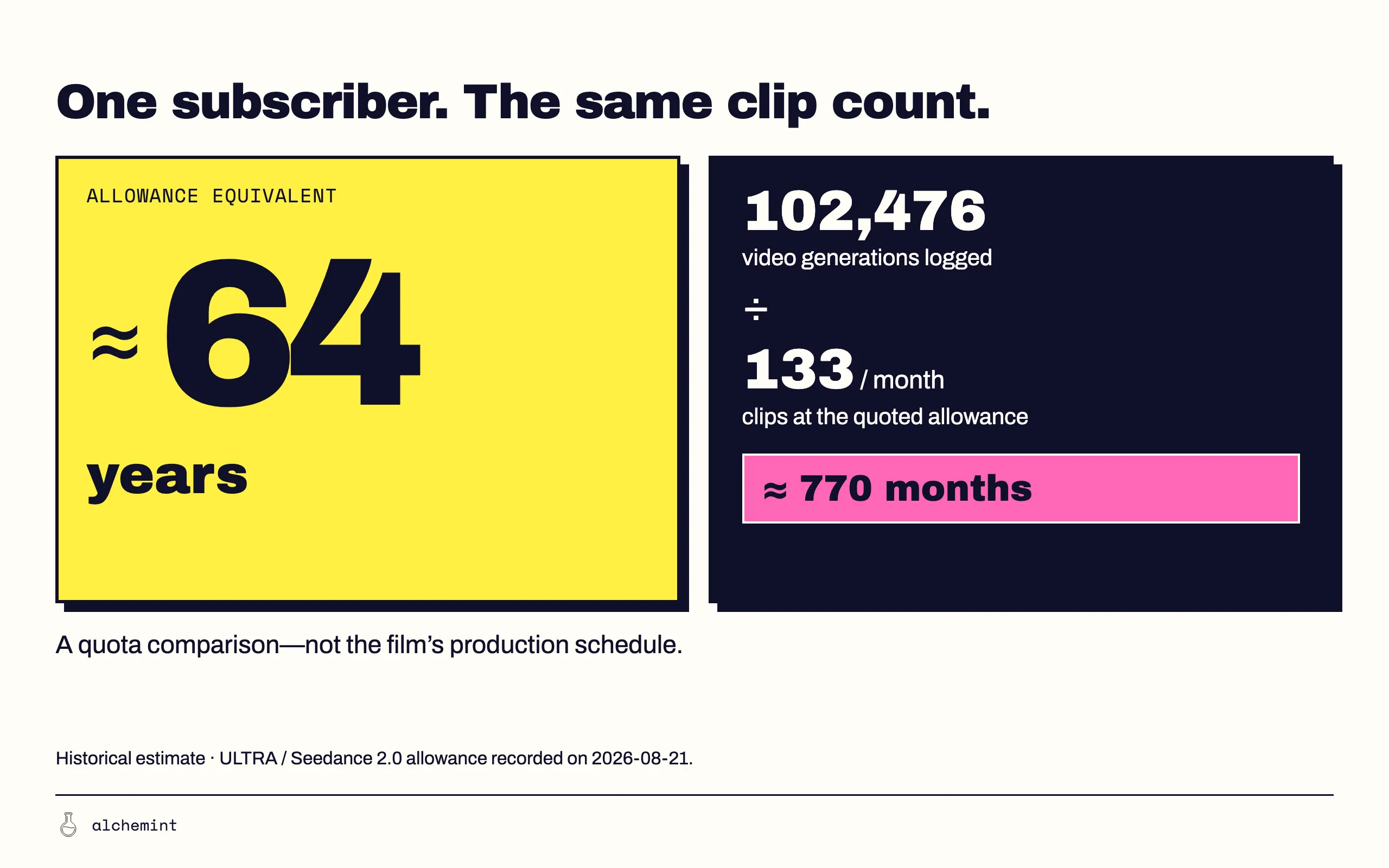
Run it the other way and it lands harder. That plan gets you roughly 133 Seedance 2.0 clips a month, and this film burned through 102,476 of them. At that recorded allowance, one subscriber would need about 770 months, or 64 years, to reach the same clip count.
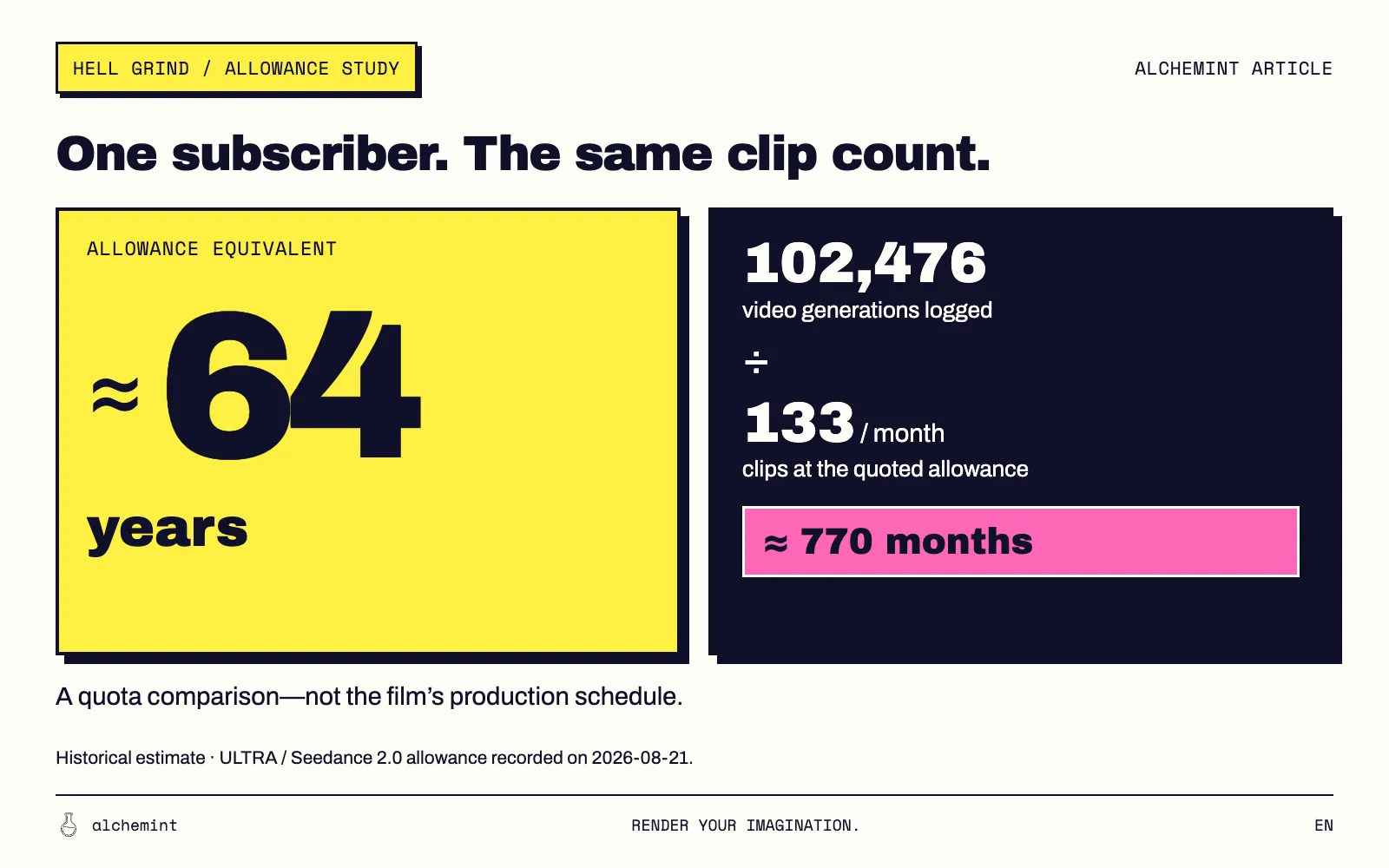
Two views of the same money: sideways it is 421 people for a year, lengthways it is one person for 64.
That is the easiest sum to reach for now that Hell Grind is out — a 95-minute action fantasy feature, 14 days of generation, a team of 15, under half a million dollars, screened off-programme at Cannes in May 2026. And that is where the money talk ends, because the money is the least interesting thing here.
What is interesting: Higgsfield open-sourced the whole production. Every prompt, every asset, every working rule. Call it less a manifesto about who gets replaced, more a company putting itself on the record trying to define a way of working with AI. Open-sourcing it means somebody can check. So we did — we went through the project folder by folder and counted.
The numbers, up front
The official line has been repeated everywhere: $500K, 80% on cloud compute, 20% on the 15 people. Here is the layer that did not make the press release — the project's actual generation log (measured 2026-08-14, method at the end):
- 115,446 generations sit behind the film. For 95 finished minutes, that is roughly 1,200 generations per minute of screen time.
- 88.8% of them are video (102,476 clips). Images are barely a tenth. The rolling happens on the video itself, not on concept art.
- At an estimate of ~570 shots in 95 minutes, that is about 180 clips behind every shot that made the cut.
- The opening scene's folder alone holds 1,714 video generations. At 12–15 seconds each, that is around seven hours of footage traded for one cold open.
- Overall usable rate lands somewhere between 0.5% and 0.7% — 150 to 200 seconds of generated footage per second of finished film.
Here is what those numbers look like when you lay them out:
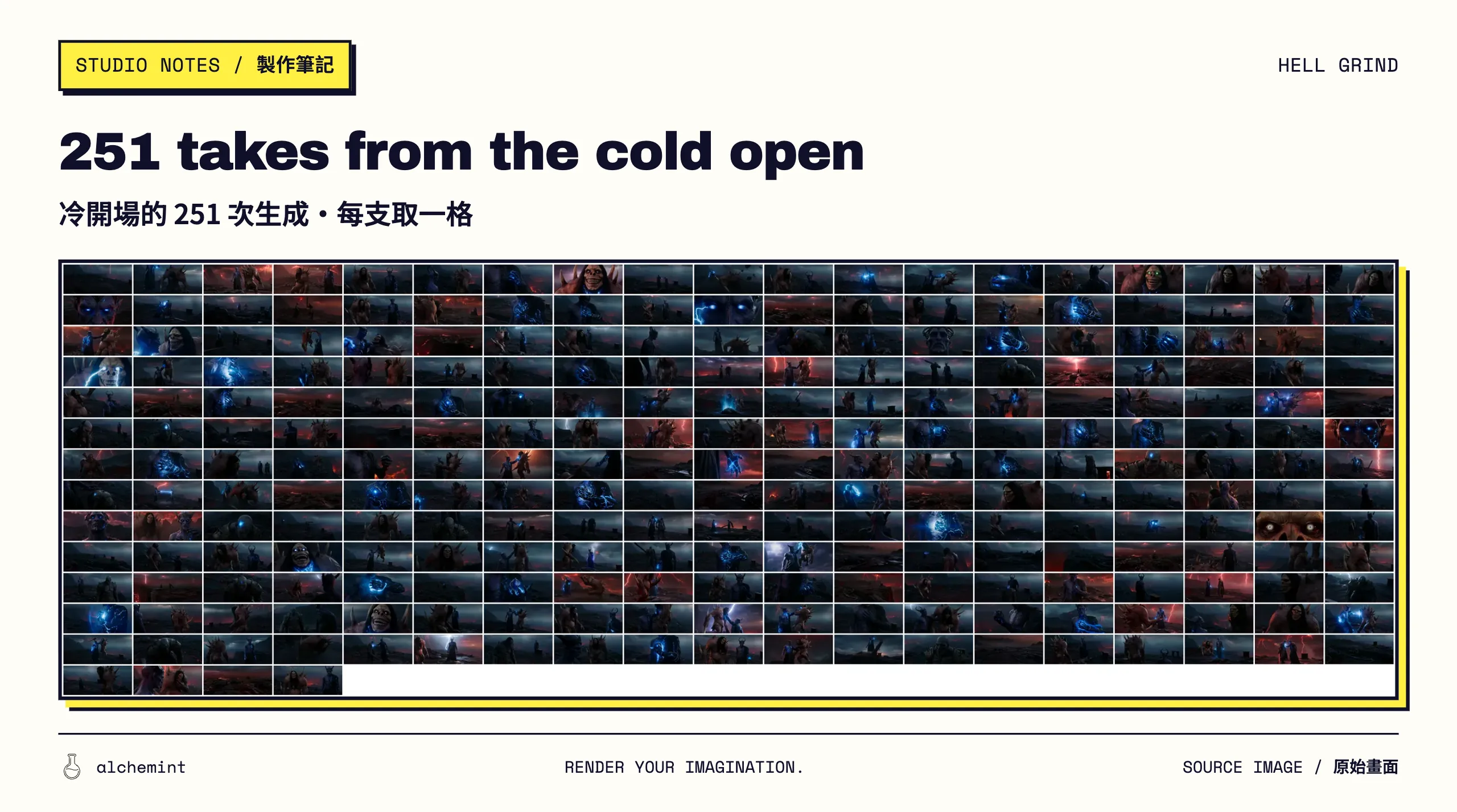
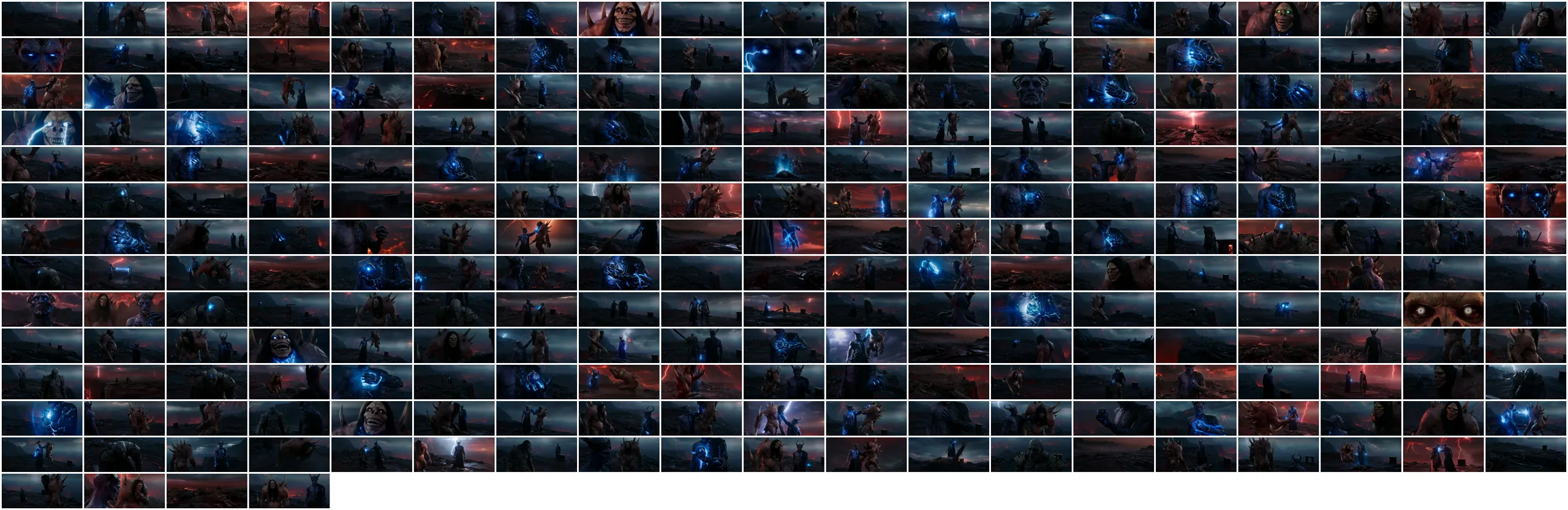
251 cold-open generations, one frame each. And this is not even all of them — that folder holds 1,714 clips.
If the story you were hoping for is "AI generated a whole film in one click," these numbers are the counter-argument. This film was rolled for.
The edit could ask for more shots
The production notes describe a workflow in which editors could request new shots while generation was still running.
Returning to a location after a shoot can mean reassembling cast, crew and lighting. Generating another shot does not require that physical setup, though it still costs compute and review time. This project does not give us a like-for-like cost comparison with a live-action shoot.
The clearest example is where the edit sits: editing ran in parallel with generation, and the editor placed orders directly with the generation side while watching finished scenes — "I need a hand insert," "I need this wider." In their own words, a reshoot takes minutes, so the editor can order shots backwards; the edit drives production instead of waiting for a wrap and cleaning up afterwards.
The folder structure says the same thing. Re-rolling gets first-class treatment here — its own dedicated Regenerations folder holding 14,593 generations, sorted by scene. Doing it again is a scheduled step.
Character and spatial references were locked before generation
Cheap retries still leave quality unsolved. Higgsfield addressed part of that uncertainty in pre-production, by locking character and spatial references.
Each shot needed enough reference to preserve the lead's identity. Higgsfield supplied that context explicitly:
- Assets first. Before anything is shot, every character, location and prop becomes an asset pack — a locked text description plus reference images — and has to pass a stress test: generate the same character ten times, and if you recognise them ten times out of ten, it's locked. Their own conclusion is that this single rule saved more money than all the others combined.
- Copy the description verbatim. Once a character description is locked, it goes into every subsequent prompt word for word, never abbreviated. We verified this letter by letter in the cold-open prompt corpus (see part two of this series).
- Draw the space before you shoot it. Every scene gets a text-based floor plan — what is on the left, what is on the right, which line the camera never crosses — pasted into every prompt in that scene. Continuity and the script supervisor's job became a locked block of text.
So the centre of gravity for quality moved forward: uncertainty on set was traded for asset discipline before it. Meanwhile the back of the pipeline is the most conventional part of the whole project — grading, sound design, frame-by-frame cleanup. That work looks like any other film. The change happened at the front, not the back.
The strata inside fourteen days
There is one more layer that even their own write-up does not fully show: the methodology itself grew during the 14 days.
We sampled prompts across different scenes (the 60 most recent per scene): scenes generated around May 1 had a median prompt length of roughly 7,000 characters. By the late scenes of May 14, the median had climbed to about 32,500 — four times longer in two weeks. Those later prompts carried whole constraint blocks — positive constraints, camera rules, audio specs — that simply do not exist in the opening scene's prompts.
The interesting part is that this evolution was not a synchronised straight line. Some scenes generated in the same late window were still running on the 7,000-character skeleton, because each small team owned its own block of scenes and converged on its own template. That "production bible" they published is the retroactively unified version: 14 days of paths beaten by different teams, tidied into "here is how you should have done it on day one."
Which may be the most honest thing in the entire project: even the people defining the workflow only found the workflow by working inside it.
So, how many subscriptions?
Back to the opening question. 421 subscriptions, 64 years of allowance — you can calculate those, but they are not the answer.
What $500,000 bought was the right to attempt something 115,446 times, plus a discipline that grew out of the attempts. The cost did not disappear; it moved house — from people and equipment to compute and re-rolls, from execution on set to asset discipline before the shoot.
This is one company's experiment, not the industry's verdict. But the books are open and the numbers hold up. Whoever does this next starts a long way past their day one.
Data and method: Official figures (budget, schedule, team size, cost split) come from Higgsfield's public project page and production notes, plus reporting from TechApple, Notebookcheck and others (all verified 2026-08-14). Subscription conversions follow Higgsfield's official price list — annual plans and their stated credit allowances (verified 2026-08-21) — using the site's own "3,000 credits ≈ 133 Seedance 2.0 clips." Generation counts, video share, per-scene distribution and prompt lengths are our own measurements of the public project on 2026-08-14: folder counts reconciled three ways through the API (within 0.05%), video and image separated per file by type, prompts sampled at the 60 most recent per scene rather than in full. Shot count and usable rate are derived estimates, not official figures.